Bactrian Camels, Gobi Desert, Mongolia (and the question: Should I set my digital camera to RAW or JPEG?)

Bactrian Camels in early morning light, Gobi Desert, Mongolia. October 19, 2014
See the original RAW file below.

There is not a clear date as to when we began to routinely create our images in RAW format. Most (all?) of the instructional material we had studied paid too little attention to this matter, or waffled on it, and so we didn’t appreciate the differences in the two formats.

Now we shoot everything – every image we might ever use other than strictly for ourselves – in RAW. Which is to say that while we sometimes use our phone to make a quick JPEG photo of our very fine kitty-cats Georgie and Kita for Facebook, or to take a field shot of a mushroom or flower we wish to identify, we’ve pretty much given up the idea that a JPEG file will suffice when we want to capture anything more than a quick record. We say that even though we have published photographs from original JPEG files in national magazines. And we say that knowing that at least one friend scored a national magazine cover with a JPEG phone shot.

So, yes, it’s possible to get a very nice capture in JPEG. In fact, oftentimes sports photographers shoot in JPEG – particularly when getting a photo out to a publisher in a timely manner is paramount. In a well-lighted stadium filled with agreeably contrasting colors, there may not be a need to retouch a photograph. Similarly, on a blue-sky mid-day at the beach, there may not be much – or any – advantage to capturing the scene in RAW format over JPEG.

But setting such circumstances aside, one’s odds of making a satisfying image increase if one begins with a RAW file. That same beach in soft morning or evening light or under a sky filled with storm clouds will photograph with more richness and subtlety when captured as a RAW file.

However, shooting in RAW is predicated on having the ability to retouch (process) the original image file in Lightroom or some similar program – and then committing oneself to doing so. Because the drawback to shooting in RAW is that images tend to look flat until they’ve been retouched.

This is the original RAW file of the above photograph. The sky is lighter, shadows are so dark details are lost – which also makes it more difficult to distinguish the outlines of individual camels-, the eye of the center camel is flat, there is less texture in the hair and the sunlit faces lack subtle variances. It’s all there… all of this information… in the RAW file. But it must be brought out in the retouching process.

So…

Generally speaking, if one’s objective is to take good – and perhaps sometimes even beautiful – pictures for an audience of family and friends, or simply to make a field record for one’s own use, and to do so with as few complications as possible, set the camera to JPEG, shoot away, and have fun.

If one’s objective is to more consistently create beautiful and even artistic images, set the camera to RAW, and then commit to evaluating and retouching images with editing software. Such software is the digital analog to processing film in a darkroom. Because a RAW image contains much more information than does a JPEG image, the software will provide more control when it comes to adjusting white balance, bringing out detail in shadowed areas, fine tuning color, sharpening details and controlling the amount of noise in an image.

One place the difference between RAW and JPEG most obviously manifests itself is in skies. Generally speaking, there’s not a lot that can be done to a sky in JPEG before noise – graininess, weird colors, strange lines – begins to emerge. RAW provides considerably more latitude before noise emerges… and once you begin to notice noise in images, you can’t stop noticing it.

Which brings me to this concluding observation. Whether one wishes to grow as a writer, musician, fly-fisherman, photographer, chef or in any creative activity, next to studying the accomplishments of others and applying the lessons therein, there is no substitute for mindful, purposeful self-editing. If you shoot in RAW, you will be compelled to edit your work.

Growth will come from that.

After the Dzud (зуд): Camel Skull, Gobi Desert

Camel Skull, Gobi Desert, Mongolia, October 18, 2014

A dzud (zud, зуд) is a weather-related phenomenon in arid parts of central Asia. It could be heavy snow or ice; or a lack of snow or rain; severe cold; drought. Any widespread weather pattern that prevents livestock from obtaining sufficient food or water. Mass deaths… and economic disaster for the semi-nomadic families who follow their animals – goats, sheep, yaks, camels, horses – from place to place across steppelands, grasslands and desert. Roughly a third of Mongolia’s 3.3 million people live this life – among the world’s last nomadic herdsman.

Sentinel

Engraved with a cross and reaching into the sky, the jawbone of a Bowhead Whale stands sentinel over a grave buried in spring snow at Point Hope, Alaska. April 12, 2012

Umiak Artist

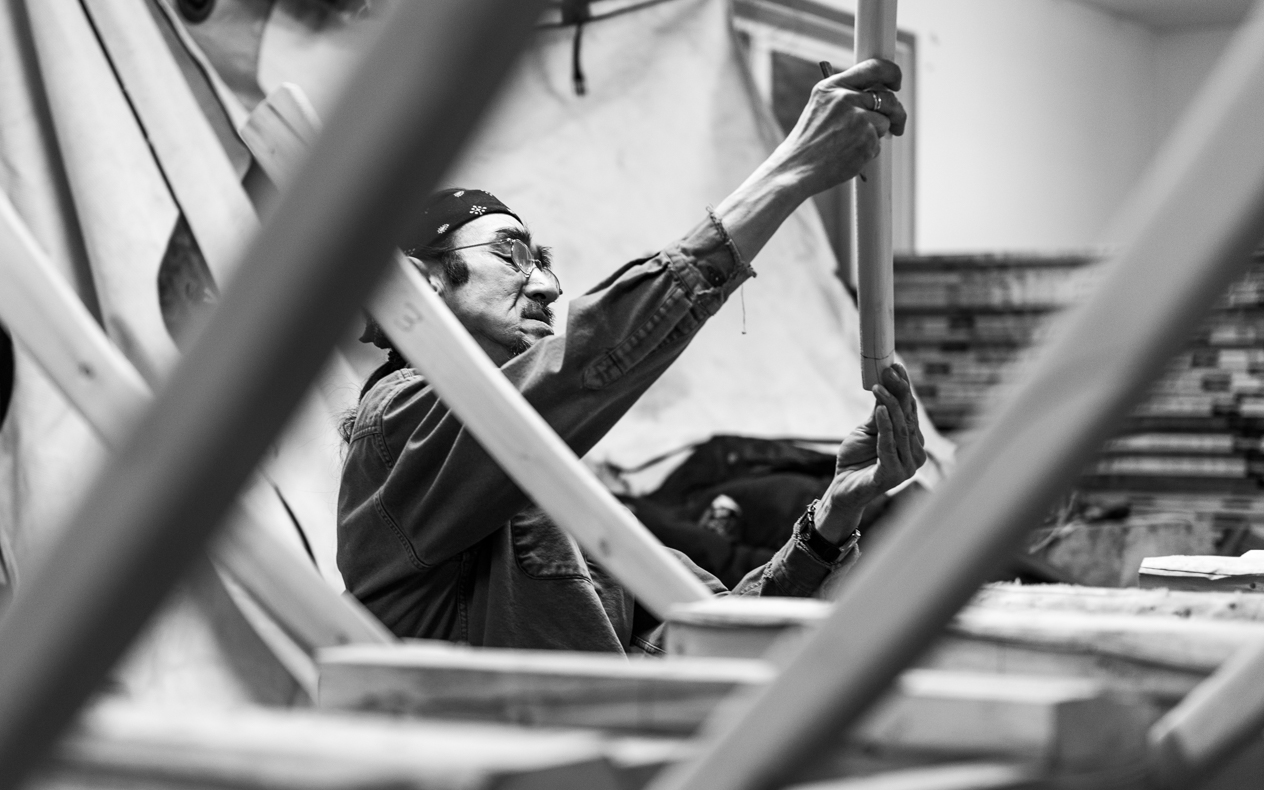
Artist and boatwright Henry “Hanko” Koonook at work on an umiak in his shop. The keel, thwarts and each wooden rib is hand fashioned and precisely fitted. When the frame is finished, it will be covered with the stretched skin of an ugruk (bearded seal). This will be the boat’s hull. Traditional skin boats such as these are still used by Inupiat whaling crews in Point Hope and other villages of the far north. Long may it be so. Point Hope, Alaska, March 21, 2013.

Igloo: Arctic Home made of Whale Bone, Ship Timbers & Sod

Ghost village ruins of an Inupiat home constructed from ship timbers, sod and the bones of Bowhead Whales. Tikigaq, Alaska September 3, 2011

Saltwater inundation caused by an encroaching sea forced the people of Point Hope to relocate further inland down Tikigaq Peninsula a few decades ago, but I am told that as recently as the 1970’s a few people still inhabited homes such as the one above. In fact, on at least one such structure we saw, there was a junction box for electricity. Along with these igloos (a term which refers not just to structures made of ice, but to any dome-shaped Inupiat dwelling), there were other more familiar-looking homes in old Tikigaq, but those too have long been abandoned to decay back into the Arctic tundra.

The Bones of Tikigaq: Whaling Festival Site, Point Hope, Alaska

The Bones of Tikigaq
Whaling Festival Site, Point Hope, Alaska. The larger bones presented as arches are the jawbones of Bowhead Whales. Traditionally, the skull is returned to the sea so that the whale’s spirit is properly released. Point Hope, Alaska, August 12, 2012

Point Hope, Alaska from the Air

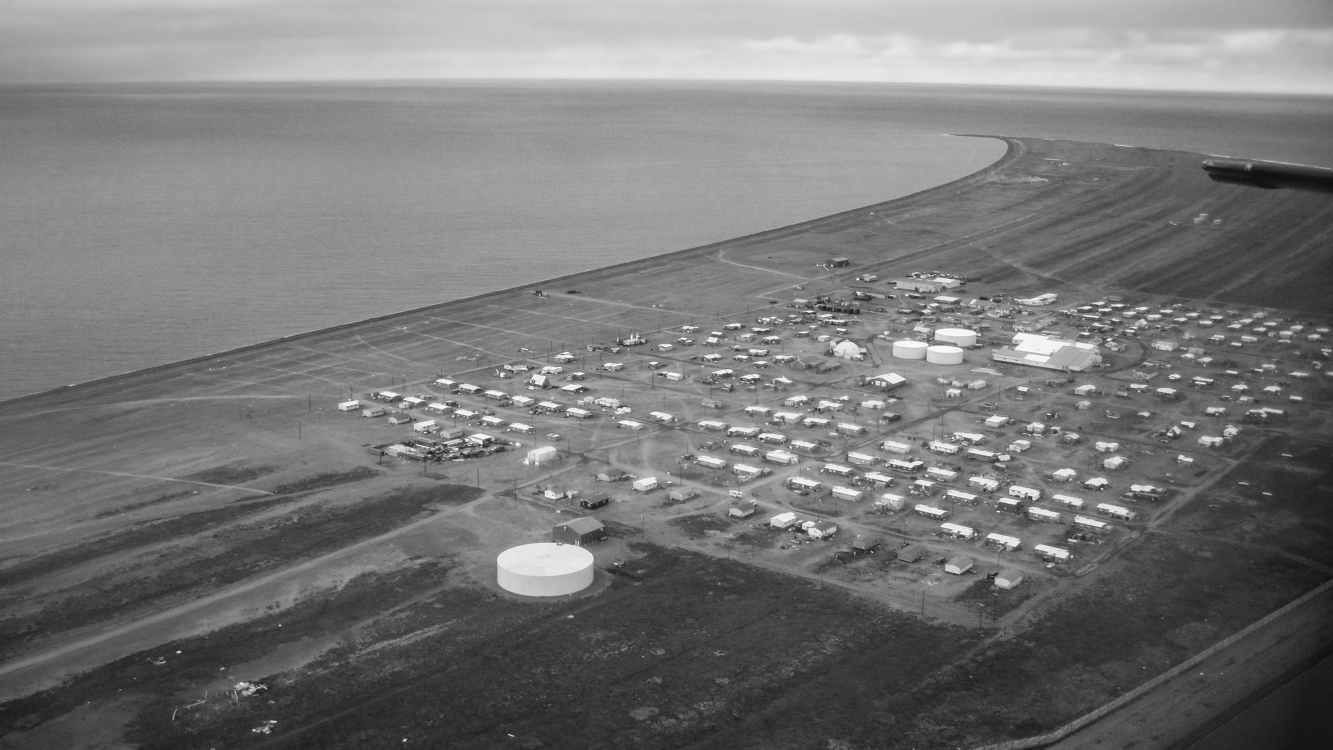
Our first view of Point Hope, Alaska – 125 miles north of the Arctic Circle (August 1, 2011)

Modern-day Point Hope is located on a narrow peninsula hooking into the Chukchi Sea. In the not-so-distant past, the village was further out on the peninsula, but erosion caused by an encroaching sea has wiped away a good bit of the peninsula, and the old village, called Tikigaq (which means index finger – for the peninsula’s shape), was relocated further inland due to seawater inundation. With evidence of habitation going back at least nine thousand years, Tikigaq Peninsula is regarded as one of the very oldest continuously inhabited sites in North America.

The very essence of an Alaskan bush village is its isolation and remoteness. The only road leading out of Point Hope, Seven Mile Road, ends abruptly a good bit less then seven miles: 250 miles from Barrow, 572 miles to Fairbanks, 694 miles from Anchorage. Thus Point Hope exists as a neatly lain out grid of homes and other buildings surrounded on two sides by water and on one by the vast Arctic tundra. Polar Bears and Arctic Foxes are regular visitors. To experience life in a place so thoroughly separated from the rest of the world is perspective changing – and in an unexpected way, exhilarating.

Large ocean-going barges freight in everything from the school bus – which keeps children safe from both frostbite and Polar Bears – to heavy equipment and building supplies; planes bring in smaller items, including groceries and mail. Hunting and gathering provide a great deal of additional food. This subsistence take includes Bowhead and Beluga whale meat and blubber, caribou, ducks, geese, ptarmigan, salmon, char and grayling along with cloudberries (Rubus chamaemorus) a few blueberries and in some families, seaweeds.

Photographs in coming days will show more of the village and perhaps lend some insight into life there. Thanks for reading.

Pedal Bike

In bush communities such as Shishmaref, virtually everything comes into the village either by plane or by barge. Trucks, boats, hondas*, snowmachines*, pipes, building materials, food, clothing, clothing washers, bags of chips, cases of pop, birthday presents… It’s not practical to ship out empty detergent bottles, worn out dryers, broken down vehicles or broken toys. So most of the refuse goes to a local dump. In these modern times, when most of what is consumed takes a very long time to return to its elemental or mineral form, whatever isn’t burned remains there – buried or piled high. And there it will remain till the sea comes one day. (Photograph by Barbra Donachy, October 31, 2010)

* “Honda” is the Alaskan term for quad or ATV. “Snowmachine” is Alaskan for snowmobile. Out in the bush, bicycles are often called pedal bikes to distinguish them from hondas/ATVs, which are also often called bikes.

Ravenous Sea

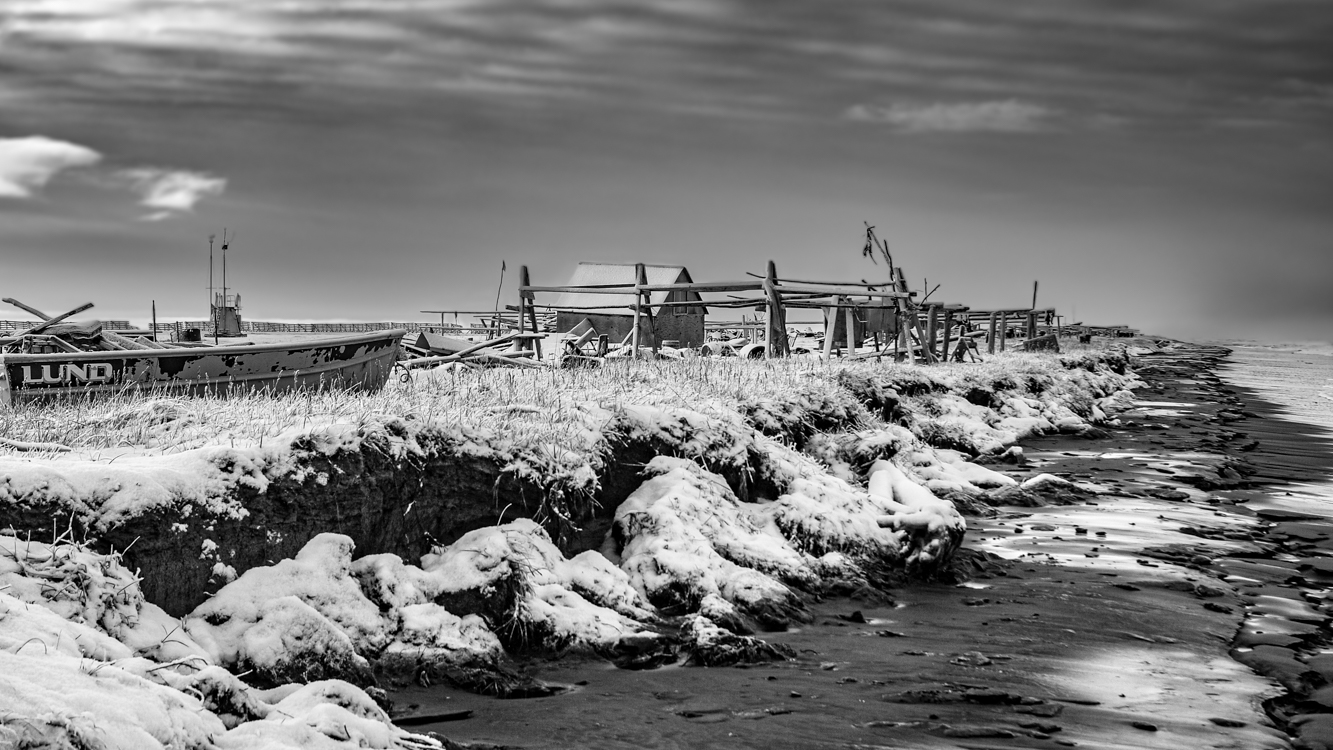
This camp along the shore of the Chukchi Sea almost looks like an ocean going vessel, the cabin itself the wheelhouse, a flag marking the vessel’s bow as it faces a fall sea. Snow but no ice, you can see how the ravenous ocean eats at the shoreline of tiny Sarichef Island. All this will be gone one day… perhaps in not so many years. October 31, 2010

Photo of the Day: Main Street, Shishmaref, Alaska

To imagine Shishmaref, begin with Sarichef Island where the village is situated. Sarichef is one of several low-lying barrier islands running for about 70 miles along the northwest shore of Alaska’s Seward Peninsula. If you’ve ever been to North Carolina’s Outer Banks, you have some idea of such islands. Sand is everywhere. The above photo depicts a section of the main thoroughfare traversing this village of about 570 residents. There are no roads connecting Shishmaref with the larger world. Vehicles and building materials arrive primarily by ocean barge. Groceries are freighted in by plane. Because of the added freight costs, everything in the small local store is quite expensive. Pink salmon and Dolly Varden Char which migrate along the beach, seals taken from the nearby sea, and Musk Oxen, Caribou, an occasional Moose and waterfowl along with blueberries and Cloudberries taken from the mainland supplement most diets.

In 2010-2011 when we lived there, virtually the entire community was without the kind of city plumbing considered necessary in most of North America. The white plastic container near the middle of the street is where “honey buckets” are emptied into. These containers are then taken to a settling lagoon. Most houses have large water tanks of up to about 300 gallons which must regularly be refilled. The closest village is Wales, population about 145, over 70 roadless miles down the coast.