Eagle with Spring Hillside Chignik Lake, Alaska Peninsula, May 20, 2019
Sam’s Boathouse, located along the shore of Chignik Lake and visible from our dining/living room windows, provided a favorite perch for eagles, ravens, magpies, gulls and occasional kingfishers. In the right light, the hillside across the lake could render a beautiful palette of colors.
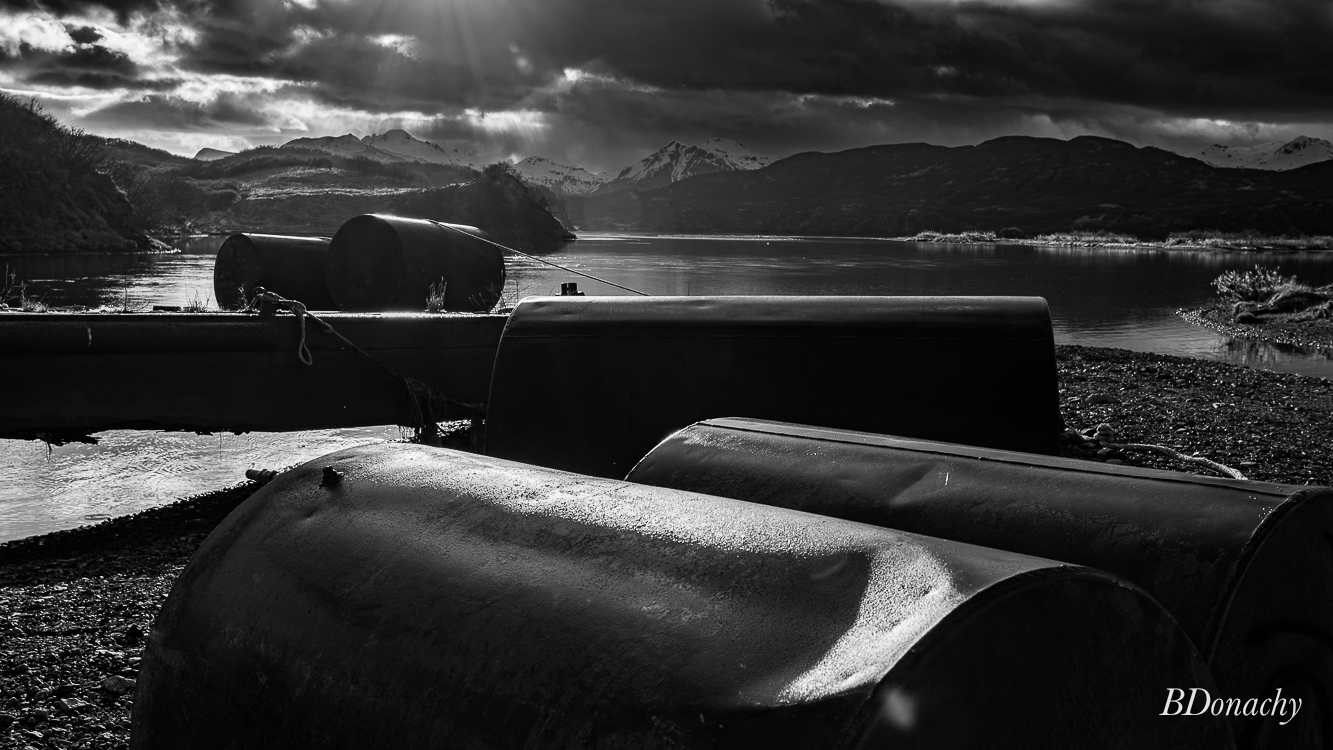
Fuel Oil Drums at The Pad Chignik River Barge Landing, May 16, 2019
Barbra has an eye for moody images such as this early morning landscape of diesel oil drums at the barge landing on Chignik River. The scene is the terminus of the three-mile road that travels from the airstrip, winds through the village of Chignik Lake (population 50 something), and then follows the river along steep hillsides till it ends here at the landing. These drums are barged to this point, about six miles upriver from the salt water lagoon, on high tides of about 10 feet or more. On lesser tides, the river is too shallow for the barges to run. From here, the fuel is loaded onto a truck and carried to the diesel generators that provide the village’s electricity. Gasoline, too, along with any sort of large stuff such as vehicles and building material is brought into the village in this fashion.
Such are some of the logistical consideration in a wilderness village.
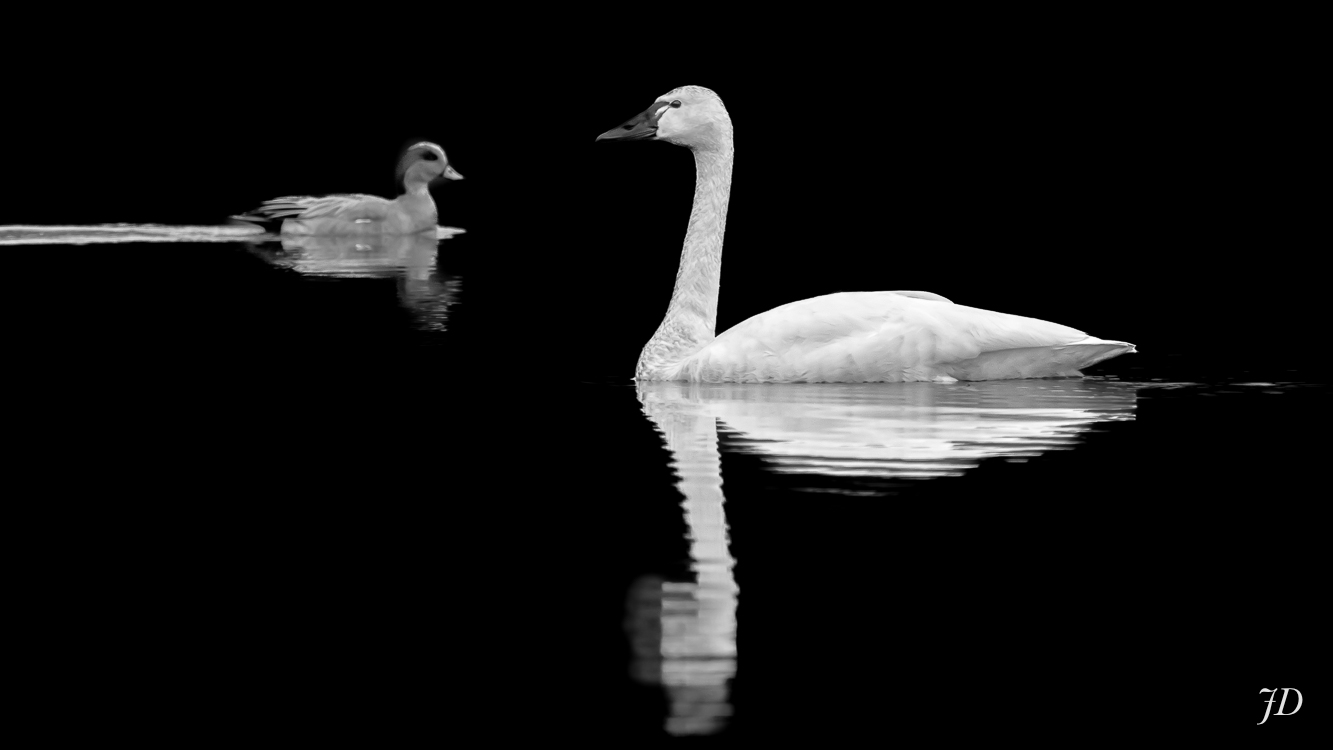
Tundra Swan with American Wigeon at Broad Pool Broad Pool on Chignik River, Alaska Peninsula, May 4, 2019
The best place to look for returning Tundra Swans (Cygnus columbians) on the Chignik is at Broad Pool, about a mile downriver from the village. One evening the swans announce their arrival with far off, lonesome-sounding notes and by morning they’ve settled at the pool. There the slow-moving, weedy water provides food for the swans as well as for migrating dabbling ducks such as Mallards, Green-winged Teal, Northern Pintails and American Wigeons. Diving ducks, mostly Common Goldeneyes, Buffleheads, Greater Scaup and both Common and Red-breasted Mergansers are also likely to be present. At this time, the banks are covered in scraggly, winter-brown grasses, sedges, willows and alders and there may still by ice along the river’s edge. By the end of the month the ice is gone and the swans and most of the ducks will have dispersed to nesting areas further up the drainage, but at least one pair of Mallards and another of wigeons usually stay to nest along along the margins of Broad Pool. They are often joined there by a brood or two of Black Scoters.
Elegant Redpoll (Acanthis flammea) Chignik Lake, Alaska Peninsula, April 25, 2019
Although peninsula checklists list redpolls as uncommon or rare, during our years at Chignik Lake they proved to be common, at times hanging around the village in flocks of dozens. The above bird is a male in brilliant breeding plumage. Although I photographed him in spruce trees and the original forest green background is pleasing, I like the way the black makes the red pop and brings out his eye.
Mumble Creek Brookie That Stream that Shall Not be Named, Pennsylvania, May 2021
A few weeks ago here on Cutterlight I published a tribute to a recently passed friend and mentor, Bill Kodrich. Concurrently, I sent the article to the fly-fishing zine Hatch Magazine hoping to get Bill a bit more ink and appreciation. The editor asked for a longer piece, which I was happy to supply. The article went live on Hatch this morning. I wrote the piece as not only a tribute to Bill, but as a reminder of two things to consider as we move through life: That mentorship matters; and that when we join with others and put our shoulders to the wheel, big change is possible. Here’s the link: Environmental Stewardship and a Good Piece of Pie
Thursday Morning Coffee Bar, Teuri Island Campground Teuri Island, Hokkaido Japan, June 21, 2018
Clean restrooms close by (to answer the first question on the minds of most casual campers), good clean drinking water, quiet, and the entire grounds to ourselves. I don’t imagine that the camping situation has changed much since we visited Hokkaido in 2018. Traveling to Teuri with our bicycles was easy via the ferry from Haboro on Hokkaido’s west coast. We only spent two days on Teuri, but agreed we could easily have enjoyed a week on this small, bird-rich island.
Scrolling down panels in lightroom as I brought up the above photograph, I decided to give a relatively new feature a try: Lens Blur. With a single click, this AI-driven feature isolated what it interpreted to be the subject and foreground and then blurred (decreased the clarity) of the background. It worked well – which is to say, I liked the result.
To be sure, a more competent photographer equipped with the right lens could easily have achieved similar results in-camera. But six years ago when I captured this image, I was a less competent photographer. Less competent not only from a technical standpoint, but also my eye was less well developed, and so I didn’t always appreciate the pleasing effect a bokehed background could add to a photograph.
While I could have used masks and clarity sliders to isolate the subject and achieve the same effect, this Lens Blur feature significantly speeded up the process. So…
I might have more to say about AI technology in future posts. It’s here, part of our world now. Lots to think about. JD
Rhinoceros Auklet Breeding Grounds, Teuri Island Hokkaido, Japan, June 18, 2018
Not a lot appears to be going on in the above daytime photograph taken on Teuri Island’s cliff-lined northwest. The 2.1 square mile island (5.5 square km) hosts the breeding grounds for several species of birds, most notably seabirds. The holes in the above photograph are the burrows of Rhinoceros Auklets, a species for which Teuri serves as the world’s largest breeding ground.
While it doesn’t appear that much is going on in the photograph – a few gulls milling around notwithstanding – at the end of each burrow, which may be up to six meters (20 feet) in length, a Rhinoceros Auklet chick is waiting for twilight when parents will return from the sea, stomachs, gullets and bills crammed with catches of sand lances and squid. Gulls – primarily Slaty-backed which also breed on the island – will intercept some of the returning adults, but most will make it past the parasitic phalanx. Recent estimates put the auklet population at around 400,000 breeding pairs. Add in the chicks and the species count rises to over a million. Perhaps you can imagine the sight and the cacophony as night gathers and hundreds of thousands of adult auklets return, evading squawking gulls, somehow locating the specific burrow each parent calls home.
Teuri is also an excellent place to see Spectacled Guillemots, Common Guillemots and other seabirds as well as passerines such as Blue Rock Thrushes and Siberian Rubythroats. Regular, bicycle-friendly ferries from Haboro make it easy to get out to the island, and if you don’t choose to stay at the lovely campground (which you’re likely to have to yourself) there are wonderful inns offering comfortable accomodations and truly some of the world’s best fresh seafood.
Seawall Foggy Morning with Fishermen Hokkaido, Japan, June 4, 2018
This photo is an early experiment with softening rather than sharpening an image… taken before I appreciated how important careful note-taking is… I think this is in the harbor of Hagino.
We arrived in Japan on May 28, spent three days in the Crown Prince Hotel in Chitose, Hokkaido getting acclimated – figuring out where we might purchase fuel for our camp stove, re-assembling our bicycles and so forth -, and then on June 1 we embarked on a 67-day, 1,300 mile bicycle-camping trek circumnavigating most of coastal Hokkaido. For both of us, the trek was a fulfillment of childhood dreams of a self-guided bicycle trek in a foreign country. It was quite possibly The Most exhilarating adventure either of us had ever undertaken.
I paid for a significant part of the trip when I published an article in Adventure Cycling Magazine, which if you’re interested you can find here. We also published several articles about this trip right here on Cutterlight. The easiest way to access those is to simply type Hokkaido in the search box in the upper right of any Cutterlight page.
As I go through the 1,342 photographs from this trip (that’s after the initial culling), I’m not sure how many new images I’ll have to post. But I will underscore the feeling Barbra and I came away with after the trip. Go! If you’ve ever thought that a bicycle trek is something you might want to experience – think back to when you were 12 or 13 or 8 or 58 and riding in a car passed a couple or a small group of bike trekkers and wondered what it was like… wondered if you could do something like that – our answer is Why not?
Incoming Twice the male Orca swam beneath our small skiff, so near the hull we could see him plainly through the Alaska Gulf’s semi-clear water. Each time, he emerged on the other side very close, turning parallel with our watercraft, eyeing us. Using our 20-foot skiff as a comparison, I estimate his length at over 25 feet in length, shimmering, bulky, muscular, liquid, graceful. Was he simply curious? Cautiously keeping us in check while his mate and daughters practiced hunting with the still living seal she’d carried out into open sea to the left of this photo? Showing off? Warning us? Each time the male came in close our hearts rose in our chests, our breath stuck in our throats. I blew those shots, able to fit only a fraction of his massive body in the frame created by the 70mm lens, shutter speed too slow to freeze him as his movements always appeared slower than they actually were. But I did get this capture of him swimming in for one of those dives beneath our boat.
The light was in and out throughout the encounter, the sun at times obscured behind dark clouds, at other times breaking through clear blue skies. Here dappled light is filtered through thin clouds, creating a rainbow-like effect accentuating blues, mauves and purples. This image is interesting for the background landscape as well. The land mass to the left is Nakchamik Island. The smaller island to the right is the smaller of the two Kak Islands. On the right is (I think) Little Castle Cape on the mainland. JD, Chignik Bay, Gulf of Alaska, May 6, 2018



 CutterLight