Tommy Woodpecker

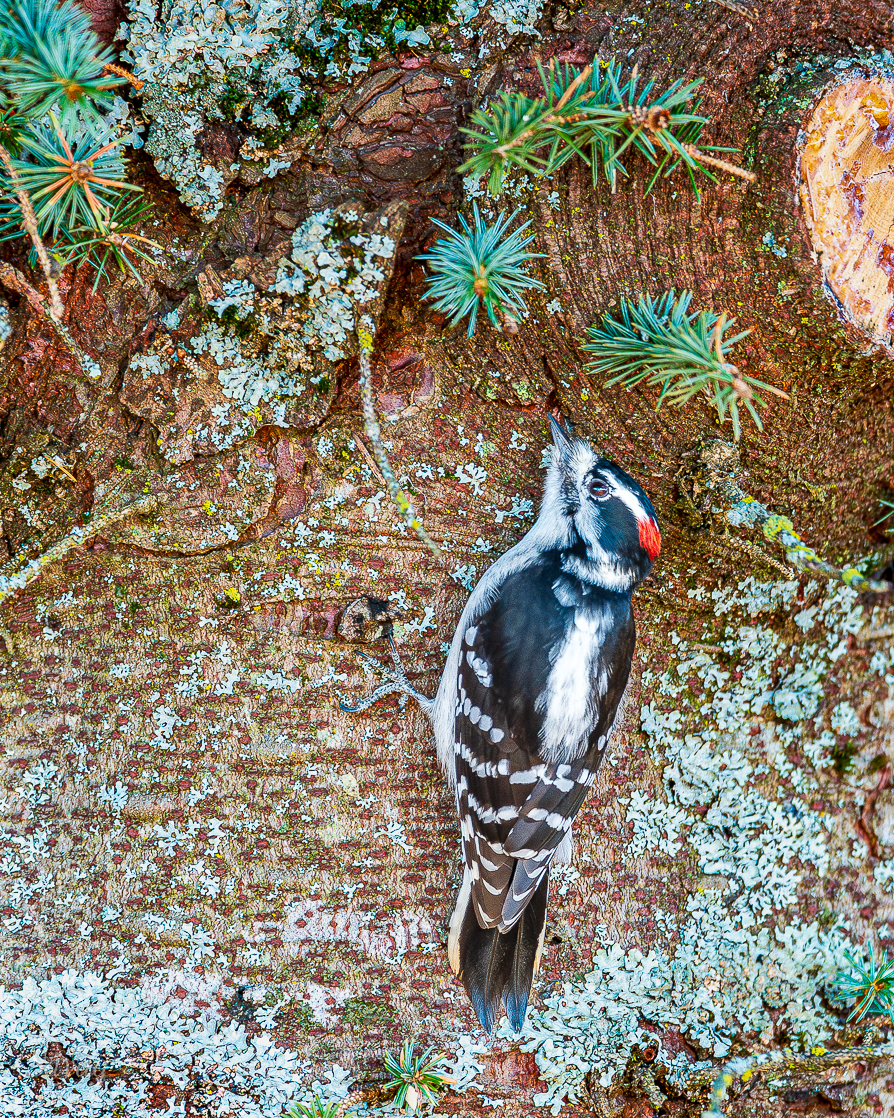
Down Woodpecker, Sitka Spruce Gove, Chignik Lake, AK, 12/30/16
The red crown distinguishes this specimen as a male. Note the blue tint on the tips of his tale, an iridescence not often so easily observed in Downies. Like other woodpeckers, Downies use their stiff tail feathers as a kind of third leg to provide leverage is they drum or search tree trunks for insects.

It is suggested in T. Gilbert Pearson’s Birds of America (1917) that the moniker Tommy Woodpecker would better suit North America’s smallest member of the woodpecker tribe “…for his boyish, buoyant disposition makes friends for him wherever he goes.” Perhaps for a moment we can set aside the sexism and celebrate an era and it ornithologists who took such a personal and personified approach to avian studies. I’d like to see any number of birds renamed, starting with discarding all those appellations that are essentially slave names applied by the person who “discovered” a given species – Wilson’s Warbler; Audubon’s Oriole; Steller’s Jay; etcetera. But Downy seems apt for this six-inch bird with its soft breast feathers.

No woodpeckers appear in David Narver’s study of the Chignik River Drainage conducted in the early 1960’s. Range maps have historically placed the Three-toed Woodpecker on the Alaska Peninsula – with no mention of Downies -, but this is surely in error as historically there was essentially no suitable habitat for spruce-and-pine-loving Three-toeds in that part of the world. My guess is that someone conducting an early biological survey got a glimpse of a woodpecker, made a guess, and that became the text for the peninsula. Very recently, I’ve noticed that the Cornell Lab of Ornithology and other authorities have begun to make corrections.

Though they are often common – the woodpecker one is most likely to encounter throughout much of North America – even in the most suitable habitat Downies are seldom abundant. And although the above photograph was recorded in the Sitka Spruce Grove at The Lake, Downies are equally likely to be found in the peninsula’s alder thickets and occasional cottonwoods. Though they are generally listed as uncommon or rare on the Alaska Peninsula, they are in fact regularly seen along the length of the Chignik River. It is probably a lack of nesting cavities rather than a shortage of food that limits Downy numbers on the peninsula, so as the land becomes more forested and trees mature and die and cavities are created their numbers will increase. Listen for their distinctive Peek! Peek! call and then for tell-tale light tapping.
Plant a Sitka Spruce, Get a Finch… or when is a new species an invasive species?

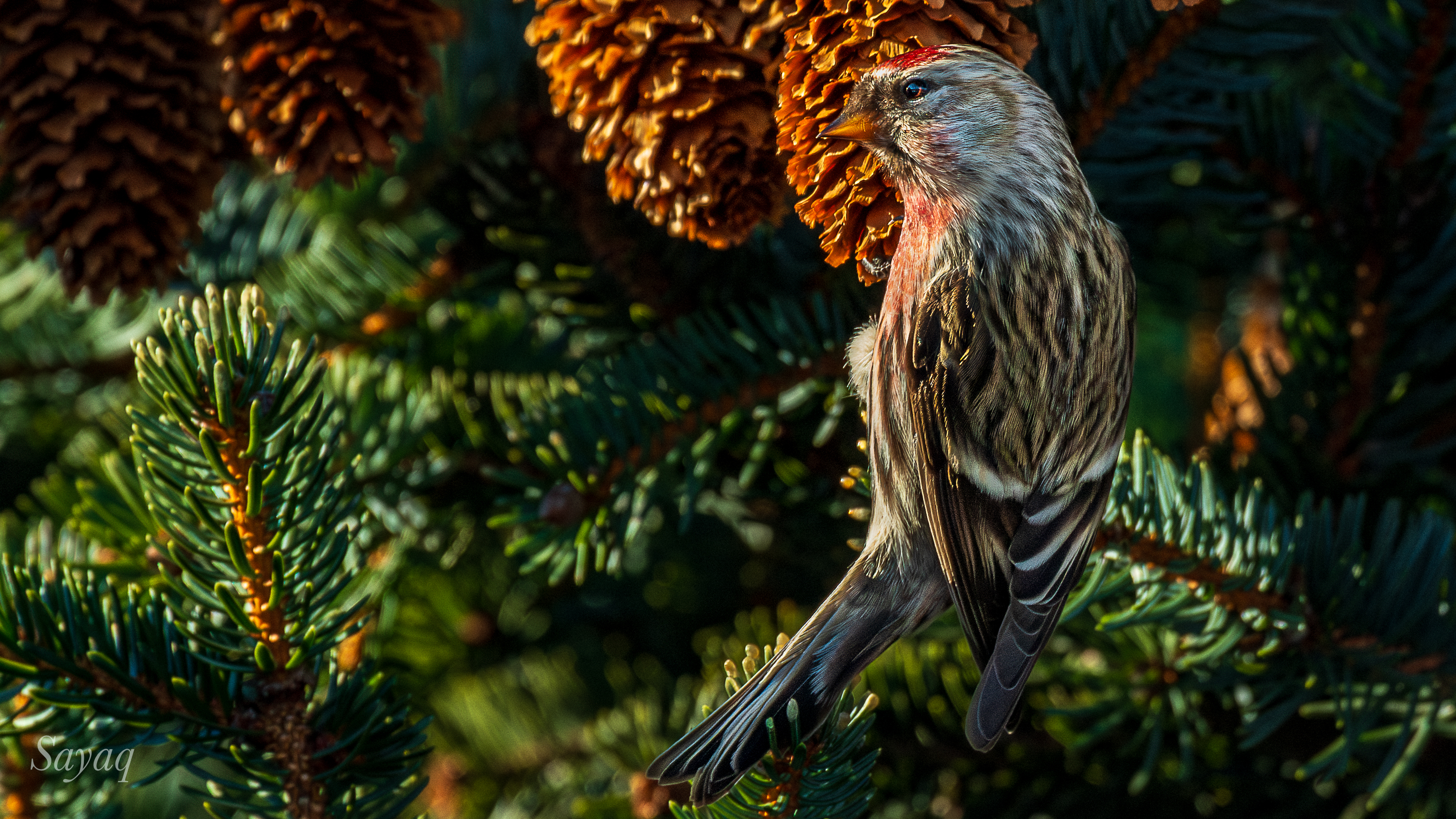
Common Redpoll, Sitka Spruce Grove
Chignik Lake, February 3, 2017

Up and down Southwest Alaska’s Alaska Peninsula, Redpolls, Siskins, Crossbills and Grosbeaks – all members of the finch tribe – have typically been marked as uncommon, rare or absent, breeding in small numbers here and there but generally not species one expects to encounter on the windswept peninsula. However, as trees – particularly alders -, have become increasingly abundant in that part of the world, so too have the finches. Seeds of the tiny alder cones are relished by Redpolls; the tender leaf buds by Pine Grosbeaks. But nowhere has the recent emergence of trees more dramatically impacted avian life than in the village of Chignik Lake where 70-some years ago Sitka Spruce trees were transplanted from seedlings gathered on Kodiak Island.

Some of the spruce trees at The Lake now tower over the landscape, producing both shelter and food for a wide variety of birds. The seeds of mature cones draw Pine Siskins, Hoary and Common Redpolls, White-winged and Red Crossbills, Black-capped Chickadees, Black-billed Magpies and several species of sparrow. While they’re still soft and reddish-purple, immature cones are feasted on by Pine Grosbeaks. Meanwhile, the variety of invertebrates that have moved into the little groves of spruce trees provide sustenance for Downy Woodpeckers, Pacific Wrens, Golden-crowned Kinglets and Yellow Warblers. Great Horned Owls roost and nest in the dark shadows of spruce bows and Northern Shrikes, Merlins and an occasional Sharp-shinned Hawk hunt the songbirds attracted to the trees. My guess is that it’s only a matter of time – and not too distant time – before the first Steller’s Jays are reported at The Lake. In fact, based on a description a now deceased resident reported to me, I’m not sure they haven’t already been there.

But here’s a question: Are these trees actually an invasive species… like the Orange Hawkweed that only very recently has begun showing up at The Lake? Or, for that matter, the dandelions which have taken over the school yard (and also, in some years, provide food for the finches as they go to seed)? And what about the above-mentioned alders that are steadily crowding out what remains of the peninsula’s tundra?

For decades, the transplanted Sitka Spruce trees did not propagate themselves in the Chignik Drainage. But about five years ago that began to change when seedlings suddenly began volunteering themselves throughout the village. One might argue that even without human intervention it was only a matter of time before Picea sitchensis made its way down the peninsula. But couldn’t the same be said of the Orange Hawkweed, dandelions and even the Kamchatka Rhododendron that has naturally, over time, found its way to The Lake from its native grounds in far eastern Russia?

Dumping a bucket of carp or pike into a lake where they never before existed is one thing…

On the other extreme are dandelions and hawkweed, which seem to to have devised strategies to show up wherever environmental conditions suit them.

Somewhere in between are a vast array of flora and fauna that – with or without humankind’s assistance – are finding their way into new niches.

So, what do you think? Where is the line between happily-received newcomer and dreaded invader?

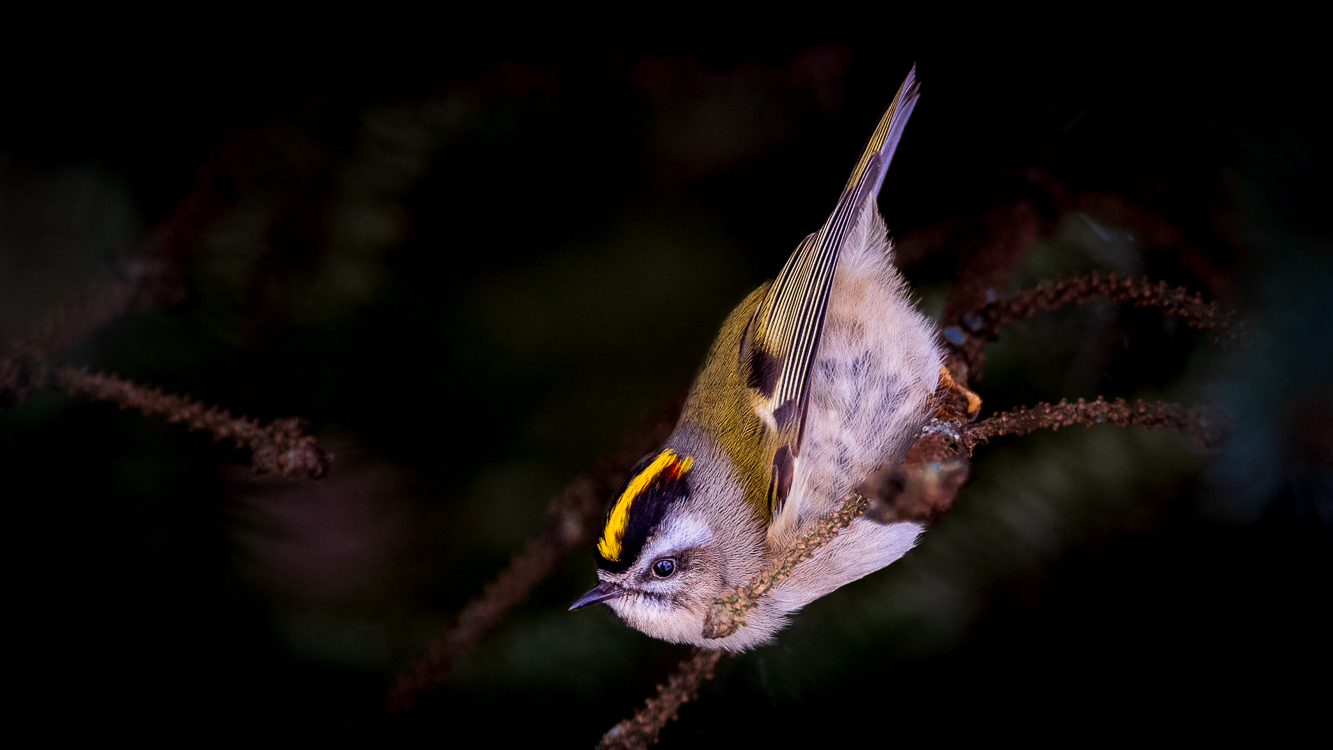
The Tiny Kings of the Sitka Spruce Grove

The Tiny King of Sitka Spruce GroveAt only about three or four inches (8 – 11 cm) in length from tail-tip to beak, other than hummingbirds there probably isn’t a smaller bird in North America than the Golden-crowned Kinglet. But they’re sturdy little beings, able to survive temperatures as low as -40° F (-40° C). The splash of scarlet identifies this fellow as a male; the female’s crown is pure yellow-gold.

Every autumn coinciding with the peak of the Coho run on the Chignik River, we’d begin to hear a new voice as we pushed through thick stands of alders or walked by the village’s scattered spruce trees. By this time, there weren’t many other passerines around, and so there was no mistaking the high, almost cricket-like call of returning Golden-crowned Kinglets. They were a new species for for us, always in motion, difficult to locate in the dense alders and dark spruce boughs they prefer, and they are not indicated on the Alaska Peninsula on any of the range maps we checked – Cornell, Audubon, Sibley – so we were very happy when we finally got binoculars on them and could make positive identification. Kinglets tended to remain at The Lake throughout winter. At some point, they presumably had cleaned all the invertebrate eggs and dormant insects they could find and moved on to other grounds, but they were there every year in those fall and winter months and should be added to peninsular checklists and range maps.

Otter Pile: Any otter’ll tell ya, it’s better when we get along

Otter PileChignik Lake, Alaska1/2/17

Red Foxes tussle, nip and bark at each other. A Brown Bear might literally rip the face off a rival in a dispute over fishing and mating rights. Even cute little Black-capped Chickadees and Redpolls sometimes aggressively gape at each other and might engage in a quick peck to establish pecking order.

I suppose there are times when River Otters squabble, but in years of observing them at the lake, we never saw anything more than a look of envy cast from one otter toward another. (The coveting occurred over an exceptionally toothsome flounder one lucky fellow came up with.) Mostly, otters are the social goofballs of the four-legged world – rolling in snow, piling atop each other, sliding over ice and snow on sleek bellies, crowding together four-heads-at-a-time popping up from a hole in the ice, chasing each other in jaunty little parades as they scoot up and down the waterway. Maybe it was the Chignik’s abundant supply of fish that allowed for such conviviality. Whatever the reason, it was our observation that these inquisitive, cheerful beings simply like each other. And we think there’s a lesson in that for the rest of us.

Things are changing. Fast. Get out and shoot.

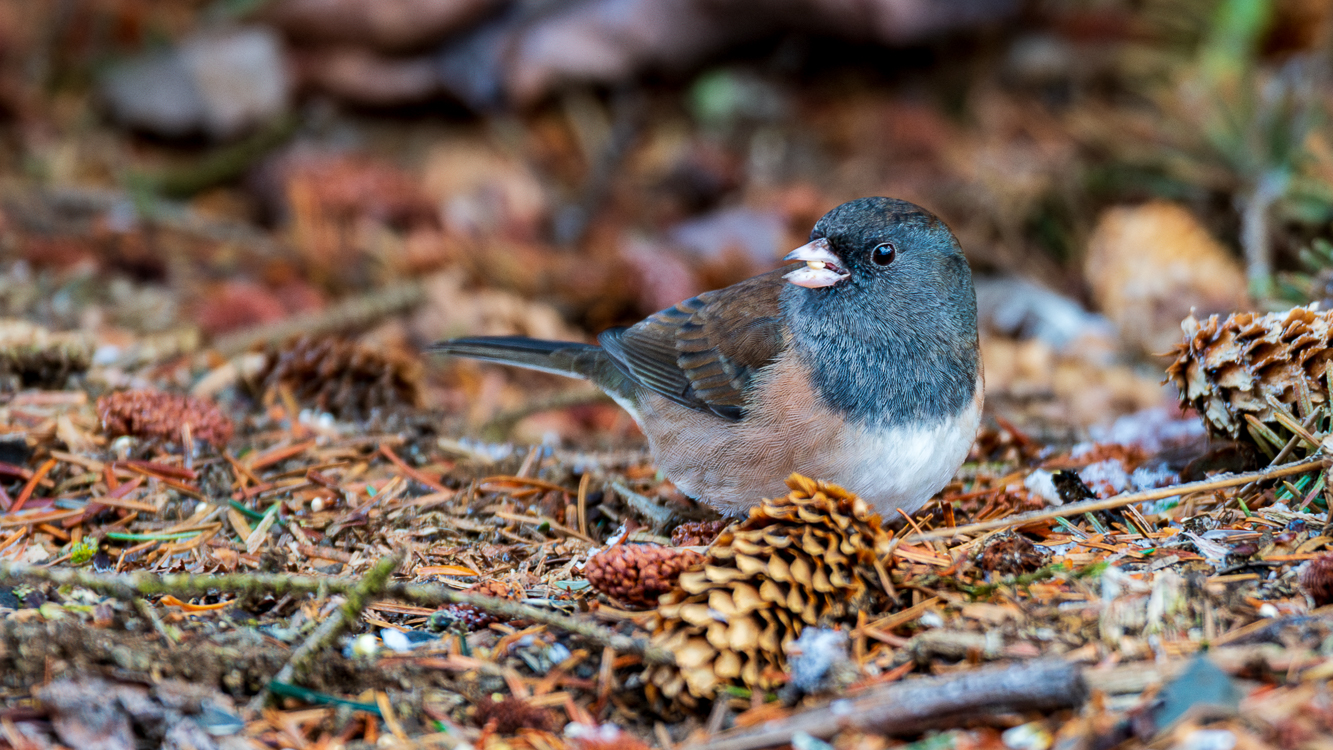
Oregon Race Dark-eyed Junco, Sitka Spruce Grove, Chignik Lake. As far as I’ve been able to determine, the Oregon Race specimens of Junco hyemalis we observed and photographed our first year at The Lake represent the first ever records of this bird on the Alaska Peninsula. We saw both Slate-colored and Oregon Race specimens of Junco hyemalis every year at The Lake from 2016 through 2023. It’s time for various authors and institutions to update their range maps. November 29, 2016.

“I’ve been hoping to see you!” Sam came out to intercept me as I was walking along the dirt road past his house on my way to Sitka Spruce Grove. It was an overcast, cold November morning, the tinny smell of snow in the air. “I’ve been seeing a bird I’ve never seen out here. Batman birds. They have a dark head, like Batman’s hood. Nick’s been seeing them too. We’ve been calling them Batman birds.”

“Yeah. I’ve been seeing them too. Just in the last few days, right?”

“Yeah. I’ve never seen them before. What are they?”

“Oregon Juncos. They’re not supposed to be here. I’ve checked my books and range maps on the internet. This might be the first time they’ve ever been out here.”

Sam, in his early 70’s and not more than five-six looked up at me as he rolled the burning cigarette he was holding between his thumb and his first two fingers. For a moment nothing was said. He lifted his arm to take a drag and looked out over the landscape as he let the smoke out. Winter-brown salmonberry breaks and willows, scrub alders an even more drab shade of brown covered the country all the way to the treeline on nearby snow-capped mountains, country that in Sam’s youth had mostly been tundra.

“Things sure are changing here,” he said.

There are still people in denial, people who not so very long ago dismissed Climate Warming as some sort of hoax, who refused to believe any scientists except those who work for the fossil fuel industry. Most of those hardcore deniers have given up the tack of total denial. But they haven’t gone away, and they certainly haven’t conceded their error. Instead, the refrain now is initial agreement, “Yes, it appears the earth is getting warmer,” followed by a deflating return to denialism with, “but the world has always been changing.”

Not with this rapidity it hasn’t – the occasional meteor strike notwithstanding.

The result is that almost anywhere one lives, change can be observed in real time. This might be manifested in new species of flowers and other plants, new birds, other vertebrates, insects… or the rather sudden absence of formerly familiar species. Anyone with a camera has a chance to contribute to real-time, meaningful documentation of the change that is occurring right now all around us.

It’s not just the natural world that is undergoing rapid change. As expanding urbanization follows an overpopulated species across the globe, historic buildings are being torn down, forests leveled, rivers rerouted, lakes and aquifers emptied. Things that had remained much the same for decades, for generations even, are suddenly in a state of upheaval.

Photography is used for many things: to capture holiday moments; family portraits; events of all kinds; and increasingly, to make fine art. But some of the most compelling photographic images have always been and continue to be well-composed, straightforward documentation.

Anyone with a camera can make a meaningful contribution. Get out and shoot.

Merlin at Sitka Spruce Grove, Chignik Files #8: How important is “Tack Sharp” in Photography?

Spruce Grove HunterAugust 19, 2016, Chignik Lake, Alaska

Fairly new to photography when I got the above capture of a Merlin strafing songbirds at the spruce grove in Chignik Lake, I was somewhat frustrated with my inability to get the bird “tack sharp.” I was shooting with a 200-400 mm telephoto lens at the time, to which I often affixed either a 1.4 mm or 2.0 mm teleconverter, and simply didn’t have the skills to follow North America’s second smallest falcon as it zipped around the grove at breakneck speeds in pursuit of warblers migrating south in late summer. So I climbed a small rise that put me eye level with the upper branches of the trees, chose a section that was well enough lighted, focused on a group of cones, and waited and hoped for the little falcon to enter the scene. The bird obliged, I snapped the shutter, and at least came away with what I would imagine is the only photographic documentation of Falco columbarius in the Chignik Drainage. The species had been documented there… but I think not photographed.

However, before much time passed the photograph began to grow on me. In fact, I actually began to like it. The bird is clear enough to easily identify as a merlin, and I began to appreciate that the blur, while not depicting the bird itself as clearly as I had originally hoped, captures something else: the story of the falcon’s incredible speed and maneuverability as it circled the grove. Had I been able to make a sharp, clean capture of the bird, as I swung the lens to keep up with the falcon the trees would have become a blur. But the Sitka Spruce grove, a copse of 20 trees transplanted from Kodiak Island in the 1950’s when Chignik Lake was first permanently settled, is central to the story here. I love the way the lush green trees draped with new cones anchors this photograph, thereby helping to create a fuller story.

These days, the incredible capabilities of modern lenses paired with technologically advanced cameras have created a push… a demand, actually… for ever sharper images. This has become particularly so in the field of wildlife photography. But it seems to me that sometimes… perhaps often… this insistence on “tack sharp” (and perfectly colored) images of wildlife has come at the expense of the overarching story behind the image.

Over the next several years photographing bears and birds, fish and flowers, landscapes and life at Chignik Lake, as I gradually came to understand more about photography, I returned to the above photograph many times, mulling, contemplating, turning it over in my mind. We already know, in great, tack-sharp detail, what all of North America’s birds and mammals look like. There are thousands of beautiful photographs of just about every species… in some cases perhaps millions of such images. So, how does one employ a camera to go beyond documentation, to tell a larger story? For me, the beginning of the answer to that question started with Spruce Grove Hunter.

Back in the Day: Wooden Salmon Seiner, Chignik River (and a note on the perils of passing up photographs)

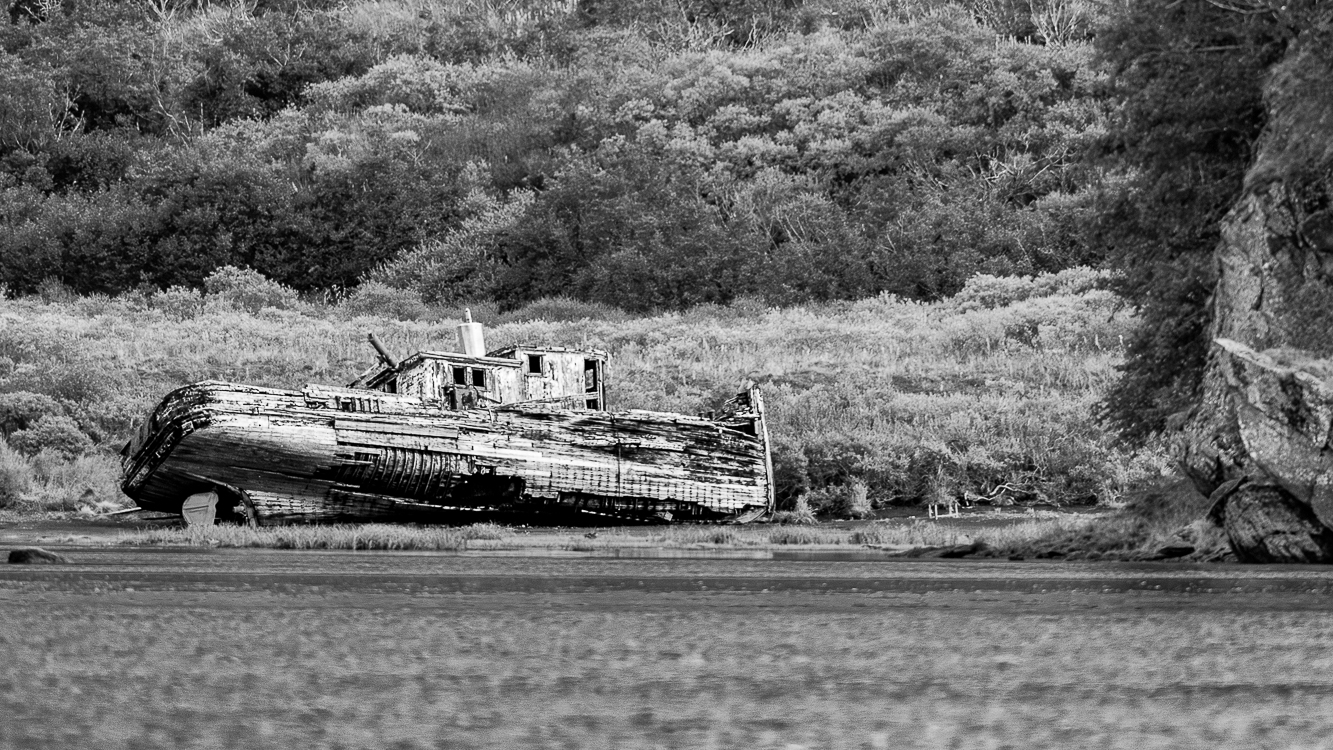
Back in the DaySalmon Seiner from the wooden boat era in the Chigniks
Chignik River, September 23, 2016

Concurrent with publishing this photo, I’m putting out a request on other social media asking my Chignik friends for more information on this vessel. I don’t know a lot about boats, but I’m fairly certain that this is a salmon seiner, perhaps built sometime in the 1940’s or 1950’s. It was aground, as you see here, about two miles up from the salt chuck when I noticed it tucked into the back of a wide river cove accessible only on high tides. The tide was out, the person whose skiff I was riding in was in a hurry to get down to Chignik Bay, so I settled for this passing shot. I always intended to go back and get additional photographs, but it never worked out. Years later, I saw what appeared to be the same vessel on a beach at Chignik Bay – perhaps towed there by someone who valued its history.

The lesson here, such as a lesson exists, is to be careful… mindful… about passing up shots – even if the composition is imperfect. No doubt every serious photography has in their memory banks a list of pictures that they passed on and later came to regret not getting. You arrive at a new locale, note a species of bird that is new to you, assume that they must be abundant there, pass on the shot and never see another bird like it. You keep telling yourself you’ll make a portrait of that special friend – and never create the right moment. Or you tell yourself that you’ll come back to make a photo of the stunning landscape before you. But way leads to way and you never return.

While no one can get every shot they’re presented with, some of the ones we pass on haunt us. They become very much like those big fish that got away, growing larger over time… until all those photos and fish meld into a single image of a monster of a Japanese Sea Bass emerging from the surf, shaking her massive head, and then dark tunnel vision as the white jig breaks free from her jaws and comes springing back through the air as your knees turn to rubber – that Sea Bass my own personal metaphor for In my life as a photographer: a rare Spotted Redshanks flitting around me as I cast flies to Chignik River Salmon, assuming the bird to be more common than it is; a Parasitic Jaeger stuffed so full of fish it could barely fly perched near me on shore the first time I hiked out to Tikigaq Point, again, making the assumption that this would be a regular occurrence I’d have other opportunities to capture; portraits of my friends and neighbors at The Lake… the “some other day” I was going to photograph them never arriving.

So, imperfect as this photograph is, I’m glad I got it when I had the opportunity. A boat like this will never again be seen on the Chignik.

I’ll update this post if I discover additional information.

Spirit Bird – Northern Shrike: Chignik Lake Files #4

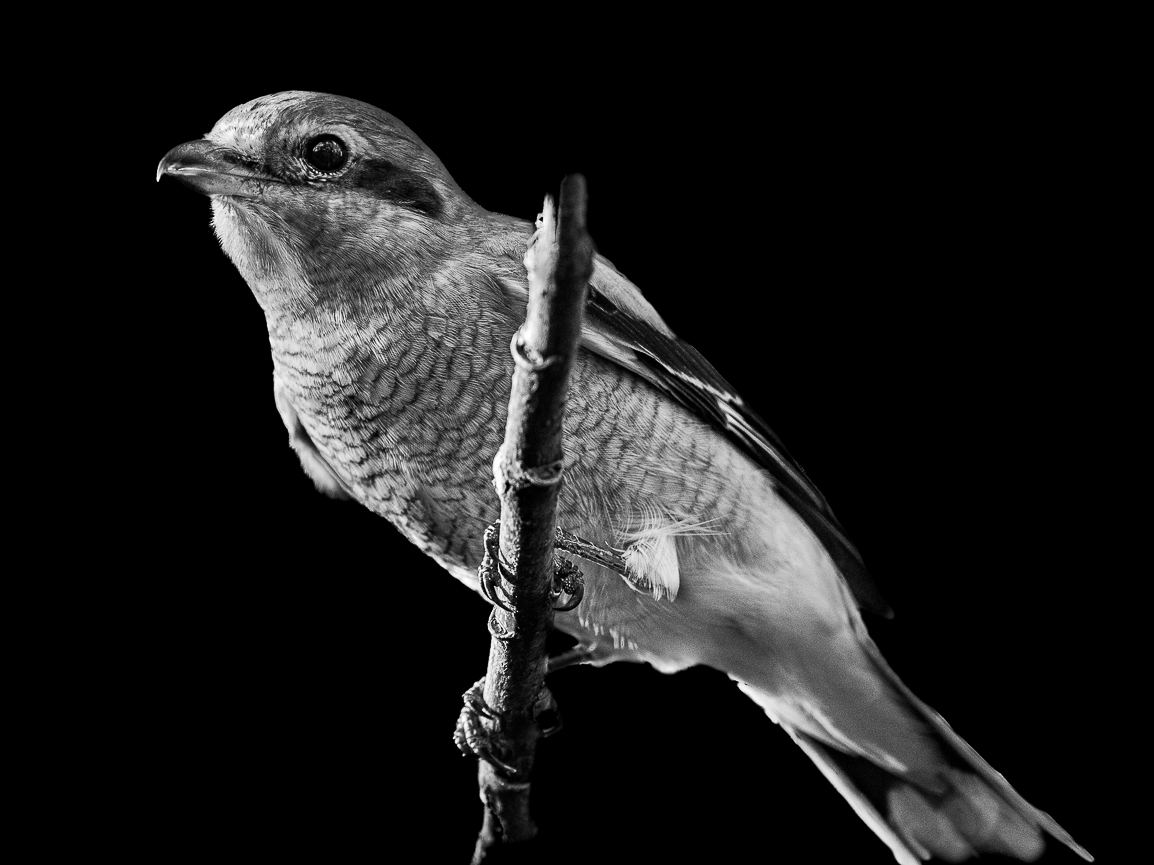
Spirit Bird – The day we arrived at The Lake, I heard the cry of a bird unlike I had ever heard. I’m not sure how I knew, but I knew. Shrike. I looked up to where it was perched on a utility wire. “Uncommon to rare,” according to Sibley. At the time I didn’t know much about photography or birds, but in that moment I understood that I was in a special place and that there was work before me. And so I ordered a new field guide and a copy of the Cornell Lab of Ornithology Handbook of Bird Biology (716 pages, more a tome than a handbook), acquired a long lens, and began. 8/27/16

View from our First Place: Chignik Lake Files

Fuchsia-colored Fireweed blossoms near the very tops of their stalks, leaves coloring with autumn, mark the calendar at mid to late August at The Lake. Initially, we attempted to save a little money by cramming ourselves into a one-bedroom apartment but soon found we were spilling out of that and moved into a larger two-bedroom place. But this was the view from that first place, looking down the lake toward the beginning of Chignik River. Maybe 60 people living in the village at the time, Sockeyes still running strong, the first Silvers beginning to trickle in. Bears on the beach nearly every day. Still, in mid-August, 15 hours of daylight. It was glorious. Our back yard. Home. 8/15/16

Seward Summers: Spawning Sockeye Salmon… and a simple philosophy to incorporate into your life if you are single but ready not to be single

They truly are this colorful – Sockeye Salmon in peak spawning colors, undisclosed stream, Alaska, 7/20/12

If you are single and want to keep things that way, start by making certain that you have only one really nice place to sit in your house. Have only one good wine glass in your cupboard, one decent dinner plate, one nice place setting. Strive, also, to have single-subject art – a lone person in any photographs, one carved bird alone on a shelf, only of any souvenirs or keepsakes. People will get the message.

If, on the other hand, you wish to communicate to the universe that you are desirous of and ready for a commitment to another person, populate your home in pairs. Two fine bourbon glasses, two equally comfortable places to sit, pairs of items on shelves, paired subjects in paintings, photographs and other artwork, a second bath towel that is every bit as luxurious as the one you yourself use. And when you find a special pair of beautifully crafted chopsticks, purchase a pair for yourself… and a second pair. The mere act of approaching life in this manner will begin to prepare you for an other person.

And people will get the message.