Sunset over Mount Veniaminof at Black Lake – January 3, 2018
Veniaminof was active on and off in the years we lived at The Lake. There were times when, while out fly-fishing the river, we could hear it rumbling, it’s smoking cone just over 20 miles to the west. In this photograph from a remote cabin on Black Lake near the headwaters of the Chignik, the volcano is even closer – perhaps just 20 miles distance. The forecast during our stay on Black Lake had been for fair weather, but shortly after sunset the evening one of us took the above photo we were hit with a huge out-of-nowhere storm packing freezing temperatures and winds in excess of 100 miles per hour. The little cabin rattled and rocked and we dug deep under a pile of blankets and sleeping bags, hoping the shelter would hold together. It did. That morning we woke to calm and a lake locked in thick ice. Our way out – back to the village, was by boat – a mile down the lake, seven miles down Black River and then seven more miles down Chignik Lake. No cell service. We were locked in, solid.
Golden-crowned Kinglet – Chignik Lake, December 2017 Sitka Spruce Trees transplanted at The Lake from Kodiak shoots 70 years ago provide a great deal more than just cone seed forage for finches and chickadees. Golden-crowned Kinglets and a few other avian species glean the boughs, bark and understory for invertebrates. Here a lucky female kinglet has come upon a silk-wrapped treasure – perhaps a spider egg case or an insect trapped and wrapped.
Yellow-billed Loon – Chignik Lake, Alaska, 11/27/17
When I initially got into studying the Chignik Drainage’s birds, I thought that a loon was a loon was a loon, a species I knew primarily from seeing Common Loons. I assumed that that is what a loon is. It turns out that there are five species of Gavia, four of which occur in the Chignik Drainage. In order of common occurrence, they are: Common Loon, Pacific Loon, Yellow-billed Loon and Red-throated Loon. (Only the rare Arctic Loon is absent from The Chignik.) It is probable that in the salt waters of the nearby Alaskan Gulf that from fall through spring it is the Pacific Loon that is most common.
We encountered Yellow-billeds as wintertime visitors to the main lake and the river outflow just below the lake. In wintertime, their plumage is rather drab (you’ve got to go to the most northern parts of Alaska, or Siberia, to see them in their stunning breeding colors); however, even in winter these, the largest of the five loons, were easily distinguished from Common Loons by their big, lightly-colored, yellow-tinged bills. We found the Yellow-billeds to be shy and to prefer deep water. The only photos I was able to get were taken using a 600mm lens affixed with a 2.0 teleconverter of far off specimens – and even those images require significant cropping to present a picture such as the one above. Still, Yellow-billeds are uncommon to rare and adding them to the Chignik Drainage List – perhaps a first documentation and almost certainly a first photograph – was a thrill.
Any documentation of this sort is important. As the planet continues to rapidly warm – due largely to a certain overpopulated species’ reliance on burning fossil fuels and turning forests to farmland – things are changing. Fast. (It’s not just that the climate is warming – it’s been doing so for a very long time. It’s the recent rapidity at which it is warming.) Audubon’s climate model projects a 64% loss of winter range for Yellow-billed Loons in coming decades. Not centuries. Decades.
Wherever you live, it is likely that you can see changes in flora and fauna over time. And these changes are not due only do warming. Although in pure numbers countable trees have increased in many areas, most of this new growth is in the form of pulp and timber forests – trees destined to be cut down just as they are reaching maturity. As fewer forests are allowed to reach and sustain maturity, there is less mast (acorns, other nuts, seeds and seed-bearing cones) for animals to forage and often fewer nesting sites as well. Wild grasslands have nearly disappeared from our landscapes. In many locales, streams, rivers and lakes have become warmer, shallower and increasingly over-nutrified owing to run-off from fertilized lawns and farms. So grab a pair of binoculars, a notebook, your iPhone or camera and get out and observe. The regular outings might prove to be a great education, and a daily walk is invigorating.
Male Red Crossbillforaging on Sitka Spruce Cones, Chignik Lake, Alaska. These birds can only live where forests are allowed to mature and produce healthy cones. Forest management that focuses only on replanting trees destined to be turned into pulp before they mature provide little to no benefit to most species.
Anyone who has much studied biology in general, birds in particular, or evolution specifically has undoubtedly encountered “Darwin’s Finches” and the remarkable diversity in bill shape that evolved among a species related to tanagers (not true finches) that became geologically isolated on the Galapagos Islands. Darwin visited the islands, which straddle the equator approximately 560 miles west of Ecuador, in 1835. There he collected (his servant shot) an array of birds featuring 18 different bill shapes. The variation correlated with the different foods each type of food the birds had adapted to take advantage of on the islands. As all of the species Darwin identified originated from a single type in genus Geospiza, Darwin’s Galapagos finches have long been held up as an example of how evolution works. It’s a complex process that occurs over time and I don’t want to oversimplify it. However, for the purpose in this article, it is useful to think of 1) an underutilized food source and 2) genetic isolation. The original tanager-like specimens of a single type in genus Geospiza became isolated on the Galapagos islands. Given an absence of competition from other species of birds and an abundance of various foods – insects & invertebrates, berries, seeds of different size -, various forms of the original type of Geospiza evolved different bill shapes and sizes (and even different body types) as they keyed in on a given kind of food.
Somehow, I think, (speculate), vocalizations must have played a key role in the genetic isolation that concurred with the move toward food specialization among these Galapagos finches. Most species of birds have a variety of calls and songs, each of which conveys a specific meaning. Black-capped Chickadees, for example, communicate with at least 15 different sounds (let us think of them as words) differentiating everything from the approach of different kinds of predators (one vocalization for ground predators, another for aerial predators) to vocalizations used during breeding, to identify food sources, and so forth.
Bird vocalizations play an important role in differentiating similar species. For example, although certain thrushes to the untrained eye appear quite similar, their songs are different enough to easily distinguish. Similarly, the Pacific Wren found in west coast states from California to Alaska is nearly identical in appearance to the Winter Wren which is found in the east and midwest. But the songs of the two species are different. Thus, they are genetically isolated from each other as much by their vocalizations as by geography. After all, they have wings. They are thus able to transcend geographical boundaries. Their songs – agreeable to members of their own tribe, a foreign language to others – helps keep the two populations separate.
Apparently a good bit of the above applies to Red Crossbills. I have photographs of Red Crossbills from Montana that show a recognizable difference from the Red Crossbills we encountered at Chignik Lake. The Montana birds have larger bills. What causes the difference? Probably diet. The Montana birds we saw were feeding on the seeds of Ponderosa Pine cones. My guess is that it takes a more substantial bill to get into the harder, tighter pine cones than it takes to pry apart the looser scales of the softer Sitka Spruce cones found at Chignik Lake and other locales in Alaska.
So, just as ichthyologists have come to understand the significant genetic variation that can exist among a given species of fish – such as Steelhead or Coho Salmon – as each kind of Steelhead or Coho has adapted to thrive in a given river system – ornithologists are coming to understand that there can be a great deal of intra-species variation among birds as each type within the species has evolved features allowing it to thrive in a specific habitat.
To me, the take-away lesson here is that we should not merely be focusing on the preservation of life forms on the species level, but that instead we should be dedicated to the preservation of each unique biome and ecosystem.
Male Pine Siskin Thousands and thousands of photos either culled and discarded or key-worded, retouched and placed year by year, month by monthinto digital folders. Still lots to go. Now into late October and early November of 2017, I hadn’t remembered that I got some nice captures of Red Crossbills and Pine Siskins that fall – finch species that generally do not appear on range maps for the Alaska Peninsula and which David Narver did not observe in his Chignik River Drainage study conducted in the early 1960’s. With the exception of Pine Grosbeaks, Alaska’s finches – which also include White-winged and Red Crossbills, Hoary and Common Redpolls and Pine Siskins – depend heavily on cone seeds. The siskin in this photo would probably not be at The Lake were it nor for the Sitka Spruce trees transplanted as seedlings from Kodiak Island back in the 1950’s. Now mature and beginning to reproduce on their own, these spruces provide shelter and seeds for chickadees, sparrows, finches and magpies as well as a diverse array of invertebrates for all the above along with woodpeckers, wrens, kinglets and warblers. These passerines in turn provide a source of food for owls, falcons and shrikes. Want to change the world? Well, you could try yelling at the evening news on TV… or you could plant a few trees.
Paradise Sunrise – Salmon water on the Chignik River
It wasn’t so long ago that I was at the stage in life where a number of iconic figures in the art and entertainment world had begun to pass out of this life. I am far from being a celebrity hound, but as I scanned the news headlines each morning, it was always a sad and somewhat mildly shocking thing to see that an actor, singer or other icon I’d long admired had been admitted to a hospital for the kinds of illnesses that portend the end, or that indeed the end had come. The mild shock in such moments stems no doubt from the reminder that in fact we are all, all of us, “in the queue.”
More recently, feathered in among these iconic entertainment artists, the mentor-friends of my boyhood have been departing. The deaths that have hit closest have been among the men with whom I had the honor of hunting and fishing, men who I studied closely and learned from. The lessons included the proper handling of firearms, where to look in a pool for trout, various forms of woodcraft and the like, of course, but more importantly my association with these men provided vital guideposts along my own path toward – and into – adulthood.
Bill Kodrich 1933-2024
I doubt that there was anyone who had a greater influence on my young life than did Bill Kodrich. The winter when I was 12, he taught me to tie flies, the very first of which was a white-winged Coachman… I can still remember my clumsy fingers fumbling to tie in matched sections of Mallard wing. That spring at the small pond on his property, Bill let me borrow one of his fly rods as he showed me how to cast a fly line. Later, he brought me into the fold of Trout Unlimited, an organization in which my wife and I are proud to be life-time members. (Bill, who was a biology professor at Clarion State College/University, served as Pennsylvania’s TU President and in 1991 received TU’s Distinguished Service Award.
As important as those early lessons were, it has been Bill’s example that has had the greater impact. Were one to glance at my various tools, fly boxes, cookware and so forth, one might notice every drill bit accounted for and in its proper place, flies arranged in tidy rows, cookware stored thoughtfully, clean and cared for. “This is the way Bill would do it,” I’ve said to Barbra or thought to myself countless times – and will continue to do so, a fly rod wiped clean and returned to its proper place on wall pegs after a day’s fishing bringing back fond memories of Clarion and of hunting and fishing with Bill and studying his example. In fact, I find that as I pass by vegetable gardens here and there, compared with the impeccably well-ordered rows Bill attended to, all are somewhat wanting. And it’s seldom that I have a really good piece of pie and he doesn’t come to mind. “We’ve got to fuel up if we’re going to be spending the day…” hunting or fishing.
The testament of Bill’s life – of the lives of all of these mentors from my youth – is that even a little attention cast to a young person can have an impact that lasts a lifetime. It is a legacy grander and more meaningful than the largest mansion, a pile of money to the sky, or fame in any measure.
Under a Broken Sky – Barbra swinging a Rocket Man streamer for Silvers at Paradise Bend, October 7, 2018
During the several years we fished the water at Paradise Bend (our name for an expansive area of tidally influenced braided runs and gravelled, vegetated islands), we only encountered other anglers on one occasion. Their guide had them casting in the wrong places – unproductive water unlikely to hold salmon. In due time their casts became listless, eventually gave way to billed caps lifted and head-scratching, and then to searching glances at each and beseeching looks toward the guide. They left fishless, and that was the only time we encountered anglers on “our” pool.
Paradise is a very special place, often beautifully lit by morning light, frequented by some of the world’s largest Brown Bears, traversed by moose, mink, fox, otter and wolf, shorelines decorated in season by magenta fireweed, sunflower-like arnica, marsh marigold and a dozen other showy blooms. At any time of year the water is free of ice you might hear the ratchety call of a kingfisher, and all summer long there are the songs of thrushes, sparrows and warblers to cheer the day. Gulls and eagles scavenge the islands when the fish are in, and in spring the wide, weedy shallows load up with Tundra Swans and hundreds of ducks. The ducks, particularly Mallards and Green-winged Teal, return en force in fall, and it was near Paradise that I encountered a brilliantly marked male Spotted Redshanks – a rare stray from Asia.
Tucked back in a bend off the main channel where boats never ran, it was easy to lose oneself during a morning at Paradise. Schools of newly arriving Coho pushing up tidal-bore-like bulges of smooth water as they arrived in the main pool were a thrill, and the fishing could be agreeably challenging in the clear, shallow water where we could watch the fish come to our flies. At the take, we would strip-set and then brace for long runs punctuated by cartwheeling acrobatics. There were more productive pools on the river, but none more enjoyable to fish.
Maybe even more satisfying than these periods of activity were the times in between, the water temporarily empty of salmon, the big sky, the vast landscape, bird song, rushing water and quiet… a place to let thoughts find their own way and perhaps to visit with a friend or love from the past who, for whatever reason, is now absent. There are a lot of reasons to take down a fly rod from its wall pegs and go to the water. There is the fishing, of course… but there are times when the promise of uninterrupted thought is the more compelling motivation.
We procured a backcountry permit at the park office, took a shuttle bus a ways into the park, debarked and backpacked into the landscape in this photo to spend a couple of nights. The only sign of people we came across was a plastic lens cap from a camera – something accidentally lost, not littered. Caribou and Dall Sheep, Wolf prints and Wolverine tracks… A Grizzly Bear caused us to change our course… Short-eared Owls cruising low, nesting Willow Ptarmigan hens – the males waking us at first light with their call of Potato! Potato! Potato. Tree Sparrows flushing from tiny ground nests where clutches of blue-green & brown eggs were crowded together. We came across Caribou antler sheds; a moose rack attached to a skull suggested a successful hunt by wolves. In 1846, Thoreau needed only to travel from Concord, Massachusetts to Maine’s Mt. Katahdin* to immerse in the vital contact with wilderness he sought. During the 2022-2023 season, 105,000 tourists traveled to Antarctica – up from just 5,000 only a few years prior… which was up from somewhere near zero not so long before that. Even Alaska’s remote, far-north rivers are typically floated by multiple parties each year. Not long ago I came across a recent piece of video depicting an unimproved campsite I overnighted at on youthful floats down my native Clarion River. The site was seldom used in those days, nearly pristine, and you could nice-sized large trout in the pool and the riffle water that flowed by. The contemporary video showed trampled vegetation, fire pit scars, bags of trash…
There are no doubt as many definitions of wilderness as there are human expectations of what might be present or absent in such a place. The one certainty is that wilderness is becoming more difficult to find, to immerse in, to discover and explore. My recollection of reading Thoreau’s account of his attempt to ascend Katahdin is that at some point the climb (or was it the descent?) was terrifying. Perhaps therein lies a piece of what wilderness means… a place cut off from civilization, where things could go wrong, and if they do, you’re on your own. There’s something liberating in it.
*Thoreau’s account of his journey to Mt. Katahdin can be found in his book The Maine Woods.
Downward Fox – There’s nothing quite as satisfying in the moment as a good stretch at the beginning of a day. Wherever you are, we hope your day is going well.
Between the two camps regarding testing new ideas at the beginning of each new year – the one camp advocating for trying new things, the other camp taking Eeyore’s “What’s the point?” position -, we are firmly in the camp advocating for trying out new things. I emphasize here trying out new things. We are notfans of New Year’s Resolutions. The very term, “resolution,” feels like a lead weight – leading to the even weightier prospect of “failure.”
Simply giving something a try – a gentle approach to change – is more suited to us. And so for the year 2024 I’ve begun (nearly) daily morning meditation. A few minutes of calm stillness, seated/kneeling on a low, cushioned wooden meditation bench, doing my best to empty my mind for a little while, sometimes allowing a selection of Mark Isham’s light orchestral arrangements to play in the background, other times keeping things as quiet as I can, is proving to be refreshing.
Additionally, we’ve both decided to go alcohol (and marijuana) free. It’s been about two months now. So far, so good. Surprising to both of us is that we haven’t missed the beers, wines and spirits that have often been integral to our gustatory and social lives. Of course, there is money to be saved by such a venture. And increasingly the scientific/medical consensus is recognizing that there is no health benefit to alcohol, that even modest consumption appears to be somewhat harmful. In good health but older now, having recently purchased a home (and imagining new art for this home), we’re mindful of both of those factors. But they weren’t the primary motivations behind this decision.
One of the happiest moments in our shared life these past few years occurred toward the very end of our bicycle trek in Hokkaido. We had just pushed up a long hill – a small mountain, actually – and then had the reward of the effortless sunshine summer day warm breeze on our faces coast down the other side.
In that moment, we were transported back to sheer joy of freedom total immersion in a moment childhood memories. Way leads to way. Thought to thought. We embraced and enjoyed experiencing wines and other drinks in that season. But all of that had become a distraction, on several levels. Time to experience something else. It has been an enjoyable two months… completely sober in every moment, and thus, at least for us, living more in the moment, a little closer to the quick of Now.
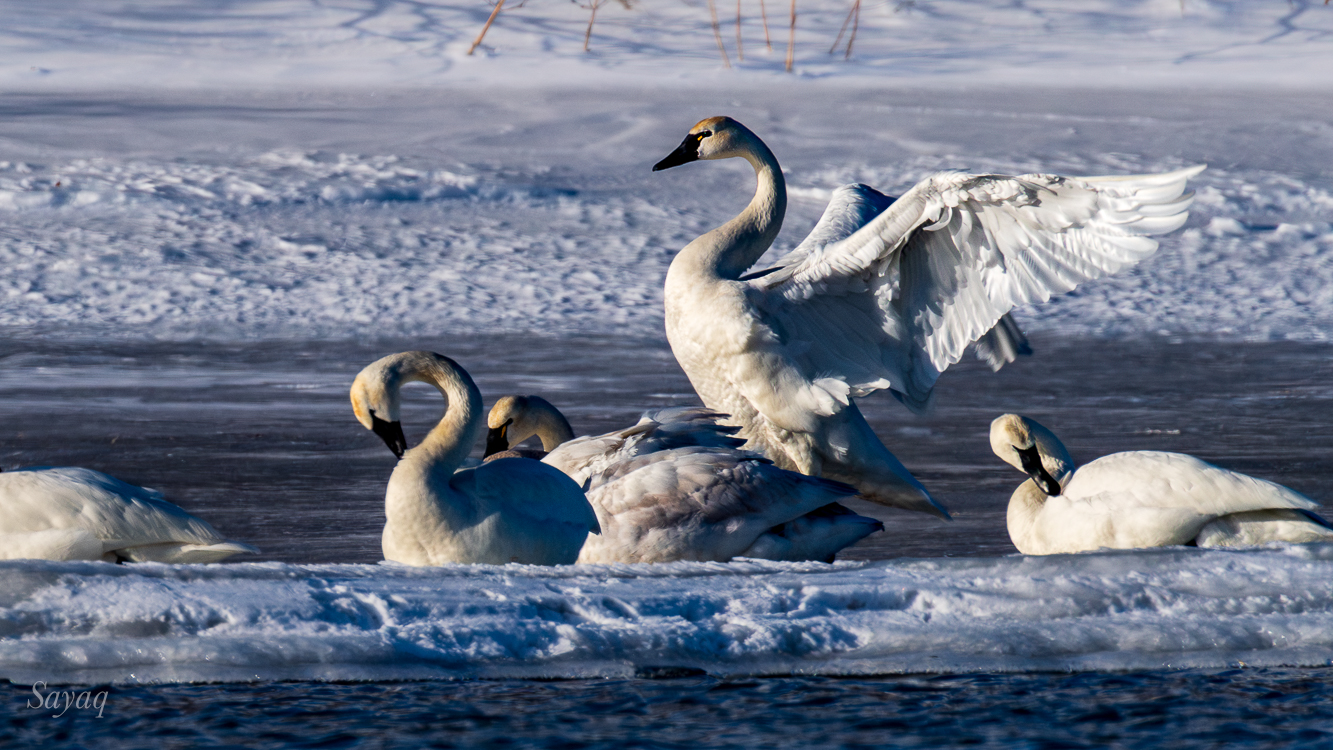
The Swans at Broad Pool Chignik River, 3/16/17 Each March, residents of Chignik Lake begin checking Broad Pool for early signs of spring – arriving flocks of Tundra Swans. The best swan viewing occurs in years when the river is partially iced over and therefore closed to boat traffic. This expansive pool has abundant Water Crowfoot, an aquatic vegetation preferred by swans and dabbling ducks. The swans, which mate for life and can live to be over 20 years old, will rest here and in other quiet water in the Chignik Drainage for up to a few weeks before breaking off in pairs and heading to tundra nesting sites on the Bristol Bay (northwest) side of the Alaska Peninsula. As human activity continues to cause the planet to warm and years of ice become fewer on the Chignik, Broad Pool may no longer provide a suitable resting place for returning waterfowl. Things are changing… fast. Get out and observe, photograph, document.



 CutterLight