
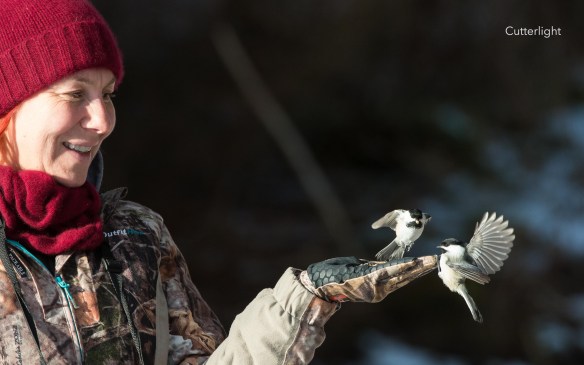
Gregarious, full of curiosity and brimming with personality, Black-capped Chickadees are often happy to take seeds right from a friendly hand. Weighing only about 10 grams (less than half an ounce) their little claws are nonetheless quite strong!
Many a hunter sitting quietly in a northern woods while waiting for a White-tailed Deer or Wild Turkey to come by has experienced a chickadee approaching ever nearer before boldly perching right on the rifle barrel – or even on the hunter’s arm or cap. Such an event feels like a stamp of imprimatur from Mother Nature herself.
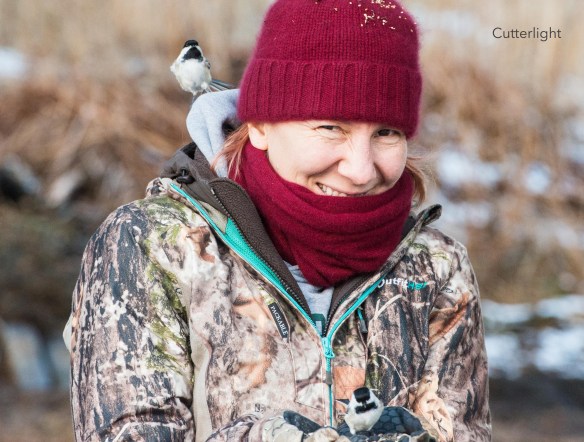
Last fall, when we hung bird feeders at the White Spruce Grove a little over half-a-mile from our home and began putting out seeds for Chignik Lake’s birds, within just a few days we noticed something uncanny. As soon as we hit the trail to the feeders, chickadees would descend upon us, fluttering and chattering with a familiarity that suggested that they somehow knew us. And each day as we came within view of the spruce trees themselves, a dozen or so chickadees would erupt in excited calls, flitting down from the boughs as though to greet us. There seemed to be no doubt that these little birds recognized us, Barbra in her red hat and scarf, me in my black watch cap, both of us in camouflage jackets. That sent us to the internet to do some research.
As it turns out, Black-capped chickadees are remarkably intelligent little beings, in possession of 13 different, complex vocalizations as well as memories that allow them to recall the precise location of food they’ve cached for up to several weeks. Regarding their vocalizations, not only do they warn each other with rapid dee-dee-dees, it has been shown that these calls vary according to the danger at hand, with their longest and most insistent alarms reserved for Pygmy Owls, a predator that poses an especial threat to chickadees.
Another, happier call among our local chickadees (it seemed to us) appeared to go something like, “Here come Jack and Barbra with more seeds!” While the various sparrows hung back demurely, deep in the cover of the spruce trees, the chickadees would land on our camera lens and flap around our heads.
“I once had a sparrow alight upon my shoulder for a moment, while I was hoeing in a village garden, and I felt that I was more distinguished by that circumstance than I should have been by any epaulet I could have worn.”
Henry David Thoreau in Walden
We wondered if we could get these bold, inquisitive birds to take seeds from our hands – and whether or not it would be ethical to do so.
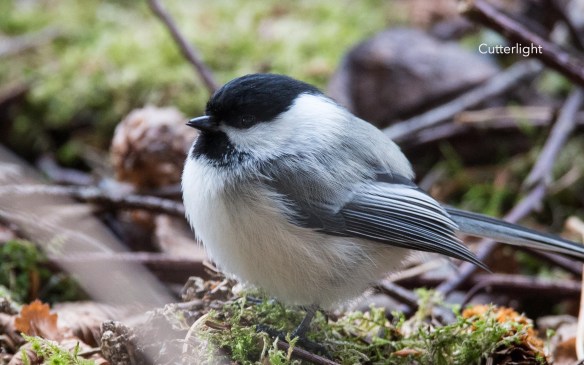
One of the advantages of feeding birds is that it provides opportunities to closely study individuals. Early last fall, we noticed that this chubby-looking fellow had broken off the tip of his upper beak. We wondered if this would adversely affect his ability to make it through the winter. Happily, it hasn’t. We still see him, and he still looks like he’s not missing any meals.
There’s no doubt that some wild animals should not be fed. Most North Americans are familiar with the cautionary proverb, A fed bear is a dead bear. That’s because bears that learn to associate humans with food become dangerous, destructive nuisances. But chickadees? After doing our due diligence in research and considering the welfare of the birds from a variety of perspectives, we felt comfortable taking our bird feeding to the next level.
Getting the birds to come to our hands proved to be fairly easy. One morning, we temporarily took down their favorite feeder, stood near the tree with outstretched arms and seeds in our hands… and waited. After a number of feints and false starts, one particularly brave bird took the plunge and was rewarded with a nice, fat sunflower seed. After that, it was one bird after another.

For the next few days, hand feeding our feathered friends was the highlight of the day. During those few days, we learned quite a lot. In addition to their many and varied vocalizations, Black-capped Chickadees establish pecking order by silent bill-gaping – an aggressive, open-mouthed gesture that is enough to cow a rival bird into waiting its turn or leaving the immediate feeding area altogether. There also seemed to be quite a range of distinctive personalities, with some birds readily and repeatedly feeding from our hands – and remaining long enough to carefully sort through the offerings for the choicest seeds -, while other birds hung back or landed only briefly.
The National Audubon Society encourages people to feed wild birds. Habitat is shrinking, and with that loss food sources can be scarce. Place your feeders in areas where birds have easy, quick access to the safety of shrubbery and trees, keep cats indoors, and to prevent the spread of disease among birds, occasionally clean the feeders. Once you start, keep the feeders full so that birds that have come to expect a food source aren’t suddenly left high and dry during inclement weather. But be warned: you might discover that the view out your window becomes more interesting than whatever’s on TV!

 CutterLight