Spruce Grove HunterAugust 19, 2016, Chignik Lake, Alaska
Fairly new to photography when I got the above capture of a Merlin strafing songbirds at the spruce grove in Chignik Lake, I was somewhat frustrated with my inability to get the bird “tack sharp.” I was shooting with a 200-400 mm telephoto lens at the time, to which I often affixed either a 1.4 mm or 2.0 mm teleconverter, and simply didn’t have the skills to follow North America’s second smallest falcon as it zipped around the grove at breakneck speeds in pursuit of warblers migrating south in late summer. So I climbed a small rise that put me eye level with the upper branches of the trees, chose a section that was well enough lighted, focused on a group of cones, and waited and hoped for the little falcon to enter the scene. The bird obliged, I snapped the shutter, and at least came away with what I would imagine is the only photographic documentation of Falco columbarius in the Chignik Drainage. The species had been documented there… but I think not photographed.
However, before much time passed the photograph began to grow on me. In fact, I actually began to like it. The bird is clear enough to easily identify as a merlin, and I began to appreciate that the blur, while not depicting the bird itself as clearly as I had originally hoped, captures something else: the story of the falcon’s incredible speed and maneuverability as it circled the grove. Had I been able to make a sharp, clean capture of the bird, as I swung the lens to keep up with the falcon the trees would have become a blur. But the Sitka Spruce grove, a copse of 20 trees transplanted from Kodiak Island in the 1950’s when Chignik Lake was first permanently settled, is central to the story here. I love the way the lush green trees draped with new cones anchors this photograph, thereby helping to create a fuller story.
These days, the incredible capabilities of modern lenses paired with technologically advanced cameras have created a push… a demand, actually… for ever sharper images. This has become particularly so in the field of wildlife photography. But it seems to me that sometimes… perhaps often… this insistence on “tack sharp” (and perfectly colored) images of wildlife has come at the expense of the overarching story behind the image.
Over the next several years photographing bears and birds, fish and flowers, landscapes and life at Chignik Lake, as I gradually came to understand more about photography, I returned to the above photograph many times, mulling, contemplating, turning it over in my mind. We already know, in great, tack-sharp detail, what all of North America’s birds and mammals look like. There are thousands of beautiful photographs of just about every species… in some cases perhaps millions of such images. So, how does one employ a camera to go beyond documentation, to tell a larger story? For me, the beginning of the answer to that question started with Spruce Grove Hunter.
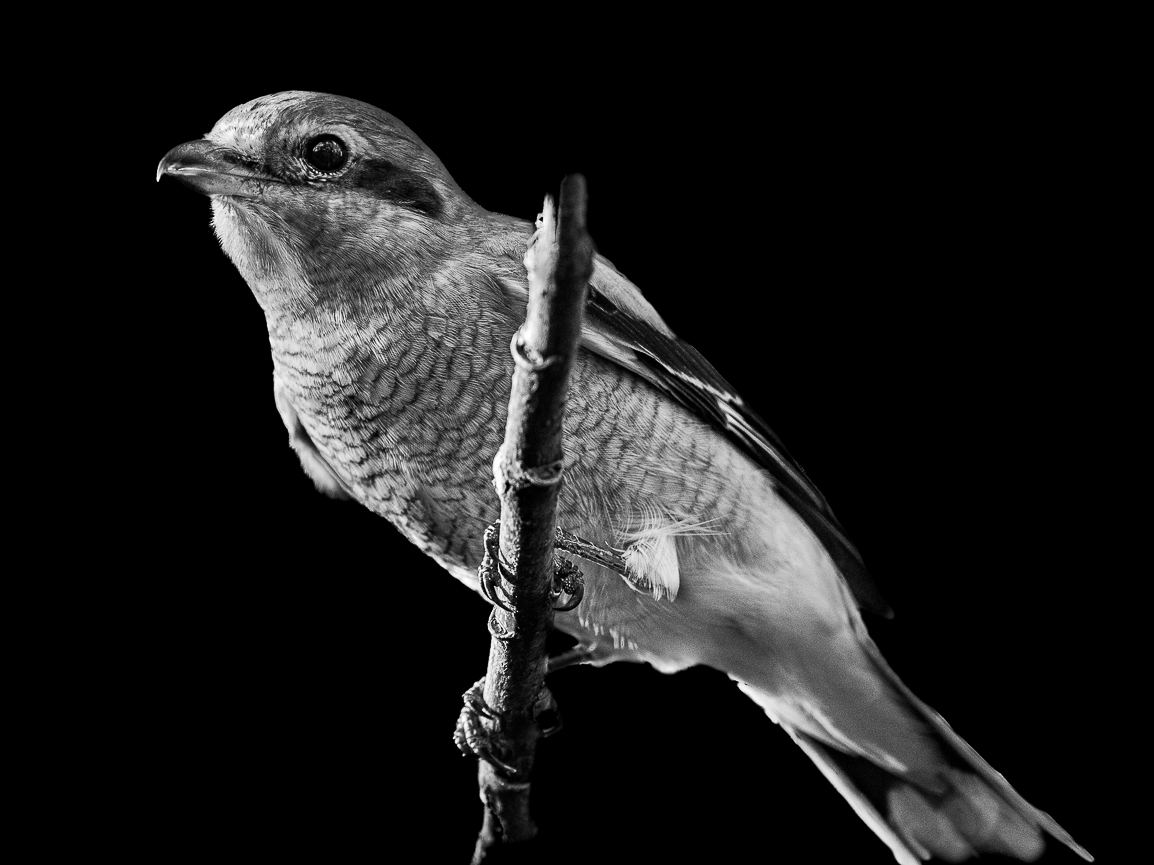
Spirit Bird– The day we arrived at The Lake, I heard the cry of a bird unlike I had ever heard. I’m not sure how I knew, but I knew. Shrike. I looked up to where it was perched on a utility wire. “Uncommon to rare,” according to Sibley. At the time I didn’t know much about photography or birds, but in that moment I understood that I was in a special place and that there was work before me. And so I ordered a new field guide and a copy of the Cornell Lab of Ornithology Handbook of Bird Biology (716 pages, more a tome than a handbook), acquired a long lens, and began.8/27/16
This photo of a pair of Horned Puffins was taken in late May, right in the heart of their breeding season which runs from mid-spring through mid-summer. This is when their enormous bills are at their largest and most colorful – literally fluorescent. Males and females are monomorphic; that is, they show the same plumage. (Alaska Gulf)
Who knew that in some species of birds, bill shape, size and color changes with the seasons? Such is the case of the Horned Puffin, which grows additional layers of colorful keratin – the same material hair, feathers and fingernails are made of – during the breeding season. When the season concludes, puffins sluff off the additional material and their beaks become smaller and duller. The vibrant lemon-yellow coloration mostly disappears and the tangerine-orange becomes a more mellow peach. While relatively large, the bills of juveniles are smaller than those of adults and appear gray or a coal-dusted orange.
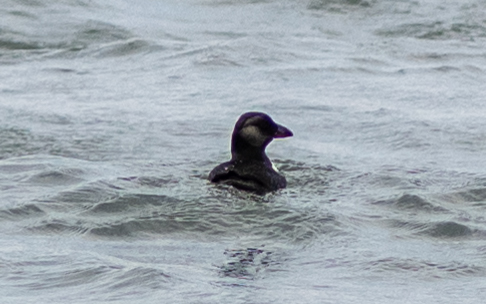
Juvenile Horned Puffin, Chignik Lake, September 11, 2021.The Chignik Drainage cuts through mountains, creating an avian corridor across the Alaska Peninsula at a point where it is about 40 miles across from the Alaska Gulf on the southwest side to the Bering Sea to the northwest. From passerines falling out in nearby spruce groves to oceanic species seeking refuge during storms or pausing during migration to forage, you never know what you’ll encounter along the Chignik.
With puffin breeding colonies on nearby Alaska Gulf islands as well as additional sites on peninsula headlands, the estuary and seas near Chignik Lake are an excellent year-round place to encounter Horned Puffins. Here they feed on abundant herring, sand lances, juvenile salmon, sculpins and other forage. Dense, well-oiled feathers and wings that become flippers propel puffins to depths of 100 feet and possibly more. Feeding for themselves, puffins swallow most of their prey underwater. If you see one with a beak overflowing with silvery sand lances or herring, it’s undoubtedly taking them back to its nest.
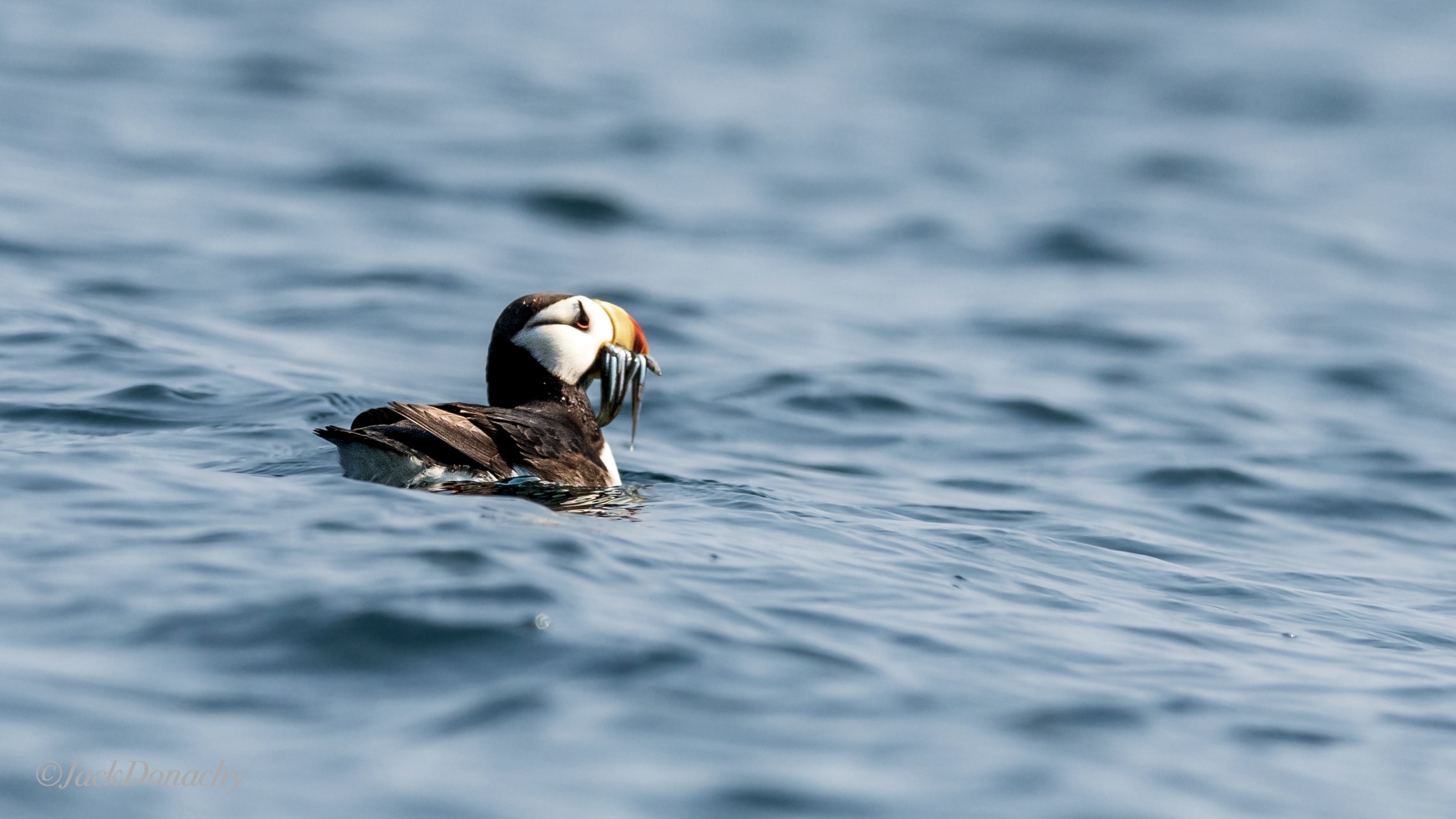
It is reported that a Horned Puffin can carry dozens of small fish in its bill. I counted eight sand lances here. (Alaska Gulf near Chignik, July 28, 2020,)
In former times, puffins were shot and salted down for food by the barrelful. They were even considered acceptable fare on Catholic holy days when fish rather than other forms of meat was to be consumed. In Alaska, both Tufted and Horned Puffins were traditionally hunted with hooks baited with fish a well as with hoop nets on long handles. Also, a type of bola was thrown into the air to entangle seabirds returning to their nests. In addition to utilizing puffin meat and eggs, the skins and feathers were used in clothing. Historical accounts describe puffins as curious and friendly, but they are apparently still hunted in some areas and anytime that’s the case they can be challenging to approach.
Horned Puffins, so named for a small, fleshy point protruding above each eye (see the first photo in this article) are easily distinguished from Tufted Puffins, above. Both species are present in the Alaska Gulf near Chignik.
The best time to see puffins along the Alaska Peninsula is during the summertime breeding season. The weather is often mild, the seas calm, and the birds, hunting for themselves as well as for their chicks, can often be found close to shore. Look for the same sorts of current breaks you might look for when salmon fishing, as these rips concentrate baitfish.
In flight, they skim the seas like some form of exotic bee, chunky dark bodies pulled along by those wonderfully colorful bills, determined wings rapidly beating the air into submission. Suddenly they glide upward along the face of a rocky headland and unerringly disappear into a crevice where a chick or mate is waiting. Over and over they repeat the circuit – the flight out, the deep dives, the return flight – until one day they gather their forces and all the puffins and perhaps other nearby nesters as well head en masse out to sea where they will spend the winter months. Juveniles, no longer under the care of their parents, will struggle at first to tag along, often not making it far before they need a rest. And then, they too will find themselves over the sea’s depths. For the youngsters, it will be two years before they return to their natal headlands or island. But the adults return each year, finding familiar ledges and spaces between rocks, watching over a single egg, and joining other puffins, murres, auklets and guillemots over shoals of herring, sand lances and out-migrating salmon smolts. It is an amazing sight to behold.
Horned Puffin Fratercula corniculata Order: Charadriiformes Family: Alcidae Genus: Fratercula – Medieval Latin fratercula = friar for the semblance of their plumage to monks’ robes Species: corniculata – Latin for horn-shaped, referencing the bill
Status in Marine Waters near Chignik: Common to Abundant; rare or accidental in the freshwater drainage
Having encountered them only once on the Chignik River in the past five years, Short-billed Dowitchers would have to be considered a rare species here. I was happy to be surprised by a small flock of them one late-summer day while looking for teal.
It’s a bit difficult and somewhat sad to think that not so long ago, shorebirds such as dowitchers were considered fair game by many shotgun-toting sportsmen. Ernest Hemingway mentions this in a couple of his books, noting (happily, I think) in his posthumously published Islands in The Stream that he loved watching the little plovers and other peeps and could no longer think about shooting them. Perhaps the early American ornithologist Elliot Coues said it best in a passage he wrote in the 1917 edition of Birds of America:
“(The dowitcher’s) gregarious instinct, combined with its gentleness, is a fatal trait, and enables gunners to slaughter them unmercifully and sometimes to exterminate every individual in a ‘bunch.’ To turn a 12-gauge ‘cannon’ loose among these unsuspicious birds, winnowing in over decoys with friendly greeting, is about as sportsmanlike as shooting into a bunch of chickens. To capture them with a camera requires skill and patience, and herein lies the hope for future existence of our disappearing wild life – substitution of the lens for the gun!”
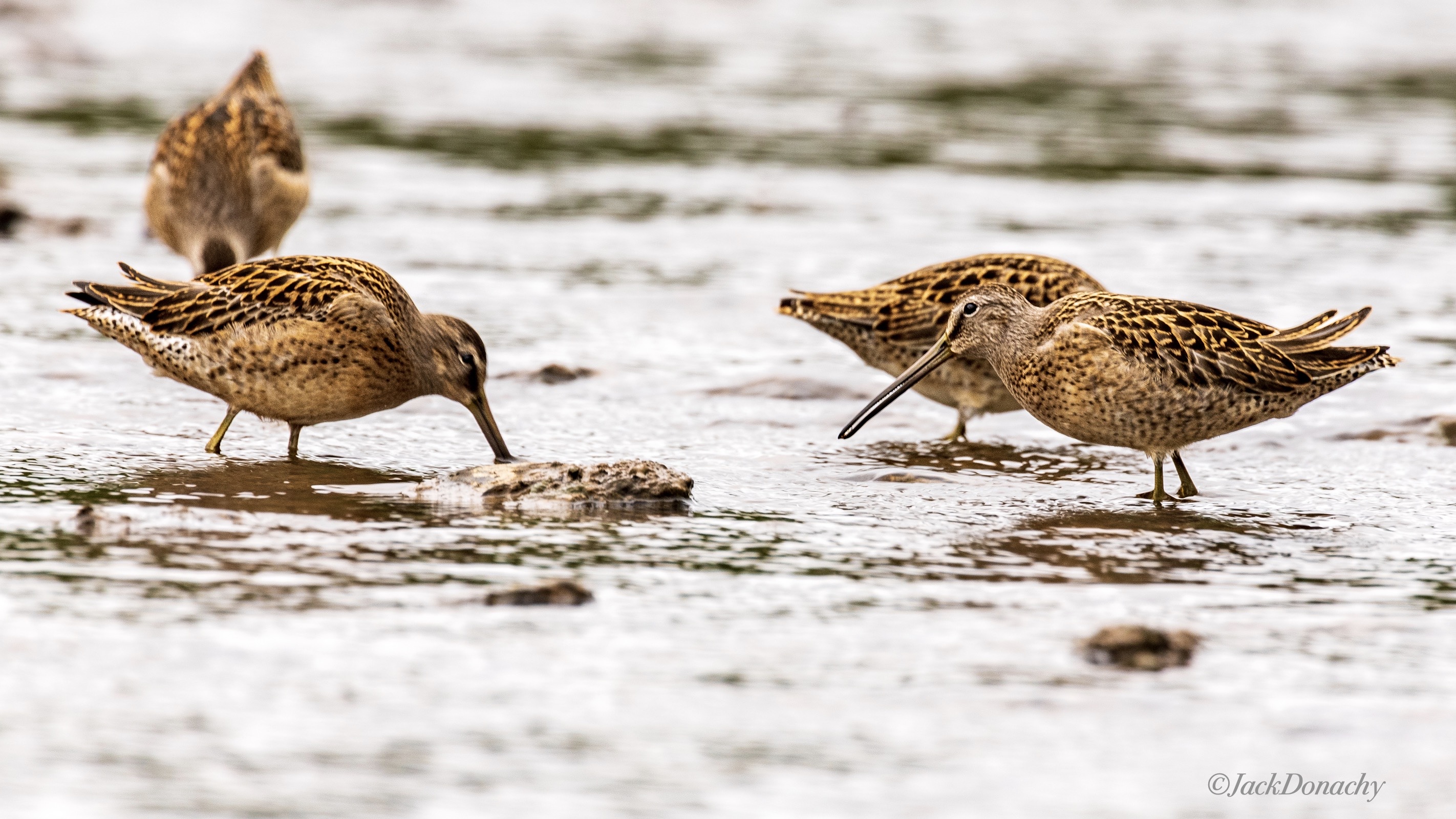
Note the bill serrations on this dowitcher which has just come up with a tidbit of some sort – perhaps the larval stage of an insect or a mass of invertebrate eggs. The tip of the bill contains sensitive receptors called Herbst corpuscles which aid it in searching for food. Short-billed and Long-billed Dowitchers both have exceptionally long bills, and as the bill lengths fo the two species vary and overlap, it is not a reliable diagnostic. In fact, unless the birds are vocalizing, distinguishing Long-billeds from Short-billeds in the field is quite difficult. The flock of over a dozen dowitchers I encountered were in freshwater on the Chignik, several miles above the estuary – habitat where one might more likely encounter Long-billed Dowitchers. They were not vocalizing, but I believe these are Short-billeds based on more overall spotting than barring, a more sloped forehead, and the fact that Short-billeds are more common than Long-billeds on the Alaska Peninsula. But I am happy to have someone with more experience with these peeps offer a correction. It is also entirely possible that both dowitcher species were represented in this flock.
In recent years, dowitchers have experienced rather steep population declines. According to the Cornell Lab of Ornithology All About Birds website, reasons include sea level rise, loss of habitat due to development and other factors, and hunting. Regarding the latter reason, I have to agree with Messrs. Coues and Hemingway. With the species in decline, it would seem the better part of discretion to stow the shotgun and opt for chicken breasts.
It’s common for shorebirds to travel in mixed flocks with each species taking advantage of slightly different feeding strategies. Here a pair of Least Sandpipers get in on the action.
The dowitcher’s needlelike bill probes silt, mud and sand with an astonishing speed that has been compared to that of a sewing machine. I’ve recently begun broadening my documentation to include video and was happy to have had the presence of mind to do so with these birds. The “sewing machine” feeding style is well demonstrated – as is the challenge of getting a good, clear still capture of these frenetic birds in typical Chignik low-light conditions.
Dowitchers feeding at Devil’s Flats on the Chignik River, Alaska
Partially concealed behind tall grasses, sedges and Arctic Dock, camera at the ready, its long lens wrapped in a camouflage sleeve, Barbra and I watch as a group of shorebirds bank in unison, the white of their underwings flashing. A short way upriver, they wheel and come back, pass overhead, bank and wheel again a little ways down river, and then return to settle in over the shallows we’ve been watching. I look at Barbra and she smiles. New birds. Our 99th species in the freshwater portion of the Chignik Drainage between Chignik Lake and the estuary. Hemingway was right. They are wonderful to watch.
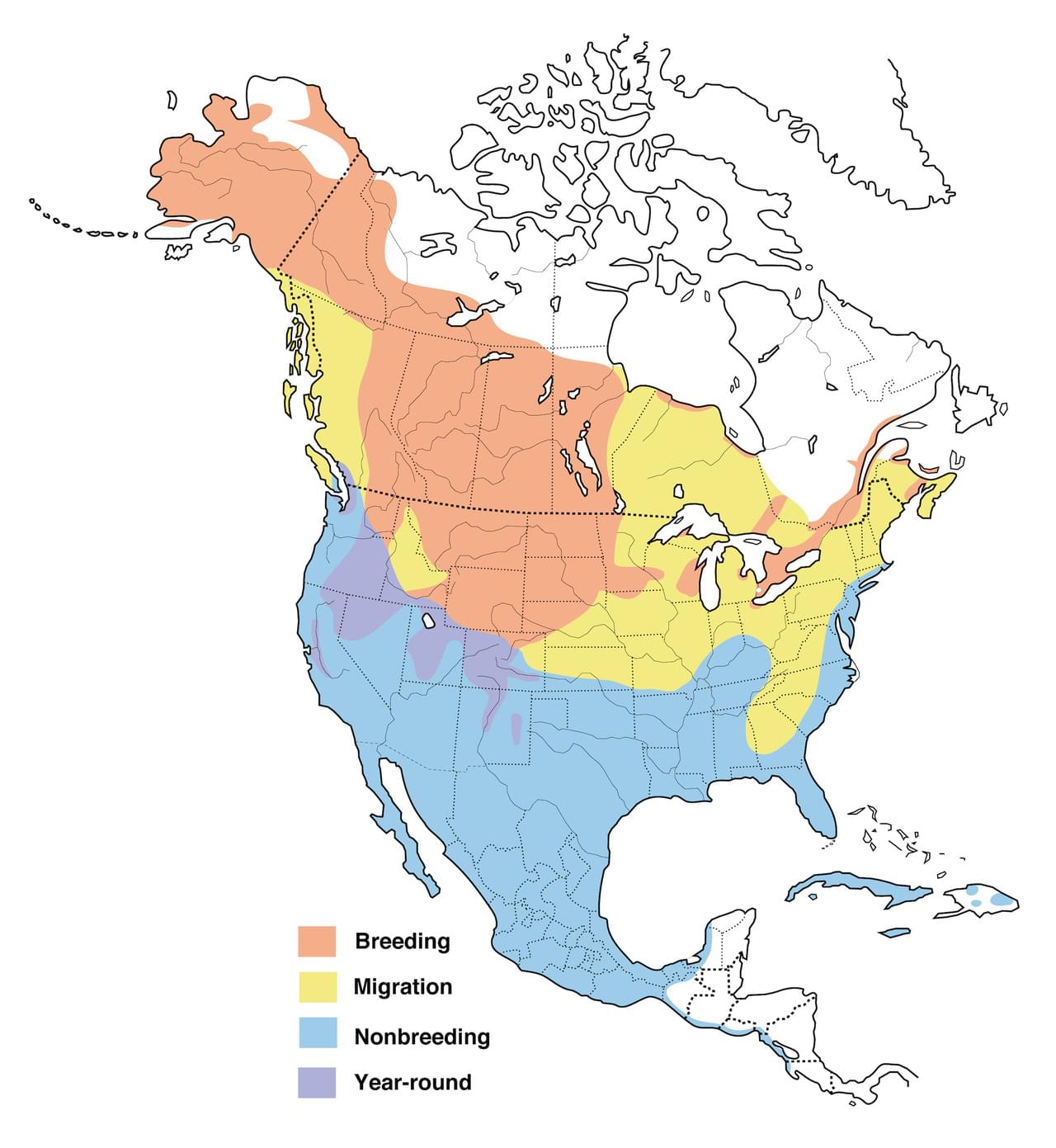
Although the range map below does not indicate the presence of Short-billed Dowitchers on the Alaska Peninsula, David Sibley includes the peninsula on the range map in his field guide as does the Audubon website.
Short-billed Dowitcher, Limnodromus griseus Order: Charadriiformes Limnodromus: Ancient Greek limne = marsh, and dromos – racer. marsh racer griseus: Medieval Latin for gray
Status at Chignik Lake: Only one sighting in five years, however it is likely that this species is a regular if brief late summer migrant in the drainage and may even nest in nearby areas of tundra or marsh.
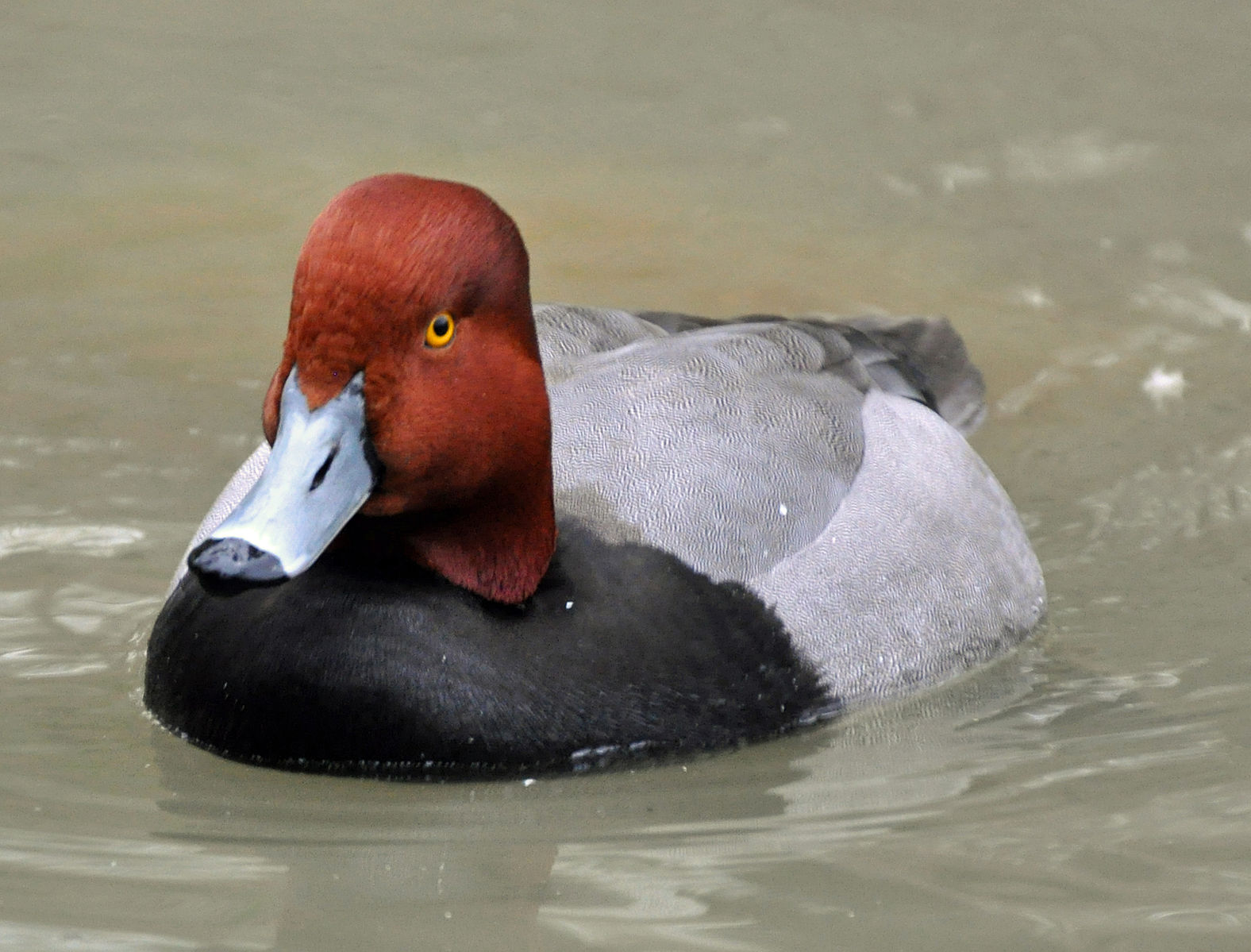
In breeding plumage, a male Redhead. The question is, how did one of these get mixed in with a flock of Greater Scaup out on the Alaska Peninsula? (Photo courtesy of Kevin Bercaw, Wikipedia)
One of the most fascinating aspects of birding in the Chignik River drainage is that at any given moment, you might encounter something rare or unexpected. Under the “rare” category are species such as Northern Shrikes, Gyrfalcons, Yellow-billed Loons and xanthochromic Common Redpolls – birds that are seldom seen outside the far north, and even in Alaska are generally not frequently encountered. But, in part because of the unique geography of the Chigniks, there are also fairly common birds that unexpectedly end up here, many miles beyond what is generally considered to be their range. Our river cuts a path between rugged mountains on the Alaska Peninsula creating an obvious migration route for passerines, raptors and waterfowl. And then there are the fierce winds that funnel through this valley, so that Pied-billed Grebes, Red-breasted Nuthatches, White-throated Sparrows, Great Blue Herons and other birds that “aren’t supposed to be here” occasionally find their way to The Lake.
Some of these birds may represent the vanguard of a species expanding its range. I’ve documented Oregon-race Dark-eyed Juncos as wintertime residents from fall through early spring every year at the lake since we first arrived here in 2016. In fact, there are a dozen in the village right now, hundreds of miles from what is considered their range. And a pair of male and female Red-breasted Nuthatches that stayed in the village for awhile this year may portend things to come for that species as the climate continues to warm and more trees populate the peninsula.
And the Redhead? I suspect that something else entirely was going on with the lone male I photographed in a group of Greater Scaup last spring. Brood parasitism. Among all ducks, female Redheads are best known for their habit of laying their eggs in the nests of other birds. According to Audubon, Redheads have been documented leaving their eggs to the care of at least 10 other species of ducks, American Bitterns and even a raptor, the Northern Harrier. Scaup are a frequent target of their brood parasitism. Knowing how ducks imprint on whatever or whomever they take to be their parent, it is quite possible that this Redhead thinks of himself as a Greater Scaup.
This is part of a flock of perhaps three dozen Greater Scaup and a few Red-breasted Mergansers. Just left of center, the bird flying highest is the Redhead. We do occasionally see Canvasbacks out here, a close relative of the Redhead. By comparison, the red of the Redhead is brighter, the head is much more rounded, and the wings in flight are darker.I searched the flock for a female counterpart, but found none.(Photo March 11, 2021, Chignik Lake)
Whether he is traveling with brood-mates or he simply fell in with a flock of fellow diving birds, it’s likely that eventually this Redhead will eventually get things sorted out. On the other hand, with breeding season fast approaching when the above photo was made, hybrid crosses between scaup and Redheads have been recorded. You never know what will turn up next at The Lake.
Redhead, Aythya americana Order: Anseriformes Family: Anatidae Aythya: from the Latin aithuia for an unidentified seabird referenced by Hesychius, Aristotle and others americana: Latinized version of America
Status at Chignik Lake, 2016 to present: Rare or accidental.
Strikingly marked with blues, iridescent greens, russet flanks and contrasting white, Northern Shovelers are a beautiful bird. And that bill…(Photo taken April 28, 2021, Chignik Lake)
Two decades have passed since the days when I used to ride my bicycle in wintertime and spring to the Hanamizu River in Hiratsuka, Japan to look for birds there. I did not consider myself a birder then, but I liked to look at the water and I carried binoculars and sometimes a bird field guide with me. There were herons and egrets, and it was a good place to see turquoise-colored kingfishers, a favorite, and to find shrikes which left worms and other small creatures impaled on barbed wire fences around gardens along the river. There were startling, parrot-like green woodpeckers, redstarts and other birds in the forested hills nearby, and sometimes I’d go there to look for those as well as owls, which I never did find. My favorite place was the river, though, and I’d often pack a lunch and find a place to sit and watch the ducks. There isn’t much hunting done in Japan, and so the birds were neither tame nor particularly wary. I was often closer to species such as teal, wigeons, mallards and pintails than I’m ever able to get here on the Chignik.
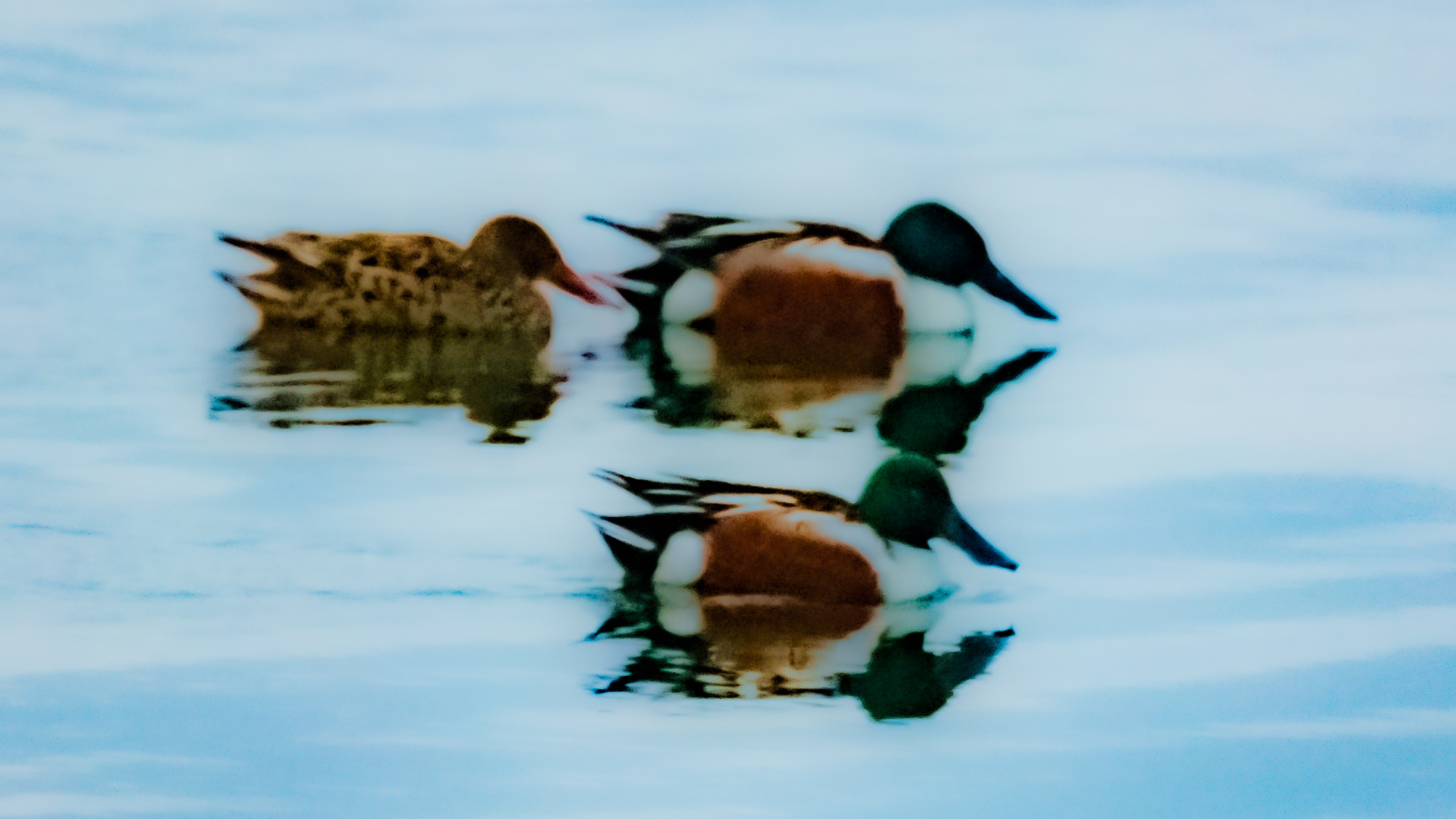
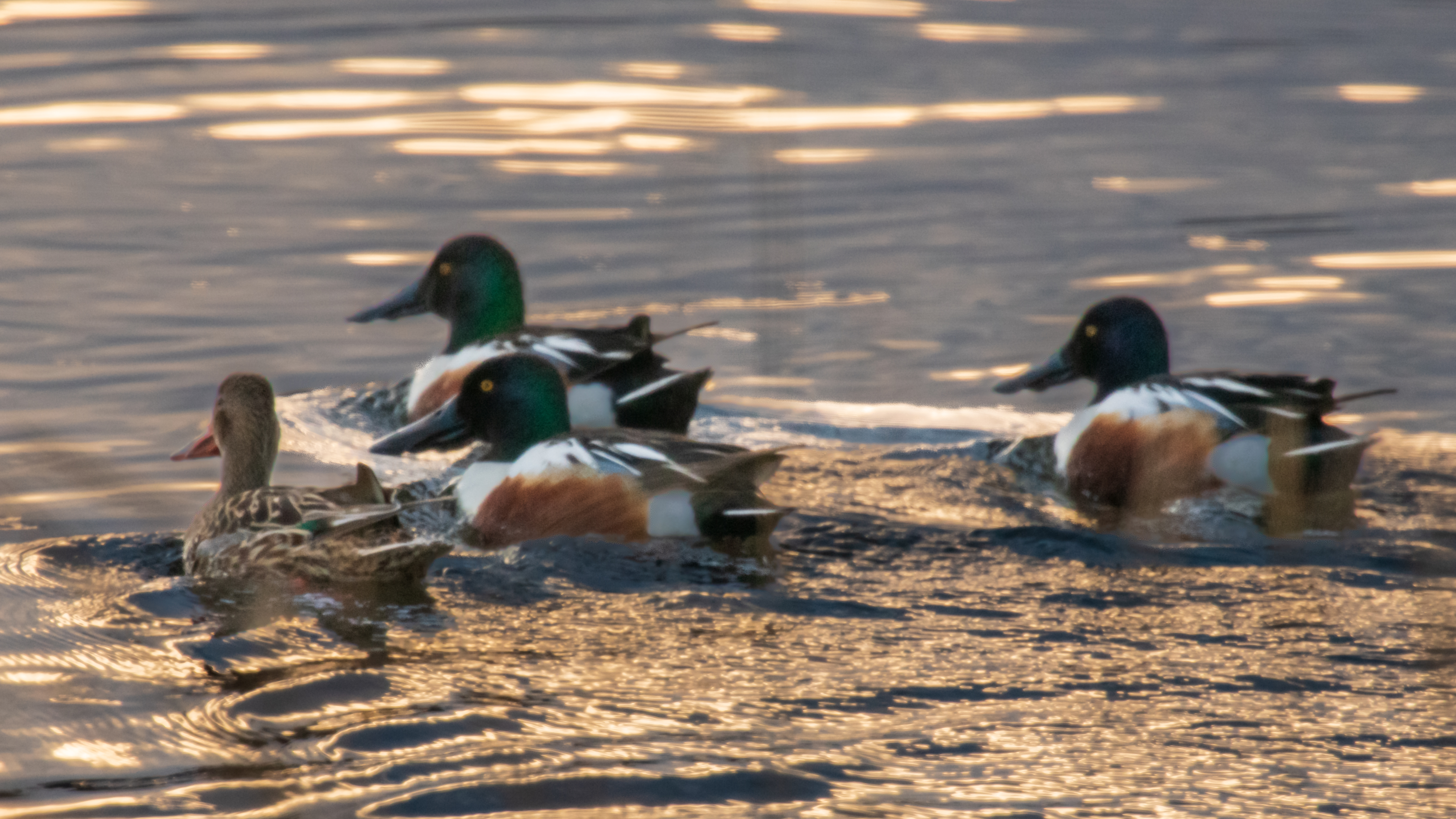
Drake (left) and hen Northern Shovelers, Chignik Lake, April 28, 2021.
Perhaps the most approachable of the Hanamizu’s waterfowl were the Northern Shovelers. Quiet as ducks go, they’d busily and rapidly swish their bills back and forth through stiller portions of the river, managing by means of their unique bills and a feeding strategy unlike the other ducks to avoid competition. As it turns out, their spatula-like bills are equipped with over 100 very fine, comb-like structures shovelers use to sift out small organisms. In both appearance and effect, these lamellae are similar to the baleen of certain species of whales. So, while shovelers are dabblers (non-diving ducks), they do more swishing and churning with their bills than tipping butt up as do teal and mallards.
In four years of living at Chignik Lake and looking at various species of ducks up and down the Chignik drainage, I’d never seen shovelers here. David Narver didn’t record them in his avian study of the Chigniks conducted in the early 1960’s, and a quick check of this species on the Cornell Lab of Ornithology’s All About Birds site indicated very few sightings on the Alaska Peninsula and none at all on the Gulf of Alaska side where Chignik Lake is located. So I was astounded to look at my window in the predawn of April 28 and see the unmistakable silhouettes of ducks sporting those bills. Three drakes and a hen, milling near shore along the beach where many of us park our skiffs and scows. I knew I had to make my pictures quickly. It wouldn’t be long before people headed down to the beach to launch their crafts, at which point the ducks would surely take flight and continue their migration across the peninsula.
Among ducks, Norther Shovelers are particularly known for lifelong monogamous pairings. (4/28/21)
The problem I was facing was that what little light there was shone from behind the birds. Given that encountering this species is at best a rare event on the Chignik, my best option was to turn up the ISO, keep the aperture as open as practical, and at the very least make some decent “record” or documentation pictures and deal with image noise and softness later. The pictures in this article are all from photos I took in the pre-dawn light that morning.
As I feared, just as the sun began peeking over the snow-capped mountains rimming the lake, a honda engine pierced the morning calm. As it drew closer, the quartet began hurriedly paddling for deeper water. Suddenly they broke, sent the water into a froth as they took wing, and were gone. (4/28/21)
The Lake is the kind of place where, at any given moment, an interested person might take a closer look and see a species of bird never before recorded here. But in what part of the world isn’t that true? Regrettably, I cannot remember the author’s name, but there is a very short piece of Japanese Zen poetry that reads,
Tend the garden any size
Those words might be paraphrased to read,
Make a study anywhere
It seems that the closer one looks – at anything – the more there is to see and to learn and to marvel at.
Northern Shoveler, Spatula clypeata Order: Anseriformes Family: Anatidae Spatula: Latin for spoon or spatula clypeata: Latin for shield bearing or shield
Status at Chignik Lake, 2016 to present: Rare or perhaps even accidental. Most likely to be encountered as a spring migrant. However, as shovelers are known to breed on the Alaska Peninsula, this is a species to be on the lookout for in any likely habitat, particularly at Black Lake at the head of the drainage.
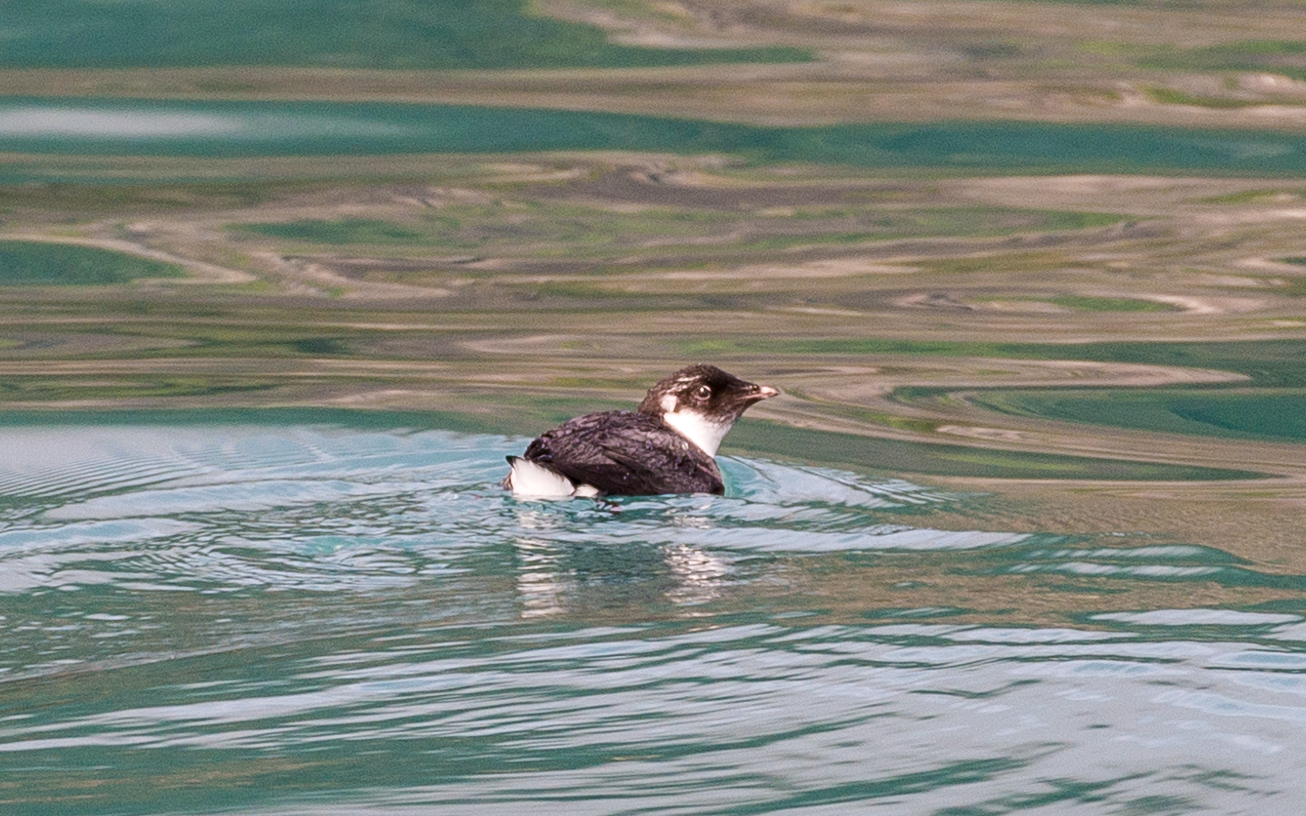
Kittlitz’s Murrelets are an uncommon, poorly studied species. Only a few nests have been located. They indicate solitary pairs (as opposed to colonial nesters) choosing sites above the tree line on the southern slopes of rugged mountains. Often the nests are located on scree fields associated with past or present glacial activity. The pair lays just one egg. The Kittlitz’s’ diet is not well known, but as bill size and shape generally indicate feeding preferences, it might be surmised that they pursue somewhat different prey than the closely related Marbled Murrelet, which has a larger, slightly curved bill.
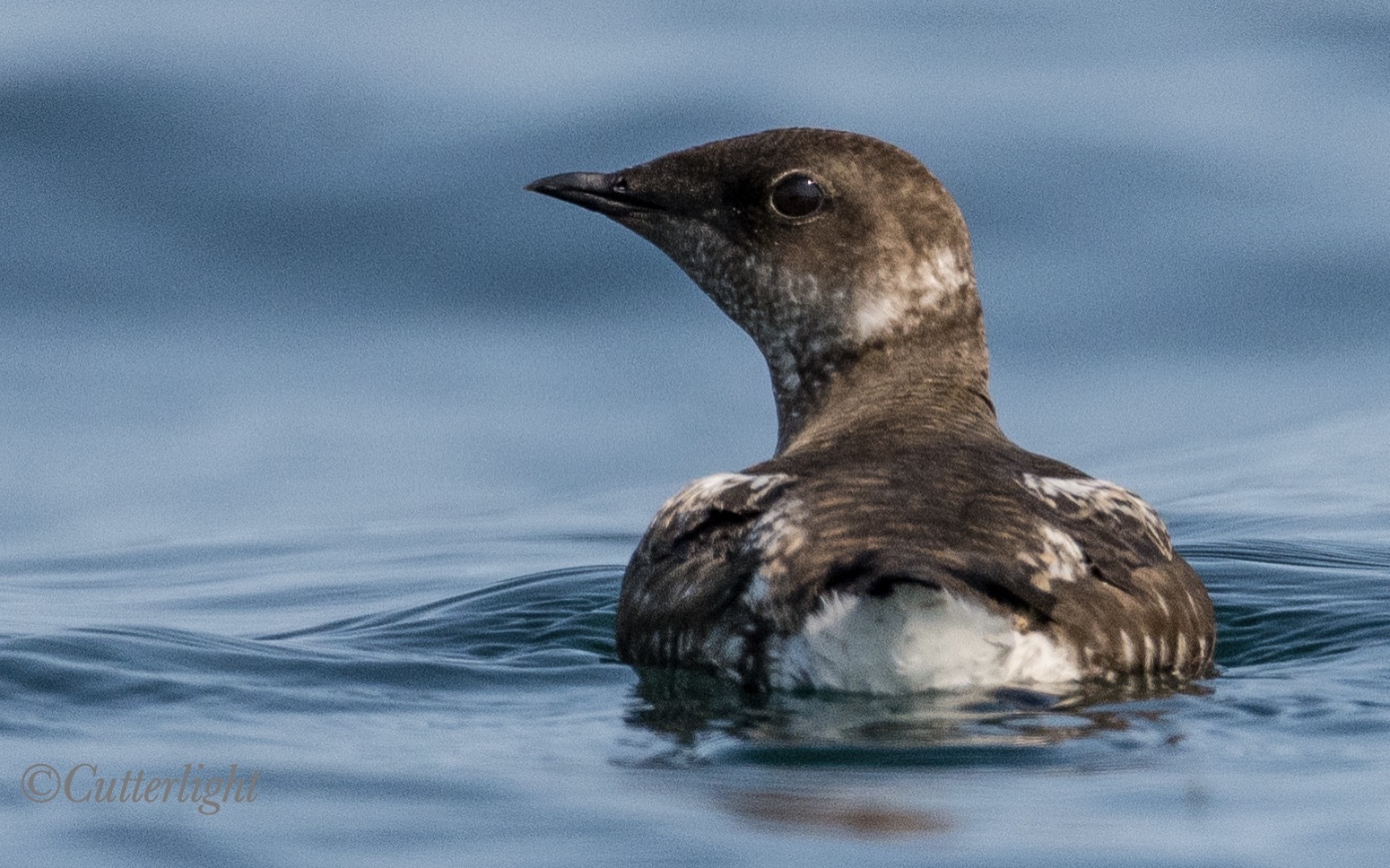
Although the specimen in the above photo doesn’t show it, in addition to a small bill Kittlitz’s Murrelets show golden-brown in their plumage during breeding season. Non-breeding birds tend toward mottled white and black much like their Marbled cousins, but in the Kittlitz’s the eye is surrounded by white whereas in the Marbled a black cap extends downward to cover the eye and the upper cheek. (See the photos in Marbled Murrelet – Seabird of Moss Nests and Old Growth Forests.)
This Kittlitz’s Murrelet shows a bit of golden-brown in its breeding plumage. Again, note the very small bill. Diving birds, they are known to prey on fish such as sand lances and herring as well as on crustaceans. (Photo U. S. Fish and Wildlife Services)
These are small birds, only about 9.5 inches from bill to tail. We will continue carefully checking the murrelets we encounter in Chignik Bay and Chignik Lagoon in hopes of getting a clear photograph. This is one of the rarest seabirds in North America. There aren’t many good photos of this species, and none at all that I could find of a Chignik bird. On the upside, our local coastal waters support abundant populations of both sand lances and herring which appear to be among the Kittlitz’s preferred dietary items, particularly during the nesting season. It is believed that about 14% of the Kittlitz’s population breeds on the Alaska Peninsula.
Due to this this species’ association with glaciers during breeding season, Kittlitz’s Murrelets appear to be particularly vulnerable to the impact of global warming trends.
Although rarely present in great numbers, Marbled and Kittzlet’s Murrelets can often be observed in the estuarial waters of Chignik Lagoon and along the rocky coast of Chignik Bay. (Chignik Bay, July 28, 2020)
Before I began this project, it never occurred to me that forest habitat might be critical to a seabird. Yet such is the case with the Marbled Murrelet. Although Russian explorers first identified this species in 1789, it’s nesting habits remained a mystery until 1974. Hoyt Foster, a tree-trimmer working high up on a Douglas Fir in California’s Big Basin Redwoods State Park noticed a ball of fluffy down in a mossy tree branch. He carefully wrapped the bird and took it to a biologist who identified it as a Marbled Murrelet chick.* Thus, a great mystery in avian biology was solved, and yet another very good reason was added to the growing list of reasons to preserve the remaining remnants of the West Coast’s old growth forests. Of particular importance to murrelets are those coastal forests growing within about 45 miles of rocky coastlines from northern California through southeastern Alaska.
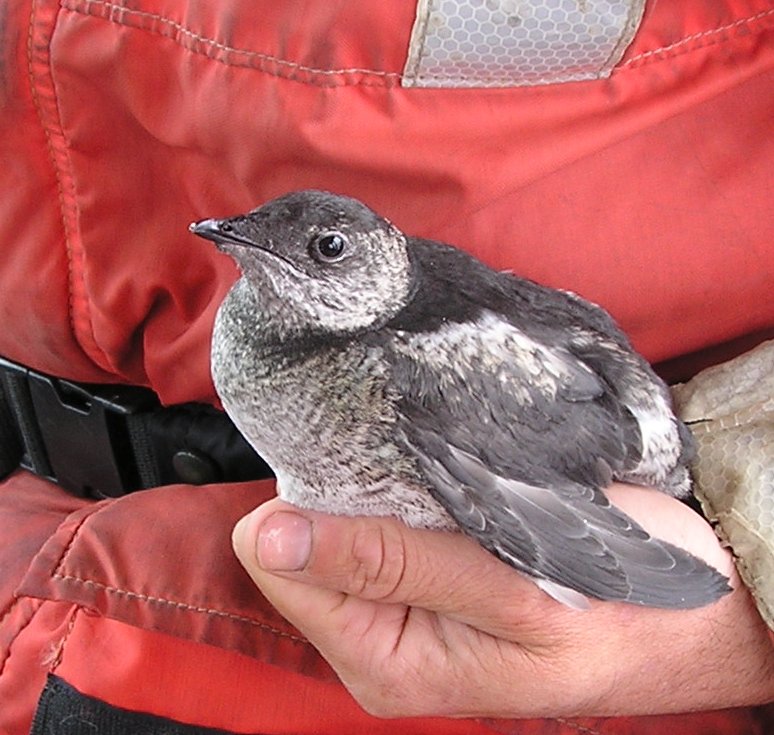
Marbled Murrelet, Kenai Fjords, Alaska. The light-colored bill makes me think this is a recently-fledged specimen. Fully grown, this species measures just under 10 inches on average – small as seabirds go. (July 22, 2012)
In addition to moss covered tree branches, a smaller number of Marbled Murrelets lay their solitary egg amidst rocks on talus slopes and among boulders. Either way, the nests are unadorned and inconspicuous. Both parents feed the chick, generally returning in twilight or darkness to avoid leading predators to the nest. Like other diving seabirds, their diet consists of fish and other small animals they might catch in nearshore ocean waters.
When you think of nesting Marbled Murrelets, think of ancient trees, early morning fog sifting through fir and redwood limbs covered in thick moss and a small, vulnerable seabird nestled into that moss, her body warming one tiny, downy being
Marbled Murrelet Brachyramphus marmoratus Order: Charadriiformes Family: Alcidae Genus: Brachyramphus – from Ancient Greek brakhús = short + rhámphos = beak
Species: marmoratus – Latin: overlain with marble
Status in Marine Waters near Chignik: Not abundant but frequently encountered in Chignik Bay and Chignik Lagoon; Infrequently encountered on Chignik Lake, particularly in Clarks River Bay
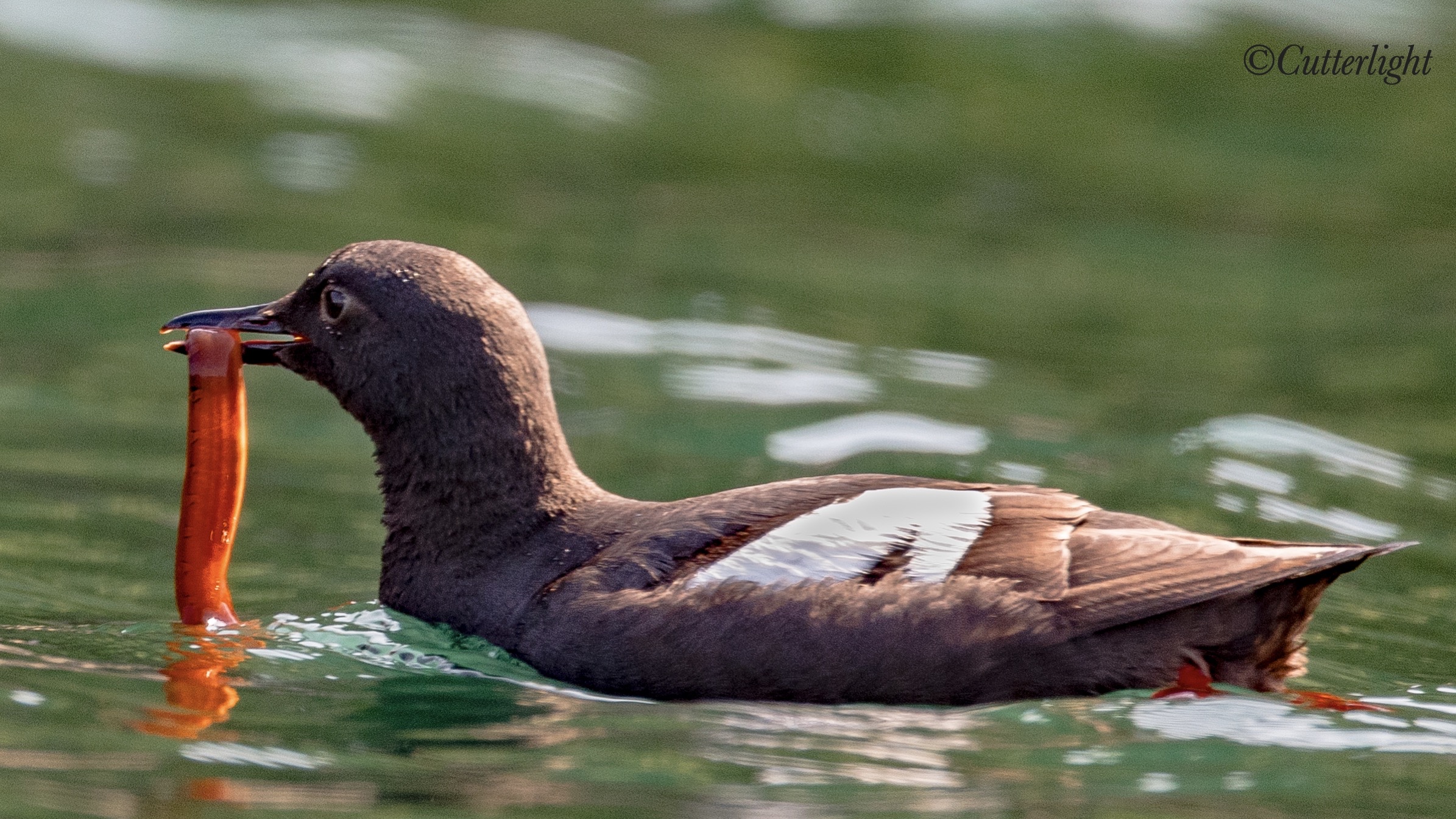
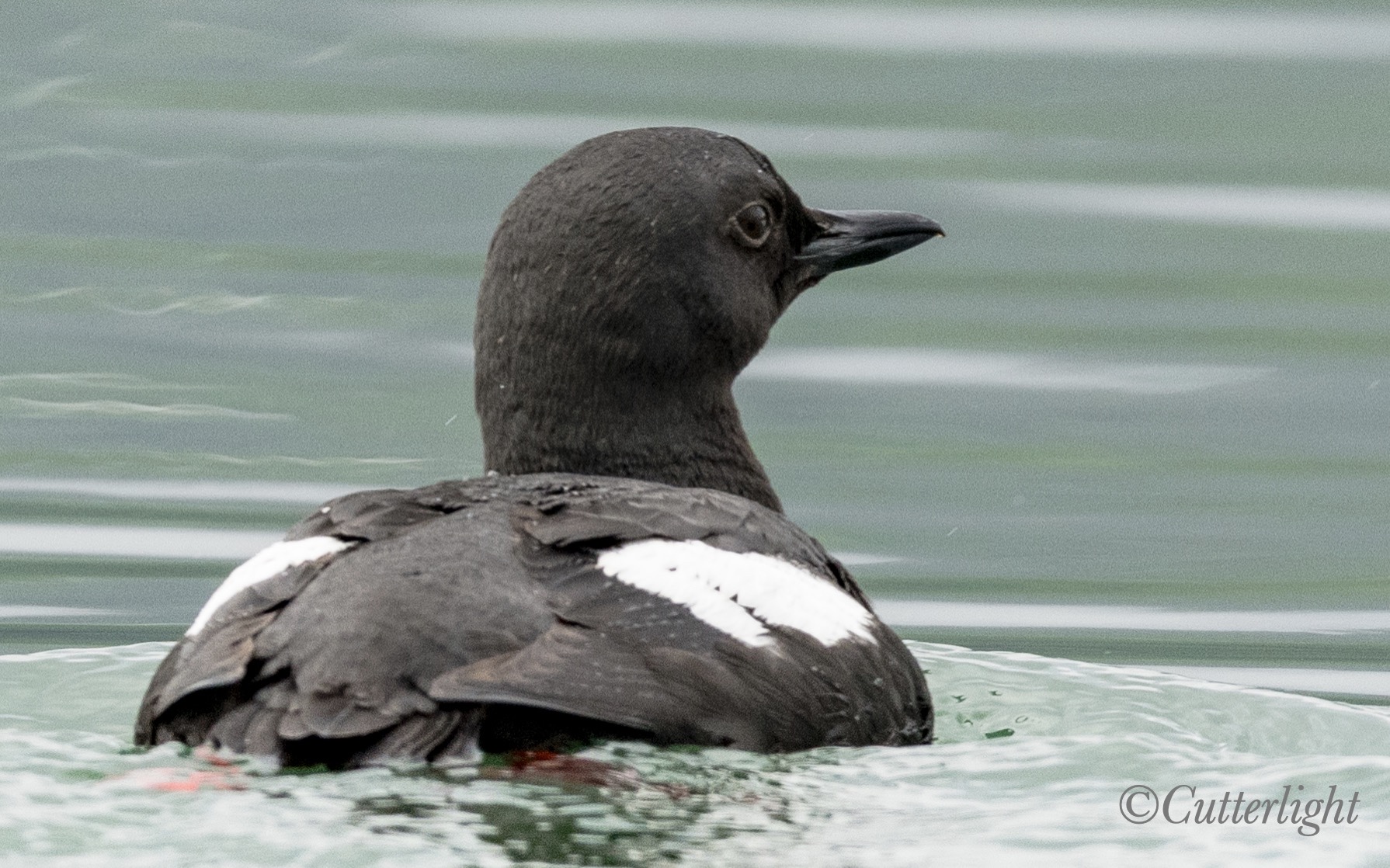
Although Pigeon Guillemots can dive at least 150 feet deep, they prefer to fish shallower waters, That puts them in the range of eel-grass-loving Crescent Gunnels such as this bright red specimen. Note the white wing patch and the coral-red legs. (Chignik Lagoon, July 28, 2020)
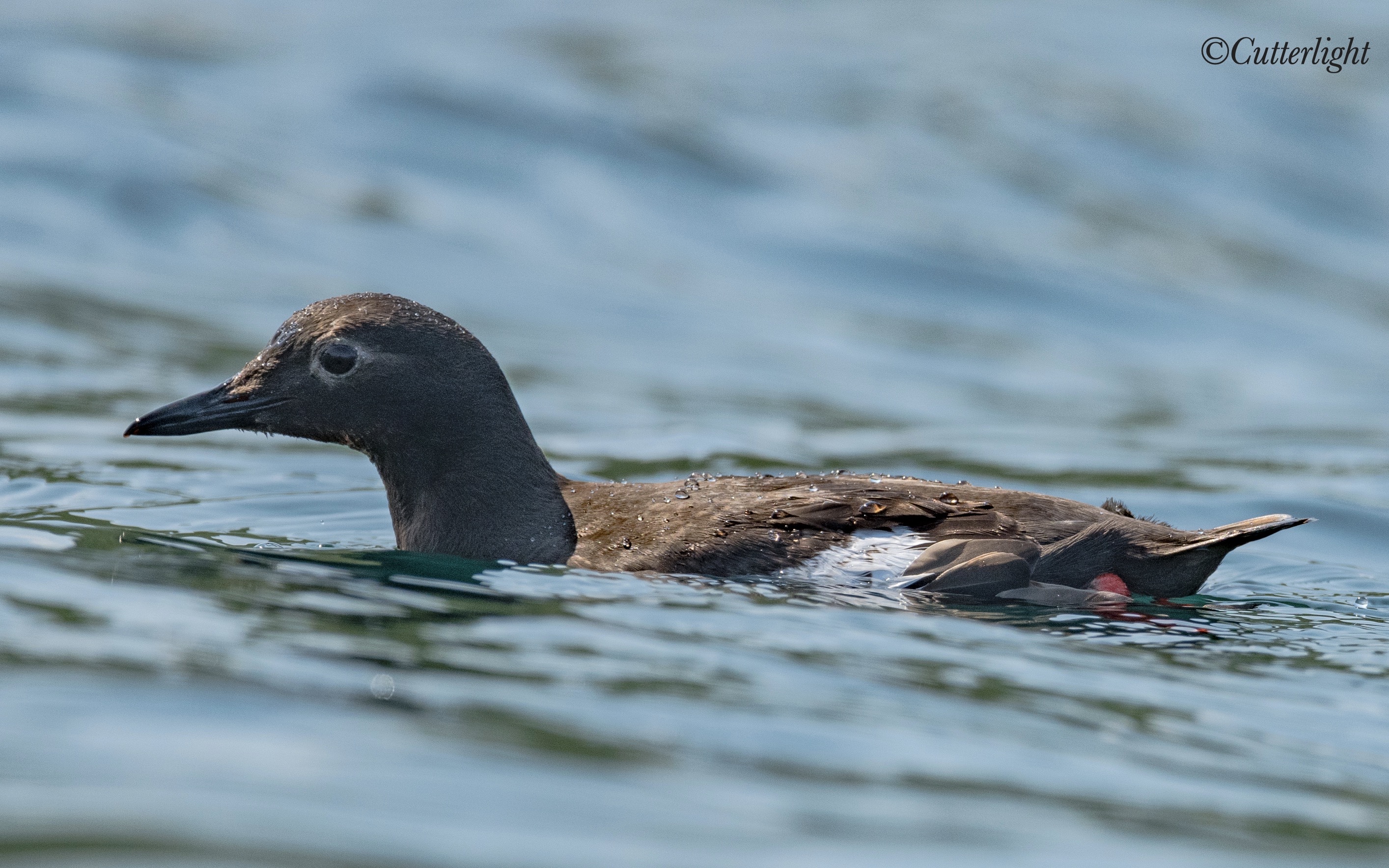
They aren’t the most abundant bird of the nearshore marine waters of the Alaska Gulf, but they are probably one of the most often encountered. Pigeon Guillemots do their best fishing in relatively shallow waters. Thus they are often seen from shorelines and docks as well as from small boats cruising coastal waters.
From a distance, Pigeon Guillemots often appear to be black, but they’re actually a variable chocolate brown. The plumage of breeding birds appears darker. Additionally, the insides of the bills of breeding birds is brilliant red. (Chignik Bay, July 28, 2020)
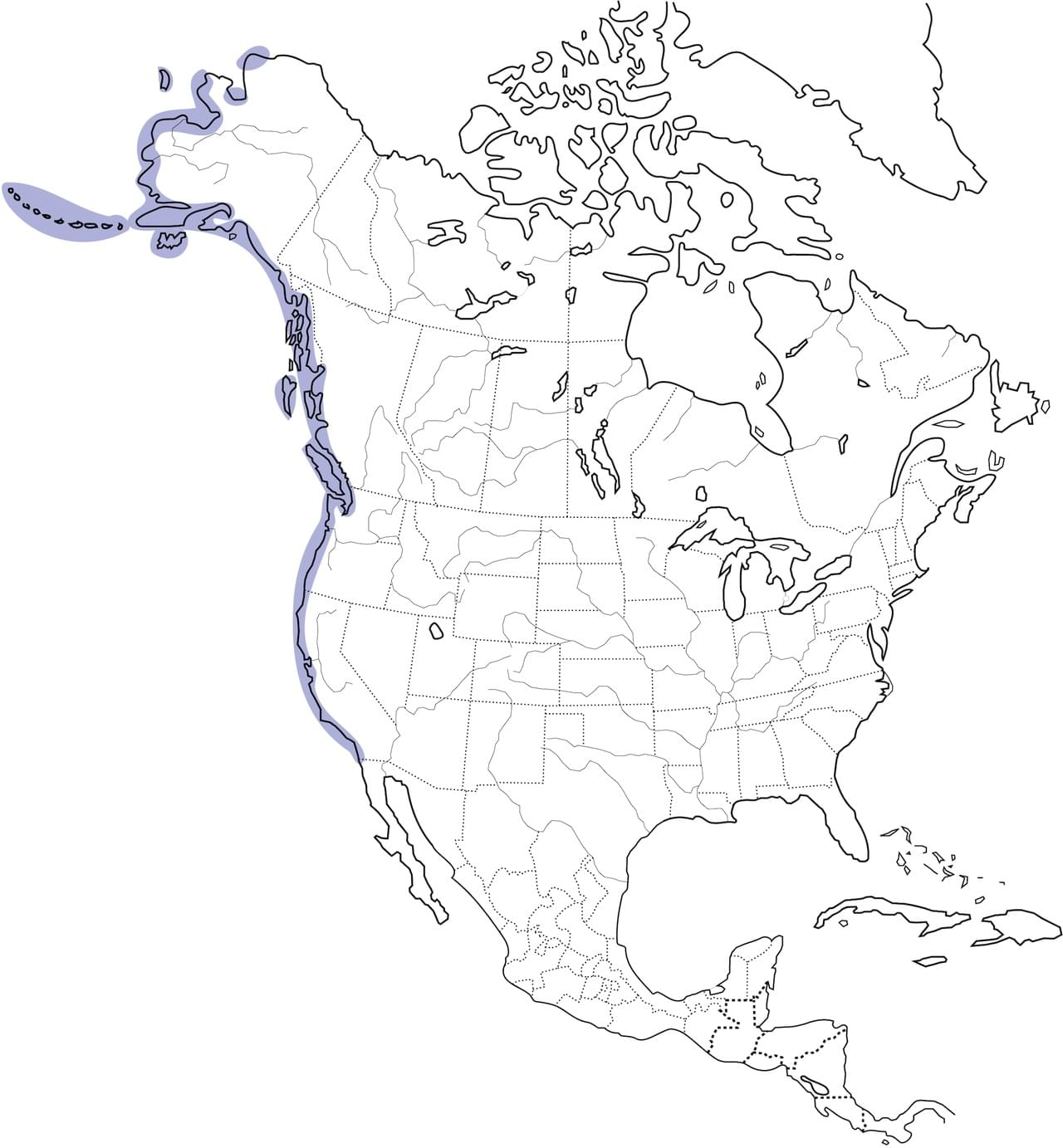
Members of the auk, murre and puffin family (alcidae), guillemots nest in rocky cliffs where they can hide one or two eggs in crevices, borrows or among boulders. Unlike most other alcids, they fly well and are able walkers on land. About 50% of the world’s Pigeon Guillemot population, estimated at around 235,000, breed in Alaska.
Along with puffins, murres and other seabirds, Pigeon Guillemots are known to nest on the Semidi Islands, located in the Alaska Gulf approximately 68 miles from Chignik Bay (the village of Chignik). Both parents incubate the eggs and feed the young, which scramble, fall or flutter to the sea a month or two after hatching. They young birds can swim and dive as soon as they’re in the water, but it will be another two or three weeks before they are proficient fliers.
Pigeon Guillemot Cepphus columba Order: Charadriiformes Family: Alcidae Genus: Cepphus – from Greek kepphos for a waterbird described by Aristotle
Species:columba – from Icelandic klumba = auk and Latin columba = pigeon
The barring on this murre’s flank indicates a Common Murre. Thick-billed Murres, a close relative, have unmarked flanks. Standing about 15 to 18 inches tall, these somewhat penguin-like birds are close relatives of the Great Auk, a bird that stood 30 to 33 inches tall and went extinct in the mid-1800s. (Photo Resurrection Bay, Alaska, July 2012)
I haven’t yet managed to get a good photo of Chignik Bay’s murres, though we see them from spring through fall on excursions out onto salt water. Chowiet Island, located about 68 miles from Chignik Bay, is a known breeding site for this species.
When not nesting, murres are birds of the open sea. In fact, one of the most astonishing wildlife scenes we’ve ever witnessed was on a day in late summer when we hiked out to the tip of the peninsula at Point Hope. Apparently our hike coincided with the end of the breeding season. We stood on the beach and watched in awe as thousands upon thousands of murres and other seabirds poured from nearby sea cliffs and streamed passed us toward the open sea where they would spend the coming winter months. Having brought along no cameras, we drank in the moment, doing our best to commit the image to memory.
At the tip of the Point Hope Peninsula 200 miles above the Arctic Circle, a birder can stand on the pebbled shoreline of the Chukchi Sea and watch murres, puffins, loons, ducks and other seabirds fly back and forth from nesting sites to feeding grounds throughout the nearly endless Arctic day. Flying from right to left, the birds in the photo are returning to nests, as evidenced by sand lances hanging from the bill of one of the puffins and one of the murres. You can bet that the rest of the flock have stomachs and gullets crammed full for waiting mates and youngsters! (August 20, 2012)
Unfortunately, the combination of a warming earth (and warming seas), oceans filling up with plastic and overfishing are taking their toll on murres. Although they remain abundant in most regions, numbers appear to be declining almost everywhere. The concern with any species that thrives as part of a crowd is that a threshold might be crossed after which numbers plummet drastically. We’ve seen this with avian species such as Eskimo Curlews and Passenger Pigeons as well as (I suspect) populations of salmon. Some species simply do better when there are lots of them.
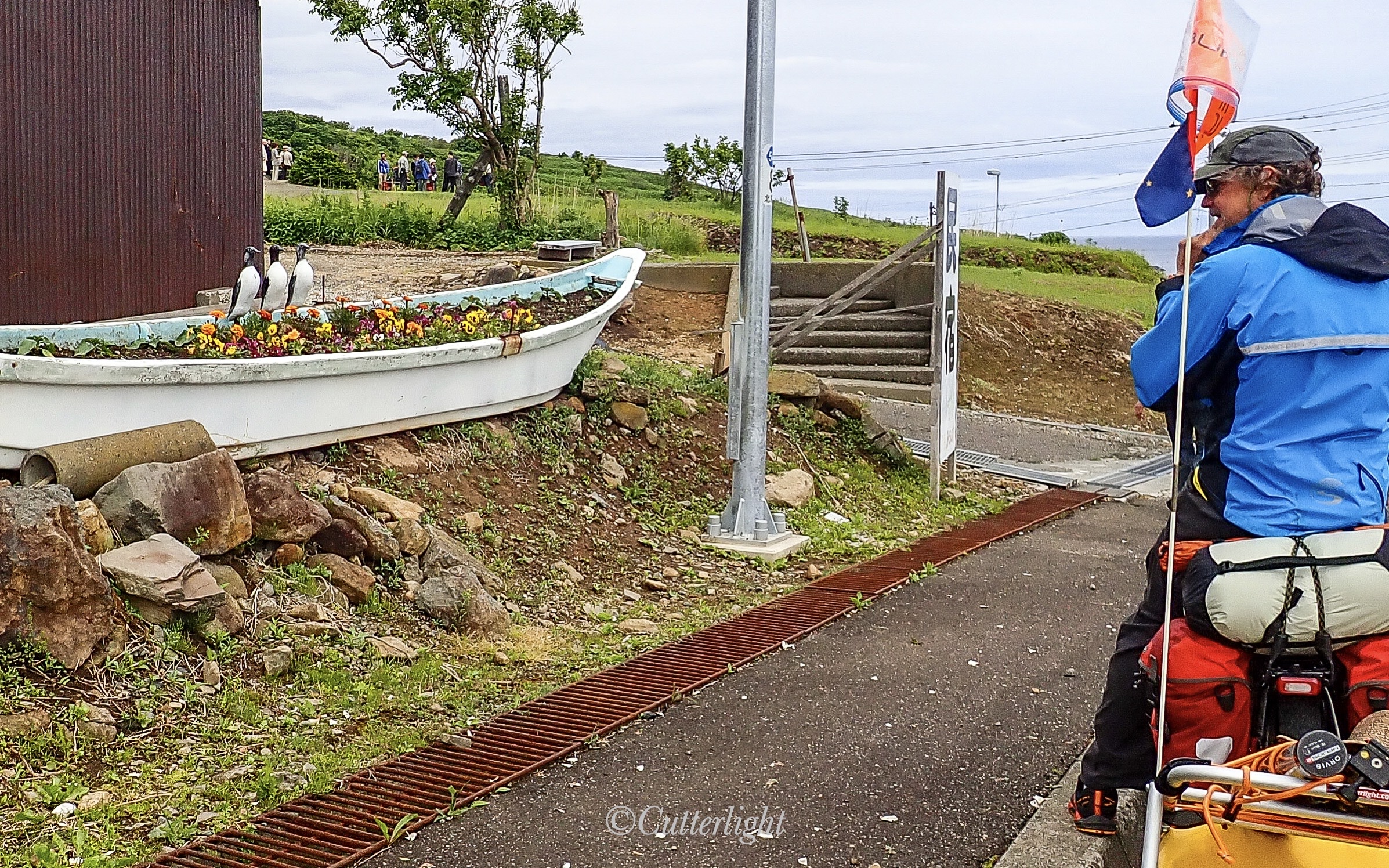
As recently as 1963, there were an estimated 8,000 Common Murres nesting on Teuri Island off the coast of Hokkaido, Japan. When we visited the island in 2018, there were only eight. For certain species, when numbers become too low predation overwhelms the individuals that remain. This appears to be the case with Teuri’s murres. The few remaining birds are no match for the island’s Slatey-backed Gulls and aggressive Large-billed Crows. At some point, restoration efforts become nearly futile. Teuri’s murres are celebrated in art and literature and in decorative memorials such as this skiff converted into a flower garden.
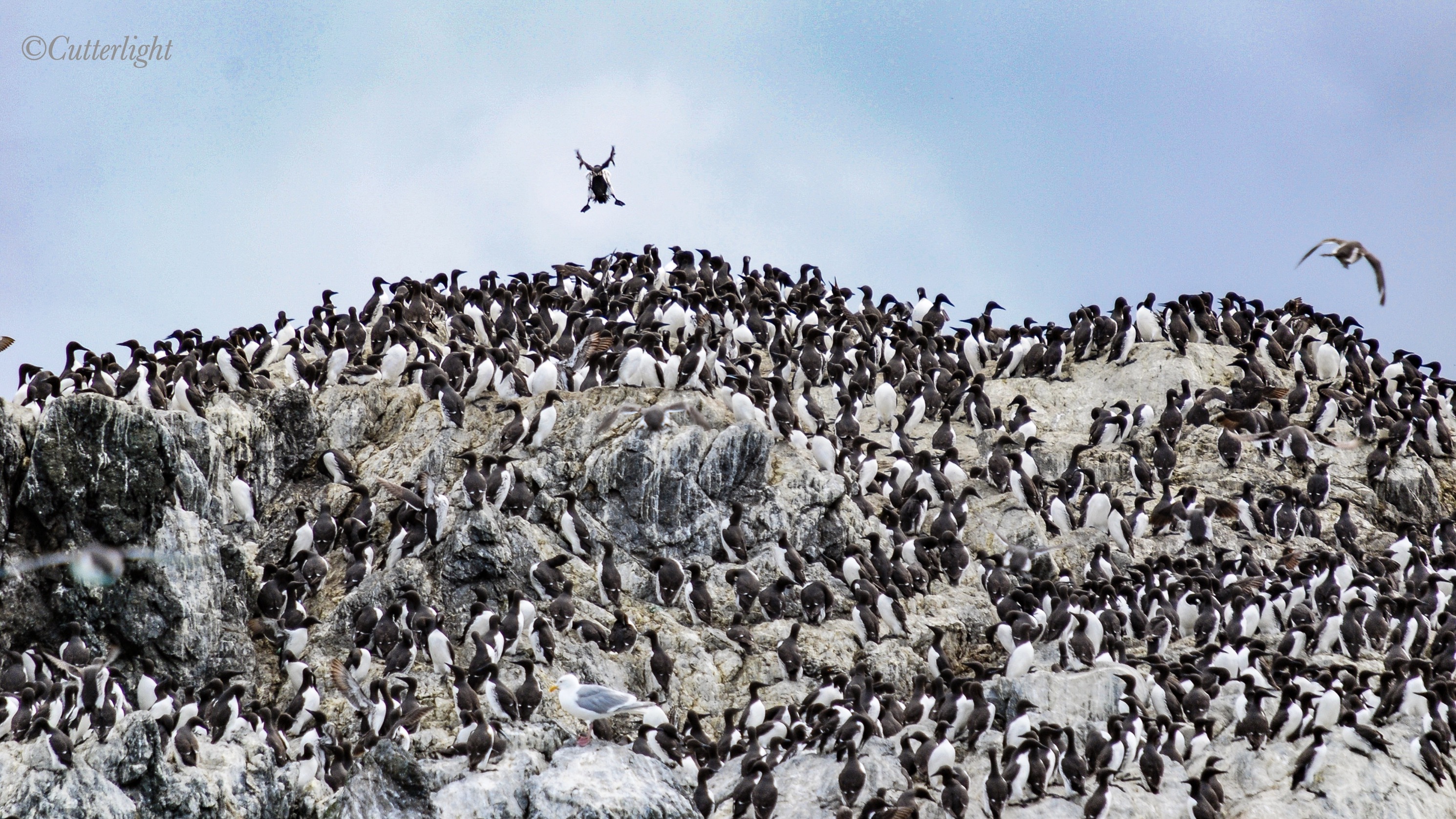
It truly is a joy to encounter a large colony of seabirds. These murres have crowded onto a sea stack near Homer, Alaska. (July 2009)
Although they remind one of penguins, murres are actually members of the auk family. Capable of diving to depths of 150 feet or slightly more, they pursue fish, squid and krill as they “fly” through the water. (Kenai Fjords, Alaska, July 2013)
I’m looking out the window at an icy Chignik Lake as I write this on a blustery day in January, but I’m anticipating a calm morning at sea this coming summer when Barbra and I might be able to get a halibut for the cooler along with some good photos of our local murres.
Common Murre Uria aalge Order: Charadriiformes Family: Alcidae Genus: Uria – from Greek ouriaa for a waterbird
Species:aalge – Danish aalge from Old Norse alka = auk




















 CutterLight