
Little One
2

We procured a backcountry permit at the park office, took a shuttle bus a ways into the park, debarked and backpacked into the landscape in this photo to spend a couple of nights. The only sign of people we came across was a plastic lens cap from a camera – something accidentally lost, not littered. Caribou and Dall Sheep, Wolf prints and Wolverine tracks… A Grizzly Bear caused us to change our course… Short-eared Owls cruising low, nesting Willow Ptarmigan hens – the males waking us at first light with their call of Potato! Potato! Potato. Tree Sparrows flushing from tiny ground nests where clutches of blue-green & brown eggs were crowded together. We came across Caribou antler sheds; a moose rack attached to a skull suggested a successful hunt by wolves. In 1846, Thoreau needed only to travel from Concord, Massachusetts to Maine’s Mt. Katahdin* to immerse in the vital contact with wilderness he sought. During the 2022-2023 season, 105,000 tourists traveled to Antarctica – up from just 5,000 only a few years prior… which was up from somewhere near zero not so long before that. Even Alaska’s remote, far-north rivers are typically floated by multiple parties each year. Not long ago I came across a recent piece of video depicting an unimproved campsite I overnighted at on youthful floats down my native Clarion River. The site was seldom used in those days, nearly pristine, and you could nice-sized large trout in the pool and the riffle water that flowed by. The contemporary video showed trampled vegetation, fire pit scars, bags of trash…
There are no doubt as many definitions of wilderness as there are human expectations of what might be present or absent in such a place. The one certainty is that wilderness is becoming more difficult to find, to immerse in, to discover and explore. My recollection of reading Thoreau’s account of his attempt to ascend Katahdin is that at some point the climb (or was it the descent?) was terrifying. Perhaps therein lies a piece of what wilderness means… a place cut off from civilization, where things could go wrong, and if they do, you’re on your own. There’s something liberating in it.

Between the two camps regarding testing new ideas at the beginning of each new year – the one camp advocating for trying new things, the other camp taking Eeyore’s “What’s the point?” position -, we are firmly in the camp advocating for trying out new things. I emphasize here trying out new things. We are not fans of New Year’s Resolutions. The very term, “resolution,” feels like a lead weight – leading to the even weightier prospect of “failure.”
Simply giving something a try – a gentle approach to change – is more suited to us. And so for the year 2024 I’ve begun (nearly) daily morning meditation. A few minutes of calm stillness, seated/kneeling on a low, cushioned wooden meditation bench, doing my best to empty my mind for a little while, sometimes allowing a selection of Mark Isham’s light orchestral arrangements to play in the background, other times keeping things as quiet as I can, is proving to be refreshing.
Additionally, we’ve both decided to go alcohol (and marijuana) free. It’s been about two months now. So far, so good. Surprising to both of us is that we haven’t missed the beers, wines and spirits that have often been integral to our gustatory and social lives. Of course, there is money to be saved by such a venture. And increasingly the scientific/medical consensus is recognizing that there is no health benefit to alcohol, that even modest consumption appears to be somewhat harmful. In good health but older now, having recently purchased a home (and imagining new art for this home), we’re mindful of both of those factors. But they weren’t the primary motivations behind this decision.
One of the happiest moments in our shared life these past few years occurred toward the very end of our bicycle trek in Hokkaido. We had just pushed up a long hill – a small mountain, actually – and then had the reward of the effortless sunshine summer day warm breeze on our faces coast down the other side.
In that moment, we were transported back to sheer joy of freedom total immersion in a moment childhood memories. Way leads to way. Thought to thought. We embraced and enjoyed experiencing wines and other drinks in that season. But all of that had become a distraction, on several levels. Time to experience something else. It has been an enjoyable two months… completely sober in every moment, and thus, at least for us, living more in the moment, a little closer to the quick of Now.
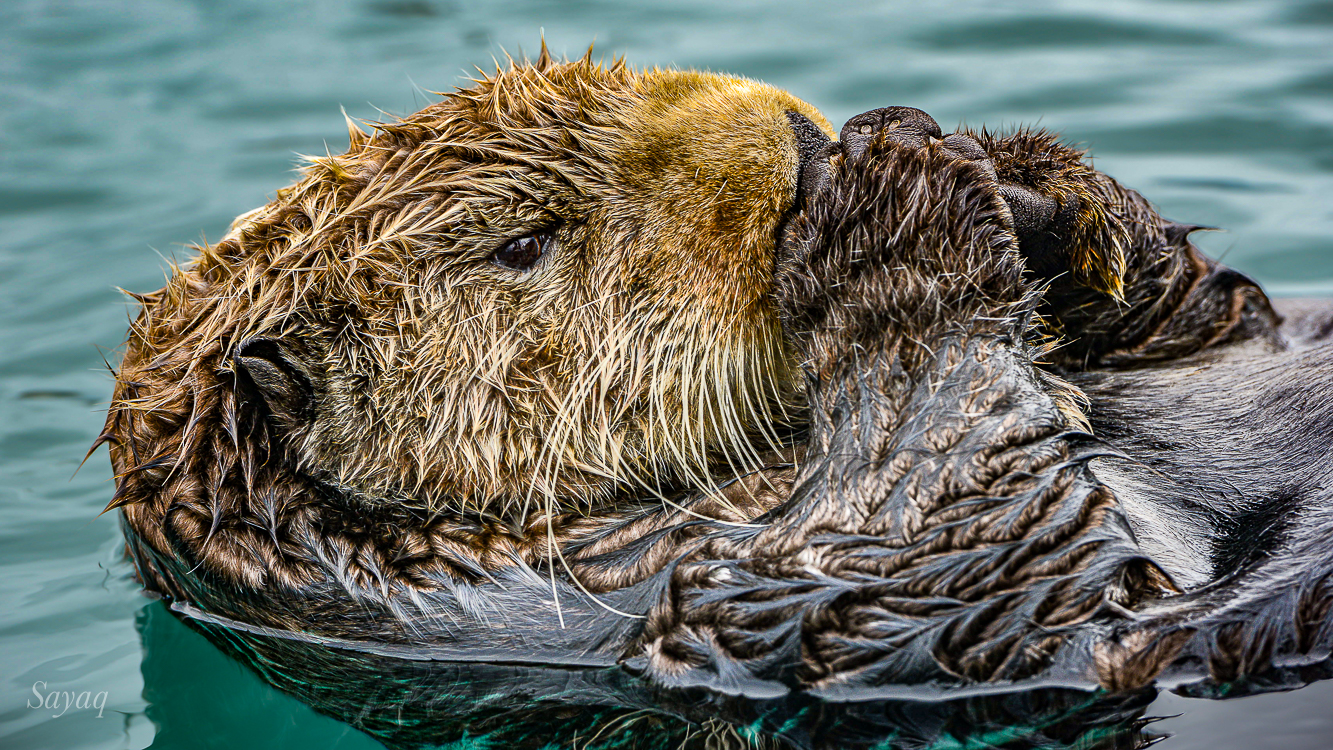

At first it seemed counterintuitive to process this picture captured on a blue sky spring afternoon as a monochrome image, but I like the moodiness. I don’t know… what do you think?

In late winter and early spring, our Inupiat friends in Point Hope began talking about “breaking trail” across the frozen Chukchi Sea so that snow machines (snow mobiles) and hondas (ATVs) could be driven out to leads (open lanes in the ice) in order to set up whaling camps. “Breaking trail?” Informed by our experiences with freshwater lakes, we wondered, “Can’t you just drive out across a smooth blanket of ice?”
Well, as we learned, a frozen sea isn’t like that. As ice forms and expands and is pushed around by winds and currents, sheets separate (creating leads) and later are pushed together again, the resulting pressure ridges can heave up massive jumbles of jigsaw ice. Some of the chunks are as large as a garage. This was all new to us the first time we hiked out to a camp. In the above photo our eyes are drawn to an otherworldly sphere and pyramid lit blue in pre-dawn light.

One hundred twenty-five miles north of the Arctic Circle, on this date there still remained four hours and three minutes of daylight in Point Hope’s sky. This late in the year the Chukchi Sea was blanketed in ice, the sun barely ascending above the horizon. From November 18 to 19, nine minutes and 52 seconds of daylight were lost. The following day, ten minutes were lost – an additional eight seconds. The next day, 10 more seconds of light disappeared. And so it continued, darkness gathering momentum toward December 6 when the sun vanished, leaving only a glow on the horizon. The sun remained down for 30 days until January 6 when it peeked above the frozen sea at 2:03 PM and remained barely visible for 19 minutes and 20 seconds.
I first encountered art in the style of Mark Rothko’s colorfield paintings (a painting by an art student at the local college) in my teens. Like many others, I was fascinated by the juxtaposition of colors. I would shoot this scene differently now… but will most likely never get the opportunity. Happy to have been there, seen it, and come away with this photograph despite its imperfections.

 CutterLight