
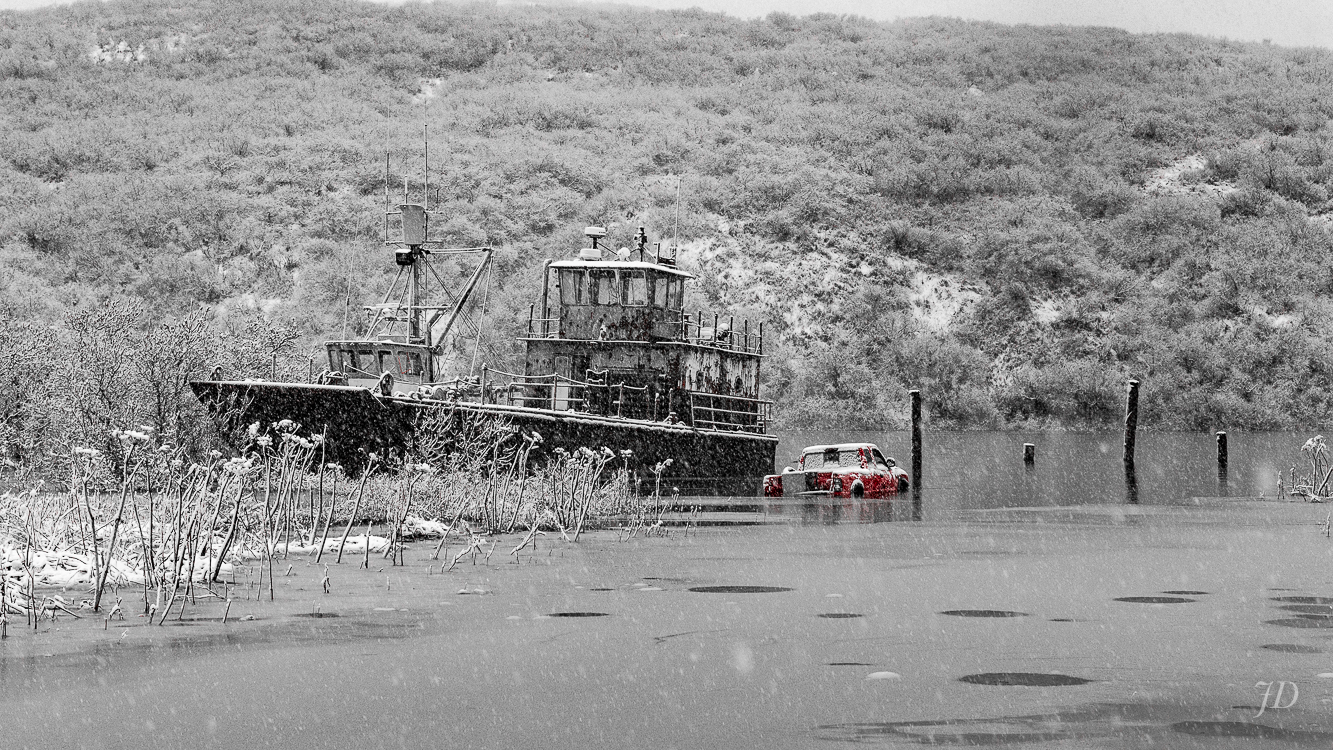
Chignik River, January 14, 2018
Located about four miles up from the salt estuary, this is the scene at the barge landing on the Chignik River during one of the big 11-foot tides that occur there when the gravitational pull of a full or new moon is at its peak. Upriver from here, the Chignik becomes unnavigable to large vessels, even at high-water. At low-water, this is a good place watch for bears, seals, otters and every so often moose. People have seen wolves here and, infrequently, lynx. This is where I once saw a nattily marked male Spotted Redshank, a bird that very rarely strays to North America from its native Asia and where on a different occasion a gyrfalcon swooped down and hovered just above me, as though to investigate. Occasional boat traffic notwithstanding, the landing is set in wilderness.
When the big tides roll up the river they bring salt scent and sea wrack, and even in the lake six miles and more up from the salt chuck the current pushes backwards and the receding water leaves behind eelgrass from the estuary. Depending on how you look at it, the landing is either the beginning or end of Chignik Lake’s lone road – three miles of dirt and gravel hugging steep hills as it winds above the river and then cuts through the village to connect the boat landing with the dirt airstrip. In fall, 10 and 11 foot tides are used to barge fuel up the river to the landing where it is loaded onto trucks that complete the short haul into the village. This is also how large equipment and building materials are brought into Chignik Lake which is otherwise accessible only by small plane.
You gotta watch where you park. These big tides come up awfully fast and will snatch a carelessly beached skiff in a blink – as just about all of us have learned through experience at one time or another. I would imagine the wheel bearings on the truck in this photo are pretty much shot… among other things.
 CutterLight