Fuel Oil Drums at The Pad

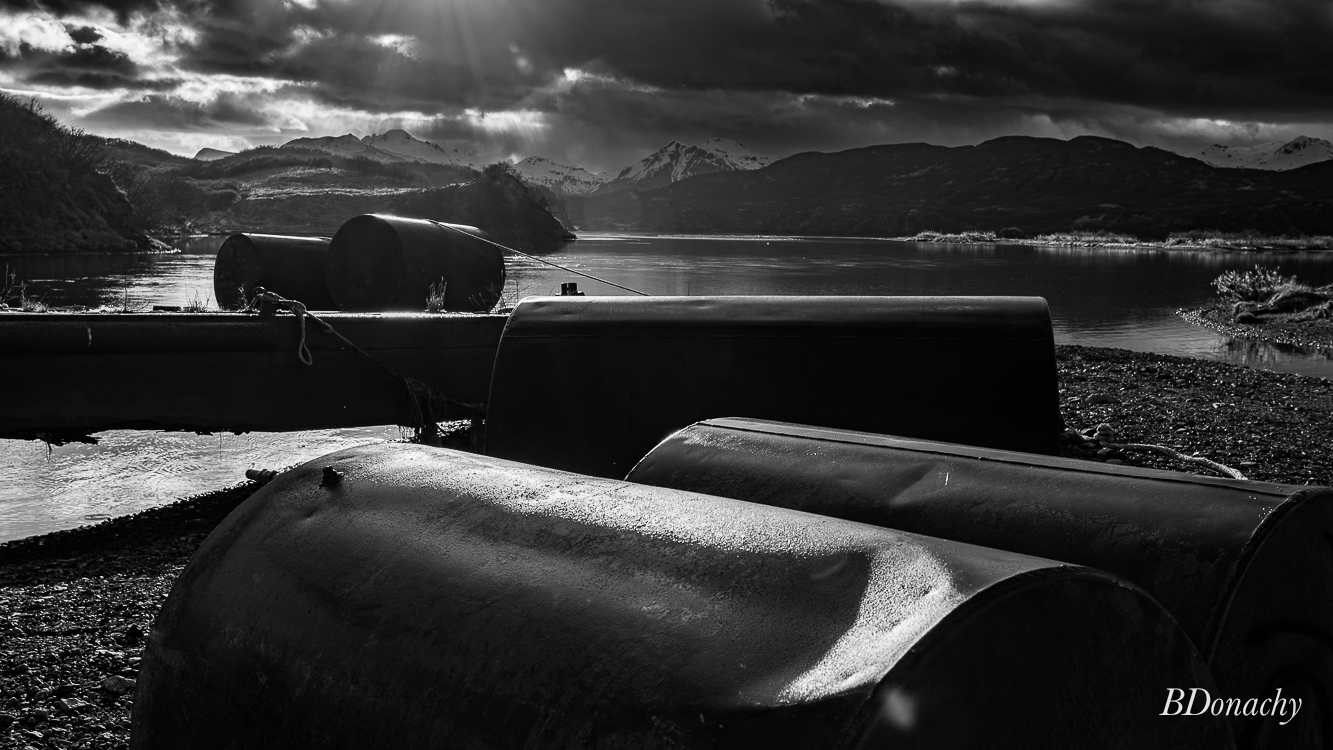
Fuel Oil Drums at The Pad
Chignik River Barge Landing, May 16, 2019

Barbra has an eye for moody images such as this early morning landscape of diesel oil drums at the barge landing on Chignik River. The scene is the terminus of the three-mile road that travels from the airstrip, winds through the village of Chignik Lake (population 50 something), and then follows the river along steep hillsides till it ends here at the landing. These drums are barged to this point, about six miles upriver from the salt water lagoon, on high tides of about 10 feet or more. On lesser tides, the river is too shallow for the barges to run. From here, the fuel is loaded onto a truck and carried to the diesel generators that provide the village’s electricity. Gasoline, too, along with any sort of large stuff such as vehicles and building material is brought into the village in this fashion.

Such are some of the logistical consideration in a wilderness village.

Ol’ Half-a-Horn

Ol’ Half-a-Horn

I almost wasn’t going to show this photo. Despite my nicknaming him Ol’, he’s probably a fully mature but young bull – perhaps in his fourth year. He’s missing his right paddle, and the remaining antler isn’t impressive. In fact, since to be legally taken during Alaska’s moose hunting season the tip to tip, antler to antler spread has to span at least 50 inches (127 cm), he probably wouldn’t have passed muster. So, no Boone and Crockett award here.

But this is easily the closest I’ve ever been to a moose, and when he suddenly emerged -seemingly to simply materialize from a thick tangle of willows, alders and salmonberries, he took our breath away. I had mere seconds to set up and make the shot has he strolled by, appearing unconcerned, barely glancing our way – our own hearts meanwhile racing like mad. Even a young bull such as this weighs close to half-a-ton and although the big ungulates are generally peaceful, mind-your-own-business types, each year here in Alaska more people are injured by moose than by bears. In fact, an Alaska man was stomped to death by a cow protecting her calf less than two weeks ago. So anytime one finds oneself this close to an animal of this size, the thrill involves wildly mixed feelings.

As I mentioned, the moment lasted mere seconds. And then, more miraculously than its sudden appearance, this fellow simply vanished. There was no departing view of dark rump disappearing into the vegetation, no hint of willows and alders shaking as he brushed by them. He crossed before us, I made 12 quick captures, the last of which featuring mainly an eyeball, part of the rack, an ear and his nape… and then he was gone, swallowed without a sound into a thicket of alders. Had we not been exactly where we were during those few seconds, we would never have guessed a moose was nearby.

Chignik Lake, October 4, 2018 – JD

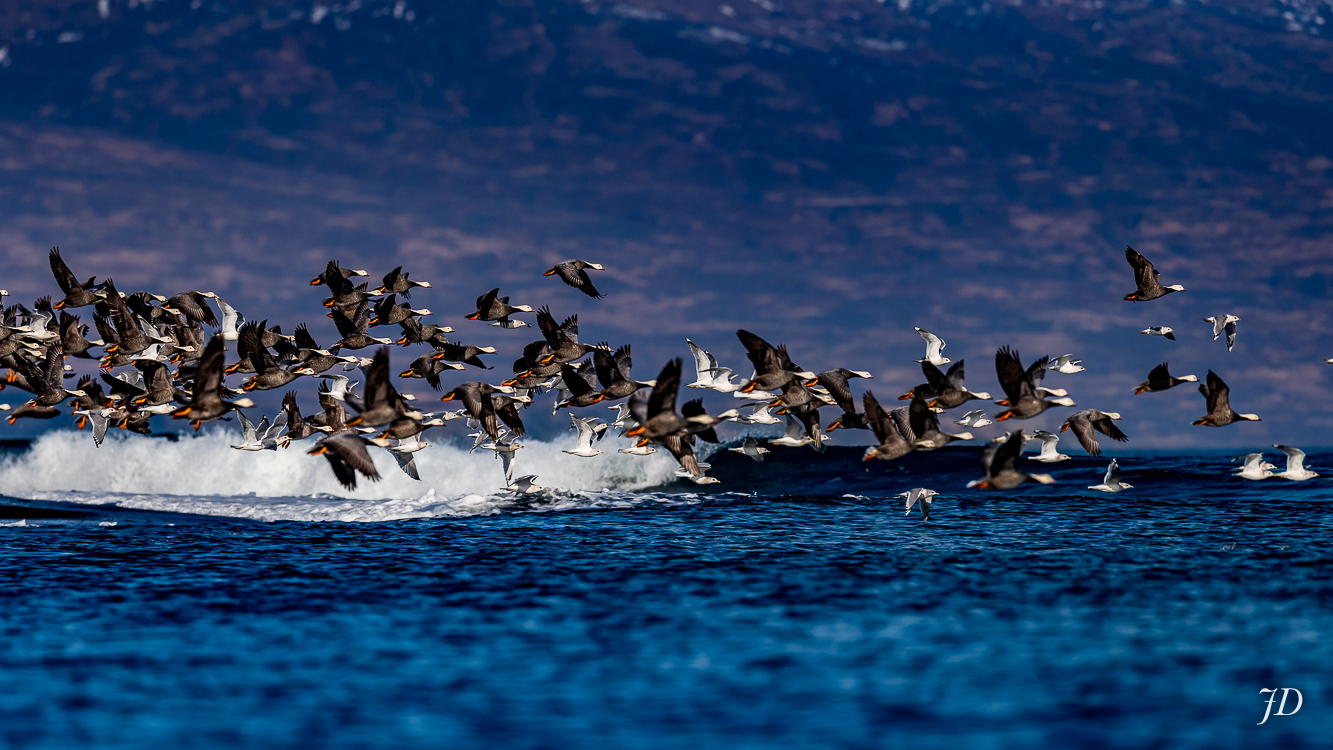
Painted Geese over Breaking Surf

Painted Geese over Breaking Surf
Emperor Geese, Chignik Lagoon, March 9, 2019

With the bright white head and nape reminiscent of the ermine capes European Royals of yore garbed themselves in, Emperor Geese (Anser canagicus) present a striking visage. But to catch a glimpse of these smallish, colorful, somewhat rare birds you have to go to coastal Western Alaska or Eastern Russia. A few dozen sometimes stop over at the sand spit at the mouth of Chignik Lagoon on the Alaska Peninsula. That’s where we found this flock, a few Glaucous-winged Gulls mixed in.

JD

Spring Rain

Spring Rain
Chignik Lake, Alaska Peninsula, May 7, 2019

Happy Friday everyone. Barbra and I hope you have an enjoyable Memorial Day Weekend. And take a moment to remember with gratitude…

JD

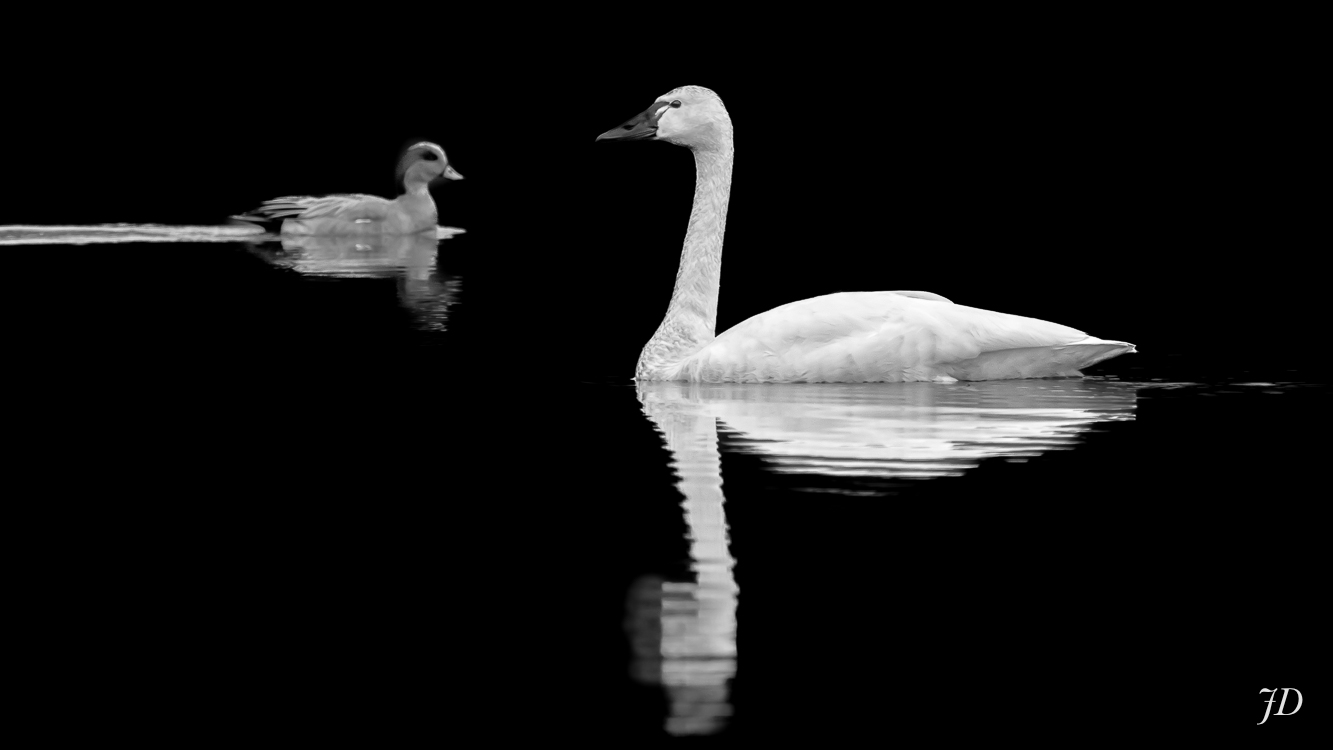
Tundra Swan with American Wigeon at Broad Pool

Tundra Swan with American Wigeon at Broad Pool
Broad Pool on Chignik River, Alaska Peninsula, May 4, 2019

The best place to look for returning Tundra Swans (Cygnus columbians) on the Chignik is at Broad Pool, about a mile downriver from the village. One evening the swans announce their arrival with far off, lonesome-sounding notes and by morning they’ve settled at the pool. There the slow-moving, weedy water provides food for the swans as well as for migrating dabbling ducks such as Mallards, Green-winged Teal, Northern Pintails and American Wigeons. Diving ducks, mostly Common Goldeneyes, Buffleheads, Greater Scaup and both Common and Red-breasted Mergansers are also likely to be present. At this time, the banks are covered in scraggly, winter-brown grasses, sedges, willows and alders and there may still by ice along the river’s edge. By the end of the month the ice is gone and the swans and most of the ducks will have dispersed to nesting areas further up the drainage, but at least one pair of Mallards and another of wigeons usually stay to nest along along the margins of Broad Pool. They are often joined there by a brood or two of Black Scoters.

Elegant Redpoll

Elegant Redpoll (Acanthis flammea)
Chignik Lake, Alaska Peninsula, April 25, 2019

Although peninsula checklists list redpolls as uncommon or rare, during our years at Chignik Lake they proved to be common, at times hanging around the village in flocks of dozens. The above bird is a male in brilliant breeding plumage. Although I photographed him in spruce trees and the original forest green background is pleasing, I like the way the black makes the red pop and brings out his eye.

Spring Portrait of Love

Mated pairs of Sandhill Cranes begin appearing on the Alaska Peninsula in late April, their loud calls trumpeting the arrival of spring. They depart in late summer or early fall. If they’ve been successful, a nearly full-grown offspring accompanies them on their journey back south. Note the heart-shaped red crown – a distinction that along with the fidelity mated adults show each other makes cranes a symbol of love in many cultures. Chignik Lake, May 4, 2019

The Redpoll X

The Redpoll X
Xanthochromic Redpoll, Chignik Lake on the Alaska Peninsula, April 25, 2019
Xanthochromism refers to yellowish pigmentation occuring where it is otherwise unexpected.

The bird in the above photo is a female Common Redpoll, Acanthis flammea. The eponymous poll – the colorful head cap – is typically bright red. Here the cap is yellow. This is a rare mutation which has been reported in other finches (Northern Cardinals, House Finches and others) as well as a variety of other animals. Whether the same individual or perhaps additional birds, we encountered xanthochromic redpolls in multiple years at The Lake.

Good Morning

Good Morning
Alaska Peninsula Brown Bear, Ursus arctos gyas. Chignik Lake, October 3, 2018

Alaska Peninsula Brown Bears share the same genus and specific name as Grizzly Bears of interior Alaska, Canada and the Lower 48: Ursus arctos. They differ only in the subspecific name: gyas in the case of these Peninsula Brown Bears; horribilis for Grizzlies.

I present this image here at a 16:9 ratio because that works well on most screens. But when I print it to show, I will print it as a square and ask that it be hung at eye-level, as a kind of mirror. There is more going on behind those eyes than where the next meal is coming from.

And yes. My heart was pounding wildly to find myself suddenly this close…

Kingfisher

Female Belted Kingfisher
Chignik Lake, Alaska Peninsula, October 4, 2018

All Belted Kingfishers sport a broad band of stormy-sea blue across their upper chest. But females possess a second, rust-colored band further down. Both male and female immature specimens, such as the bird in the above photo, can be especially colorful, with rusty-orange mixed in with the upper blue belt and appearing more extensively across the belly and chest. They’re about the size of an American Robin, but bulkier. Their ratchety, rattling calls, which never fail to lift our hearts when we’re on the water, are often the first thing that gives away their presence.