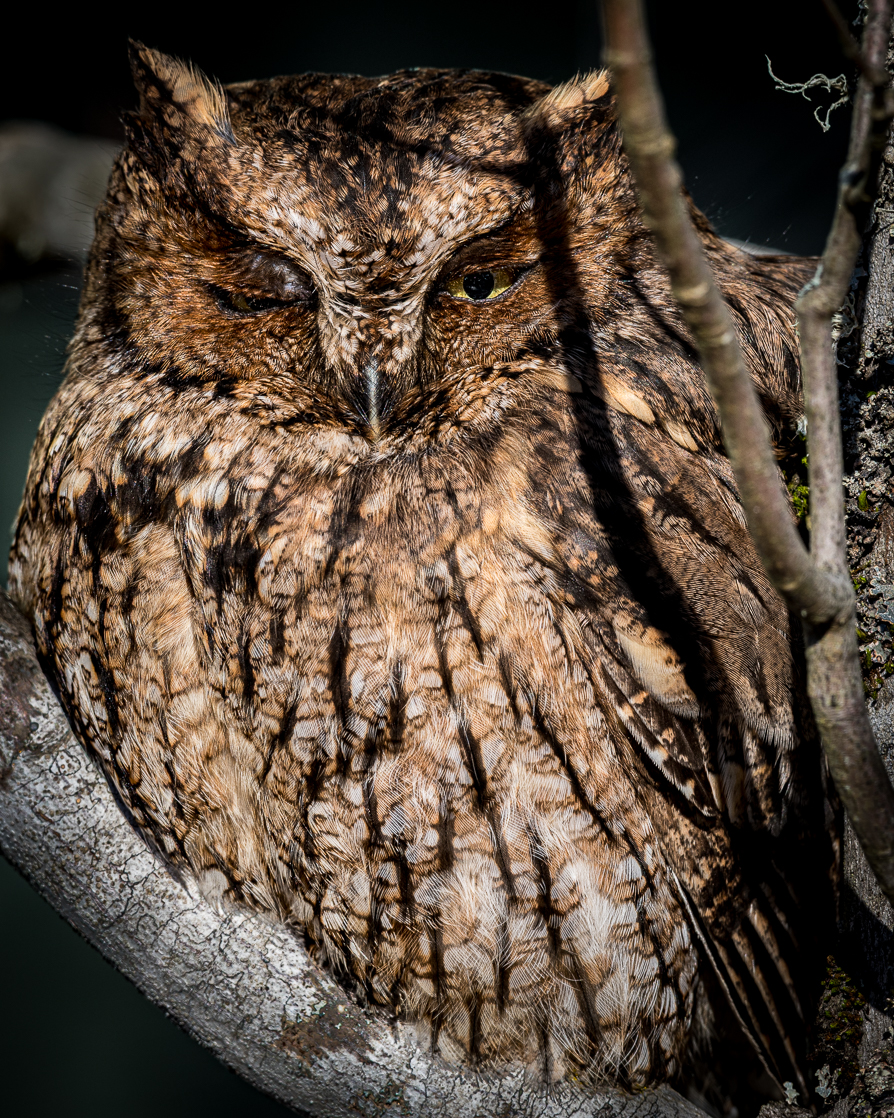
I’ve heard them a few times. In fact, we had one Tu Tu Tuu-ing outside our bedroom window in dark pre-dawn hours last fall. But until yesterday I’d never actually seen a Western Screech Owl before. This one had chosen a perch right outside the entrance to the elementary school here in Cordova, thereby acquiring instant celebrity status. Like most owls in daytime, he mostly slept, now and then barely opening his eyes for a sleepy look at the goings on near his perch.
Do you ever see owls where you live? What kinds?
Thanks for stopping by.Your likes and comments help other readers find these articles.
Watchful Dad Great Horned Owl adult and offspring in Sitka Spruce, Chignik Lake, Alaska Peninsula, June 20, 2020
I’d always wanted to live where owls were my neighbors.
It was widely known that the village had owls. In fact, the village had always had owls. David Narver reported their presence in his study of the Chignik River Drainage in the early 1960’s. But no one knew, precisely, where the owls nested and roosted. I managed to unravel the mystery once and for all during our first winter at The Lake. After that, Barbra and I could fairly reliably locate at least one of our two resident owls on any given day.
But that didn’t make photographing them much easier. During daylight hours, the owls typically secreted themselves in the very thickest parts of an exceptionally healthy and dense copse of Sitka Spruce trees. Many times, only a hint of the large birds was visible – a patch of breast feathers, a vigilant eye, an alert ear tuft. In addition to the challenges presented by the dense spruce boughs, the copse of trees was situated in a hollow where the light was almost never what a photographer might call “good.” Not only did the owls bury themselves in the boughs of those trees, their favored roosts were fairly high up. And although I am fairly certain that I knew more or less exactly where the nest was, I was never able to put my eyes on it.
For awhile, I contemplated a variety of strategies to facilitate photographing the owls, but all of them involved bothering them in one fashion or another. I didn’t think I’d permanently spook them out of the grove, but I didn’t want to press them. Making a living in the wilderness by talon, hooked bill, eye and wit is tough enough without some human invading one’s personal space. Biologists (generally) no longer shoot specimens in order to “study” them, but I have to wonder about the merit of constant nest-watching and other practices involving invasive viewing of wildlife that are now in vogue.
And so although I regularly checked on our owls (they were along the way to one of our favorite fishing spots), I did my best not to disturb them. Every once in a while, they presented themselves, and when those times coincided with my having my camera along, I did my best to record an image.
Blakiston’s Fish Owl Shiretoko Peninsula, Hokkaido, Japan, July 23, 2018
With a wingspan ranging from about 5′ 10″ to 6′ 3″ (170 – 190 cm), Blakiston’s Fish Owls are generally regarded as the world’s largest living species of owl. The photograph above is of one of a known wild pair which have been banded. The owls regularly visit a small stream where a pool has been created with natural rocks and is regularly stocked with Cherry Trout (sakuramasu, O. masau). A small inn with windows overlooking the pool provides guests with opportunities for a glimpse of this rare species which may visit the pool at any time during the night. The indigenous people of Hokkaido, the Ainu, regarded these great owls as spiritual protectors of their villages.
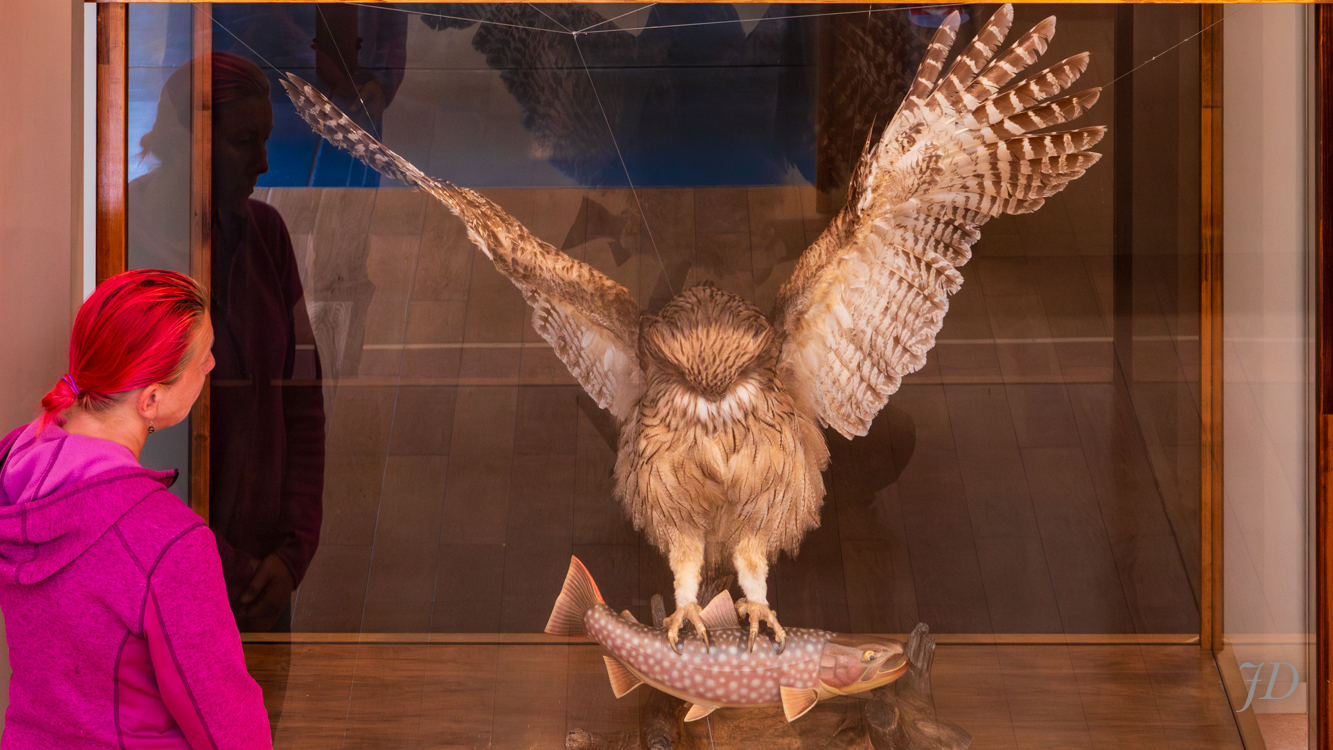
For context, Barbra with this taxidermy specimen grasping a White-spotted Char (Rain Char). Blakiston’s Fish Owl is a type of Eagle Owl and therefore related to the familiar Great Horned Owl of North America. The Great Horned Owl has a wingspan of approximately four feet, two feet less than the Blakiston’s span of around six feet.



 CutterLight