Those Crickety Chirps Mean It’s Fall on the Chignik

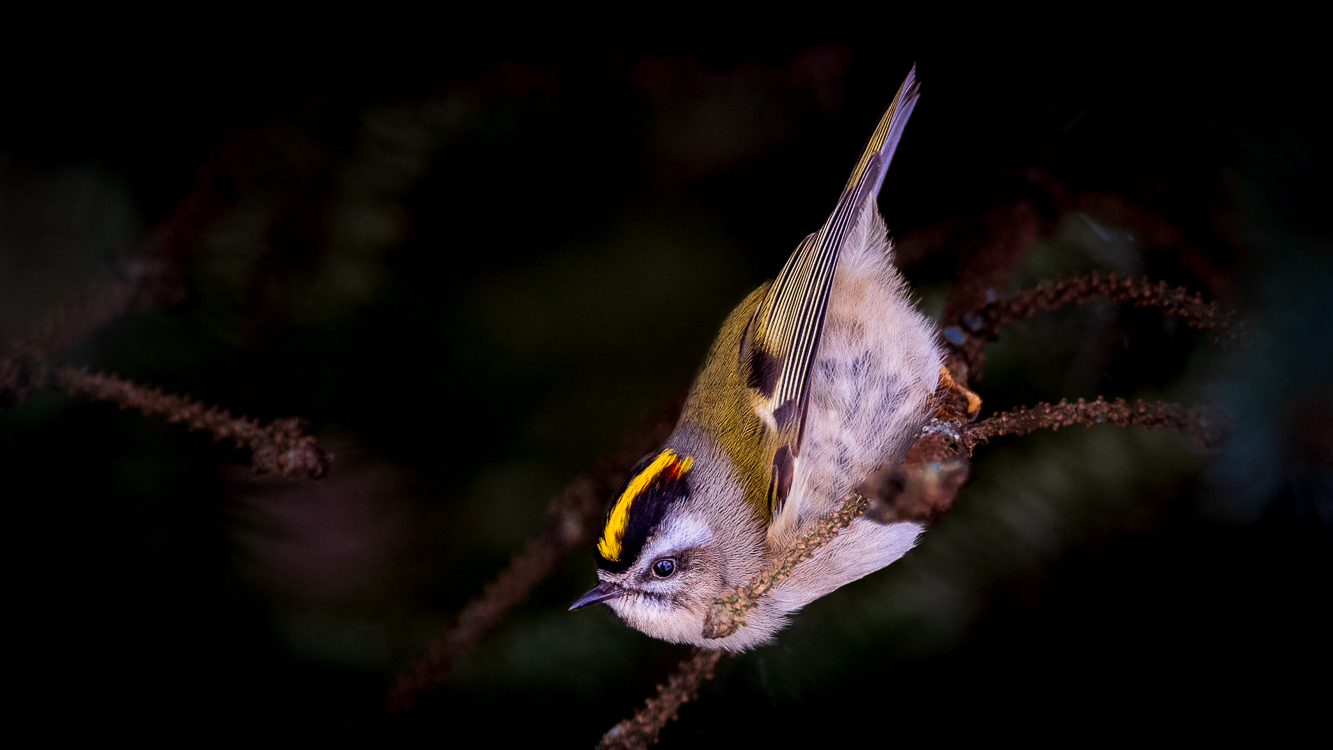
Male Golden-crowned Kinglet – Chignik Lake, Sitka Spruce Grove, January 23, 2018
Making our way along a bear trail I hacked open as it descends through a dense alder thicket toward creek bottom, we hear them – cricket-like whisper-chirps. They’re in there somewhere, hidden in a jungle leaves the alders are stubbornly holding onto even as nighttime temperatures dip and we awake to frosted mornings. Kinglets. The Silvers are in, all but the Monkey Flower, Goldenrod and maybe the last of the Yarrow is gone… Fireweed gone to seed, big brown bears fat with Sockeyes, terminal dust on the mountains. Fall on the Chignik.

Golden-crowned Kinglets are another species that is either absent or listed only as “rare” on Alaska Peninsula avian checklists. This might be because they are only a fall through early spring visitor to that part of the world, as is the case at The Lake. Or it could be that even in those non-breeding seasons these hardy little being rely on the shelter provided by mature spruce trees which, for now, only occur near the peninsula’s tiny, scattered villages. JD

Sack Lunch: Spruce Trees & Kinglets

Golden-crowned Kinglet – Chignik Lake, December 2017
Sitka Spruce Trees transplanted at The Lake from Kodiak shoots 70 years ago provide a great deal more than just cone seed forage for finches and chickadees. Golden-crowned Kinglets and a few other avian species glean the boughs, bark and understory for invertebrates. Here a lucky female kinglet has come upon a silk-wrapped treasure – perhaps a spider egg case or an insect trapped and wrapped.

The Tiny Kings of the Sitka Spruce Grove

The Tiny King of Sitka Spruce GroveAt only about three or four inches (8 – 11 cm) in length from tail-tip to beak, other than hummingbirds there probably isn’t a smaller bird in North America than the Golden-crowned Kinglet. But they’re sturdy little beings, able to survive temperatures as low as -40° F (-40° C). The splash of scarlet identifies this fellow as a male; the female’s crown is pure yellow-gold.

Every autumn coinciding with the peak of the Coho run on the Chignik River, we’d begin to hear a new voice as we pushed through thick stands of alders or walked by the village’s scattered spruce trees. By this time, there weren’t many other passerines around, and so there was no mistaking the high, almost cricket-like call of returning Golden-crowned Kinglets. They were a new species for for us, always in motion, difficult to locate in the dense alders and dark spruce boughs they prefer, and they are not indicated on the Alaska Peninsula on any of the range maps we checked – Cornell, Audubon, Sibley – so we were very happy when we finally got binoculars on them and could make positive identification. Kinglets tended to remain at The Lake throughout winter. At some point, they presumably had cleaned all the invertebrate eggs and dormant insects they could find and moved on to other grounds, but they were there every year in those fall and winter months and should be added to peninsular checklists and range maps.