
Chignik River, Dawn, September 8, 2018


A Collared Lemming burst from a thicket of grass and swam across a narrow finger in the lake which was filled to the brim with recent rains. Just as the little rodent disappeared in a patch of thick grass on the opposite side of the water, an Ermine popped out from where the lemming had just come, paused, looked around, appeared to sniff the air, then also swam the same course. I was scrambling with my camera hoping to capture something of the surprise sighting and managed to capture the above image just before the Ermine dove into the grass.
We didn’t often encounter either of these species during our years at The Lake, but there was hardly a walk after a fresh snowfall that we didn’t come across small paired tracks left by Ermines bounding through snow, so they appeared to be fairly abundant. Cool animals. I would love to have made friends with one the way Sam made friends with Baron in My Side of the Mountain… The closest I came was when one ran across the toe of my boot and into the entrance of our house as I opened the door one morning.

Upon publishing a photograph of a Wilson’s Warbler under the title Black Cap Jazz Singer a few days ago, reader Tanja Britton (see Tanja’s blog here), left a note alerting me to the American Ornithological Society’s decision to revisit the common names of species within AOS’s jurisdiction that are predicated on the names of the people (white men) who “discovered” or “identified” the bird in question as well as appellatives assigned by the “discoverer” to “honor” others. This would mean the renaming… the reimagining of a number of birds and our relationships with them: Steller’s Jay, Wilson’s Snipe, Baird’s Sandpiper, Audubon’s Oriole, Bachman’s Sparrow, and so on.
Hurray and about time. This “dibs!” approach to naming the beings we share this planet with could hardly reflect a more juvenile mindset. We, all of us, have the right to choose our own names, to imagine ourselves as we wish to be, to present our own identities and not to be enslaved by someone else’s idea of who we should be. We believe the same dignity should be accorded to all beings. And in fact, even in the instance of an “inanimate” object – such as, say, a salmon pool on a river – if one is looking at that landscape and can think only of imposing a person’s name on it, one is not looking closely enough.
Our view at Cutterlight has long been that if one creates a piece of art such as writing, a painting, a piece of music and so forth and one chooses to attach one’s name to said piece of art, it is appropriate and just that the creator’s name live on with that art for as long as the art lives. But this vain nonsense in pursuit of the illusion of immortality wherein buildings, airports, highways, and birding organizations are arbitrarily named after this person or that has always struck us as one of the least attractive impulses in Euro-American culture. The practice is as divisive as it is arbitrary – a fact we seem to be slowly waking up to as a society.
It is often the attitude among indigenous peoples of the Pacific Northwest that the totem poles they’ve created should be allowed to naturally decay over time rather than preserved. Their view is that all beings and all things have a span in which they exist in a certain state, at the end of which they must be allowed to follow their natural path into the next state of existing.
Amen.
Turning back to the matter of our avian friends…
As the AOS embarks on the enlightened task of reimagining the gray, nondescript names of men attached to various species, let them take one further step and strike from vernacular names disrespectful monikers such as “least,” “dwarf,” “lesser,” “house,” and the sobriquet we find most grating – “common.”
The only thing “common” about Gavia immer, the bird in the above photograph, is the unimaginative minds of whomever agreed this regal being should be so reduced. This bird can reach a bill to tail length of three feet (90 cm), a wingspan of four feet (130cm) and is reported to dive up to 250 feet (76 meters). “Common Loon” my foot.
They are Imperial Divers.
JD

My favorite fish is the Coho Salmon. I am absolutely fascinated by Lady’s Slipper Orchids. It’s difficult to name a “favorite” anything, and as I reflect on the matter it becomes apparent that it might be even more difficult to explain Why a given something is a favorite. The phrase “an integral part of the journey” flashes in my mind. The species in the above photo is the reason I became a serious birder and threw myself into photography. Oncorhynchus, Cypropedium, Lanius…
What is it in your life that has pulled you into travel, adventure, personal growth, new understandings?
JD


Golden-crowned Kinglets are another species that is either absent or listed only as “rare” on Alaska Peninsula avian checklists. This might be because they are only a fall through early spring visitor to that part of the world, as is the case at The Lake. Or it could be that even in those non-breeding seasons these hardy little being rely on the shelter provided by mature spruce trees which, for now, only occur near the peninsula’s tiny, scattered villages. JD
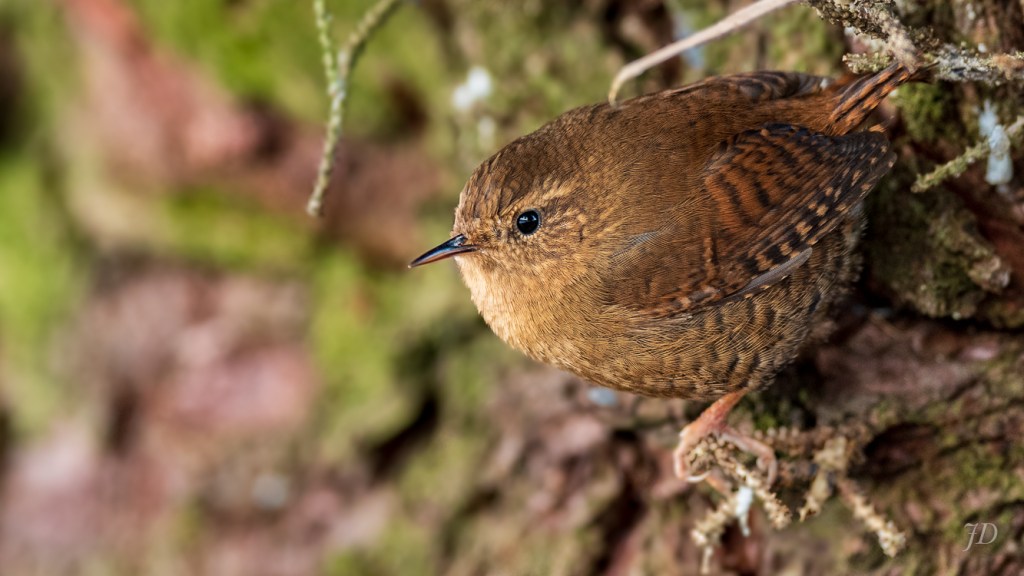
Click here to listen to the Pacific Wren’s songs and calls.
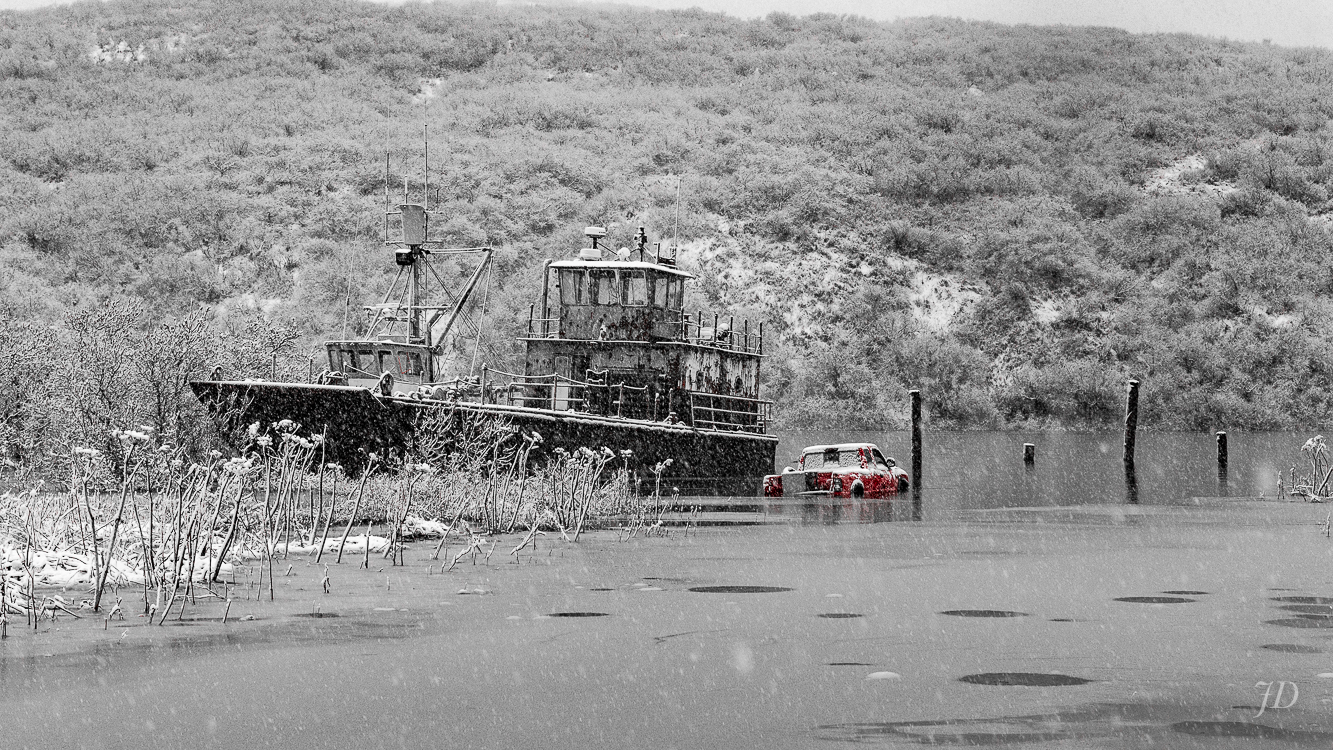
Located about four miles up from the salt estuary, this is the scene at the barge landing on the Chignik River during one of the big 11-foot tides that occur there when the gravitational pull of a full or new moon is at its peak. Upriver from here, the Chignik becomes unnavigable to large vessels, even at high-water. At low-water, this is a good place watch for bears, seals, otters and every so often moose. People have seen wolves here and, infrequently, lynx. This is where I once saw a nattily marked male Spotted Redshank, a bird that very rarely strays to North America from its native Asia and where on a different occasion a gyrfalcon swooped down and hovered just above me, as though to investigate. Occasional boat traffic notwithstanding, the landing is set in wilderness.
When the big tides roll up the river they bring salt scent and sea wrack, and even in the lake six miles and more up from the salt chuck the current pushes backwards and the receding water leaves behind eelgrass from the estuary. Depending on how you look at it, the landing is either the beginning or end of Chignik Lake’s lone road – three miles of dirt and gravel hugging steep hills as it winds above the river and then cuts through the village to connect the boat landing with the dirt airstrip. In fall, 10 and 11 foot tides are used to barge fuel up the river to the landing where it is loaded onto trucks that complete the short haul into the village. This is also how large equipment and building materials are brought into Chignik Lake which is otherwise accessible only by small plane.
You gotta watch where you park. These big tides come up awfully fast and will snatch a carelessly beached skiff in a blink – as just about all of us have learned through experience at one time or another. I would imagine the wheel bearings on the truck in this photo are pretty much shot… among other things.

Among most humans (and perhaps among most of their fellow birds as well), magpies historically have had a low reputation. They rob nests and nesting boxes; their raucous calls grate; they bully other birds out of feeders; they assemble in packs, chattering in the manner of hoodlums planning their next escapade; and although their omnivorous feeding habits are generally focused on berries, seeds and scavenging (they love a good salmon carcass), a telltale hook at the end of their bill which grows more pronounced with age should be warning enough to small creatures that it is wise to give magpies a wide berth.
But I like magpies. In fact, I think I’ve grown to love and admire them – and not just cynically because they supply a steady source of prey to the Great Horned Owls at the Spruce Grove. (At times it’s a veritable boneyard of magpie skulls, femurs, bills and feathers beneath the owl roosts there). To establish a relationship with these intelligent beings, it is first necessary to ensure that they cannot prey on the eggs and young of passerines utilizing nesting boxes. To that end:
1. Make certain that nesting box entrance holes are no larger than what is recommended for the target species.
2. Never place a perching peg on the box. Nesters do not need such a perch, but predators will use it to get at eggs and young.
3. Take appropriate measures to limit these comparatively large birds from accessing feeders. (Suggestions can be found with a google search.)
Were one on vacation in, say, a tropical locale never having seen a magpie in the wild and an adult in elegant, iridescent breeding colors happened by it is likely the bird would be greeted with oohs and ahhs for its stunning beauty. In a future post or two, I’ll publish such photos of Chignik Lake magpies with summer sunshine lighting their regal emerald greens, glowing turquoise and royal purples. And if you listen, really listen, to magpies, you’ll soon begin to appreciate that there is a lot more going on in their language than harsh cries. It can be fascinating to watch a conventicle (the preferred collective descriptor for this species) gathered together, pacing about the ground, their soft utterances back and forth sounding very much like a secret language. And then, of a sudden, one takes flight. The others follow. To where and to what mischief or adventure? There is surely more on the minds of magpies than mere food, shelter and reproduction.
Magpies are one of the few nonhuman species able to recognize itself in a mirror. They can solve fairly complex puzzles – both under lab conditions and in life. They are remarkably attentive parents (even breaking up food into equal portions to ensure that all of their young are properly fed). They mourn their fallen fellows, attend to injured brethren and give all evidence of being able to distinguish among – to recognize – individual humans. Thus, they can be befriended – and no need to take away their freedom and make of them a “pet” to do so. Recently fledged magpies are typically curious and congenial. Show them respect and kindness. It may be surprising to discover what kind of relationship develops.

 CutterLight