Ink and Light: Snow Birds and Basho

Snow Birds: House Sparrows, Ulaanbaatar, Mongolia

Come!
Let’s go snow-viewing
till we’re buried!
Matsuo Basho, 1644 – 1694

House Sparrow males and females are dimorphic: a female is center in this photo, accompanied by three males. This species has adapted so well to life with people, they’ve become nearly ubiquitous in places of human habitation throughout the world – and nearly absent in more natural environments.

Basho suffered from severe bouts of depression, occasionally becoming recluse for long periods of time. A solitary nature took him on a number of journeys, alone, along routes that were often well off the beaten path. The Edo Five Routes which he followed on one of his earliest journeys were considered to be among Japan’s most dangerous roads; When he first embarked on this trek, he expected to be killed by thieves or to simply die along the way. Widely regarded as the world’s finest master of hokku (haiku), his poetic travel log Oku no Hosomichi (The Narrow Road to the Interior) is considered to be his finest work. 

Wildlife Wednesday: Black-capped Chickadees!

barbra-feed-chickadee-dec-2016-n

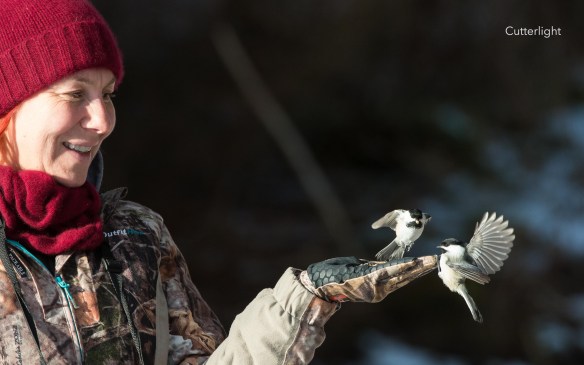
Gregarious, full of curiosity and brimming with personality, Black-capped Chickadees are often happy to take seeds right from a friendly hand. Weighing only about 10 grams (less than half an ounce) their little claws are nonetheless quite strong!

Many a hunter sitting quietly in a northern woods while waiting for a White-tailed Deer or Wild Turkey to come by has experienced a chickadee approaching ever nearer before boldly perching right on the rifle barrel – or even on the hunter’s arm or cap. Such an event feels like a stamp of imprimatur from Mother Nature herself.

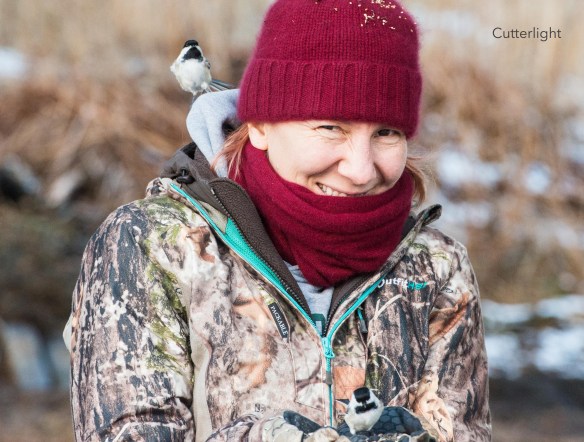
Last fall, when we hung bird feeders at the White Spruce Grove a little over half-a-mile from our home and began putting out seeds for Chignik Lake’s birds, within just a few days we noticed something uncanny. As soon as we hit the trail to the feeders, chickadees would descend upon us, fluttering and chattering with a familiarity that suggested that they somehow knew us. And each day as we came within view of the spruce trees themselves, a dozen or so chickadees would erupt in excited calls, flitting down from the boughs as though to greet us. There seemed to be no doubt that these little birds recognized us, Barbra in her red hat and scarf, me in my black watch cap, both of us in camouflage jackets. That sent us to the internet to do some research.
barbra-chickadee-shoulder-dec-2016-n

As it turns out, Black-capped chickadees are remarkably intelligent little beings, in possession of 13 different, complex vocalizations as well as memories that allow them to recall the precise location of food they’ve cached for up to several weeks. Regarding their vocalizations, not only do they warn each other with rapid dee-dee-dees, it has been shown that these calls vary according to the danger at hand, with their longest and most insistent alarms reserved for Pygmy Owls, a predator that poses an especial threat to chickadees.

Another, happier call among our local chickadees (it seemed to us) appeared to go something like, “Here come Jack and Barbra with more seeds!” While the various sparrows hung back demurely, deep in the cover of the spruce trees, the chickadees would land on our camera lens and flap around our heads.

“I once had a sparrow alight upon my shoulder for a moment, while I was hoeing in a village garden, and I felt that I was more distinguished by that circumstance than I should have been by any epaulet I could have worn.”
Henry David Thoreau in Walden

We wondered if we could get these bold, inquisitive birds to take seeds from our hands – and whether or not it would be ethical to do so.
chickadee-broke-bill-jan-2017-n

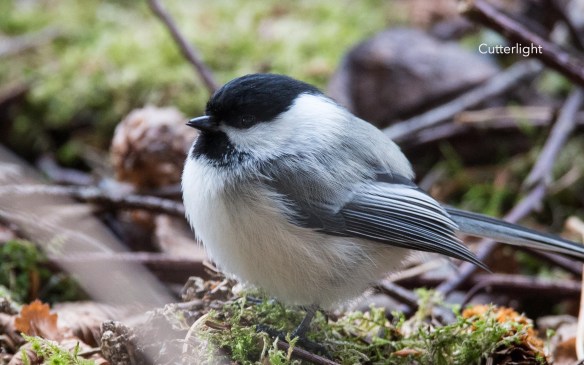
One of the advantages of feeding birds is that it provides opportunities to closely study individuals. Early last fall, we noticed that this chubby-looking fellow had broken off the tip of his upper beak. We wondered if this would adversely affect his ability to make it through the winter. Happily, it hasn’t. We still see him, and he still looks like he’s not missing any meals.

There’s no doubt that some wild animals should not be fed. Most North Americans are familiar with the cautionary proverb, A fed bear is a dead bear. That’s because bears that learn to associate humans with food become dangerous, destructive nuisances. But chickadees? After doing our due diligence in research and considering the welfare of the birds from a variety of perspectives, we felt comfortable taking our bird feeding to the next level.

Getting the birds to come to our hands proved to be fairly easy. One morning, we temporarily took down their favorite feeder, stood near the tree with outstretched arms and seeds in our hands… and waited. After a number of feints and false starts, one particularly brave bird took the plunge and was rewarded with a nice, fat sunflower seed. After that, it was one bird after another.

jack-chickadee-head-dec-2016-n

For the next few days, hand feeding our feathered friends was the highlight of the day. During those few days, we learned quite a lot. In addition to their many and varied vocalizations, Black-capped Chickadees establish pecking order by silent bill-gaping – an aggressive, open-mouthed gesture that is enough to cow a rival bird into waiting its turn or leaving the immediate feeding area altogether. There also seemed to be quite a range of distinctive personalities, with some birds readily and repeatedly feeding from our hands – and remaining long enough to carefully sort through the offerings for the choicest seeds -, while other birds hung back or landed only briefly.

The National Audubon Society encourages people to feed wild birds. Habitat is shrinking, and with that loss food sources can be scarce. Place your feeders in areas where birds have easy, quick access to the safety of shrubbery and trees, keep cats indoors, and to prevent the spread of disease among birds, occasionally clean the feeders. Once you start, keep the feeders full so that birds that have come to expect a food source aren’t suddenly left high and dry during inclement weather. But be warned: you might discover that the view out your window becomes more interesting than whatever’s on TV!

Ink & Light: “At First Sight” – Love and Lines from Richard Brautigan

x-at-first-sight-copy-n

At First Sight: Sandhill Cranes, Northern British Columbia

Sandhill Cranes choose partners based on graceful mating dances and remain together for life.

…and our graves will be like two lovers washing
their clothes together
In a laundromat
If you will bring the soap
I will bring the bleach.
Richard Brautigan (from Romeo and Juliet, 1970)

– Raised in abject poverty, Richard Brautigan (1935-1984) was struggling to gain a foothold in San Francisco’s literary scene when, in 1967, he published Trout Fishing in America. The counter-culture novel catapulted him to international fame. A year later he solidified his reputation with In Watermelon Sugar. 

Ink and Light: “The meanest flower that blows…”

x-feather-fan-n

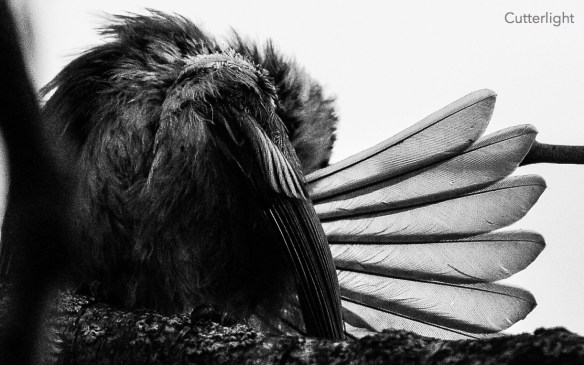
Feather Fan: Junco

To me the meanest flower that blows can give
Thoughts that do often lie too deep for tears.
William Wordsworth – Intimations of Immortality, 1807

Along with Samuel Coleridge, Wordsworth (1770-1850) is credited with founding English Literature’s Romantic Age. He was the country’s Poet Laureate from 1843 until his death.

Purple Martins: The Highest-Flying Swallow

purple martins w draggonfly n

The Catch: Purple Martins, Kimiwan Lake Bird Walk, Alberta, Canada

Swallows are a favorite bird wherever they fly, and among them North America’s largest and most universally appreciated species is without a doubt the Purple Martin (Progne subis). Before Europeans ever came to North America, Native Americans in the South were known to hang hollow gourds as nesting boxes to attract these birds. The beneficial nature of Martins is well known: not only do they consume enormous quantities of insects that humans consider pests – among them horseflies, beetles, termites and grasshoppers -, they also aggressively drive away birds of prey as well as crows and thus were traditionally welcomed by farmers. Often soaring at altitudes of several hundred feet, Martins capture their prey exclusively on the wing; they quench their thirst on the wing as well, skimming the surface of ponds, lakes and rivers.

purple martin male gun metal n

Iridescent purples and gun metal blues mark the plumage of the male Martin.

Although the range of the three subspecies of Martins covers most of the U. S. and sections of southern Canada, they tend to be rather uncommon. This is due in part to their very specific nesting requirements and to the fact that invasive species – European starlings and house sparrows – frequently outcompete Martins for preferred sites. Formerly found in hollow trees, Eastern Martins have almost exclusively shifted their nests to human created housing: apartment-like complexes on poles, rows of houses side-by-side, or, particularly in the South, hollow gourds. Like Chimney Swifts and Barn Swallows, Eastern Purple Martins have become dependent upon humans for nesting sites.

purple martin female n

The plumage of females is lighter in color, predominated by shades of brown.

Writing in the early 1800’s, John Audubon observed the ubiquitous nature of Martin nesting boxes in America:

The… Indian is also fond of the Martin’s company. He frequently hangs up a calabash on some twig near his camp, and in this cradle the bird keeps watch, and sallies forth to drive off the Vulture that might otherwise commit depredations on the deer-skins or pieces of venison exposed to the air to be dried. The slaves in the Southern States take more pains to accommodate this favourite bird. The calabash is neatly scooped out, and attached to the flexible top of a cane, brought from the swamp, where that plant usually grows, and placed close to their huts. Almost every country tavern has a Martin box on the upper part of its sign-board; and I have observed that the handsomer the box, the better does the inn generally prove to be. 

All our cities are furnished with houses for the reception of these birds; and it is seldom that even lads bent upon mischief disturb the favoured Martin. He sweeps along the streets, here and there seizing a fly, bangs to the eaves of the houses, or peeps into them, as he poises himself in the air in front of the windows, or mounts high above the city, soaring into the clear sky, plays with the string of the child’s kite, snapping at it, as he swiftly passes, with unerring precision, or suddenly sweeps along the roofs, chasing off grimalkin, who is probably prowling in quest of his young. Birds of America, John J. Audubon, printed 1827 – 1838.

Purple Martin male wings n

Healthy Martin colonies indicate a healthy environment.

The next time you see a large flock of dark birds, look closely. Although often starlings, Martins, too, come together in the thousands and even hundreds of thousands, particularly in late summer as they prepare to migrate to South America.

For more information about Purple Martins, or to learn more about building a nesting complex of your own to attract them, visit www.purplemartin.org

For more information on the wonderful Kimiwan Nature Walk and Interpretive Center in McLennan, Alberta, please visit www.kimiwanbirdwalk.ca.


Little Ringed Plover

Plover Little Ringed UB 2015 n

Little Ringed Plover, Charadrius dubius, Tuul River, Ulaanbaatar, Mongolia. Nikon D4, Nikkor 200-400mm lens, 1.4 teleconverter.

At about six inches (15 cm) from bill to tail and weighing just an ounce and a half or so (40 g), little ringed plovers are common along the Tuul River near Ulaanbaatar. Their small size, pale pink legs and bright yellow eye rings are diagnostic. These wary little birds seem to bob their heads and scurry back and forth along the shoreline constantly, hence the Latin “dubius” which means moving to and fro. They’re ground nesters. Among the shoreline rocks and pebbles, their light brown or grey speckled eggs are virtually invisible. As fall approaches, little ringed plovers migrate to Africa where they spend the winter.

We’re now at 40 species and counting in our urban birding adventures in and around Ulaanbaatar.

Long-tailed Rosefinch: Tuul River, Ulaanbaatar

Pallas Rosefinch male n

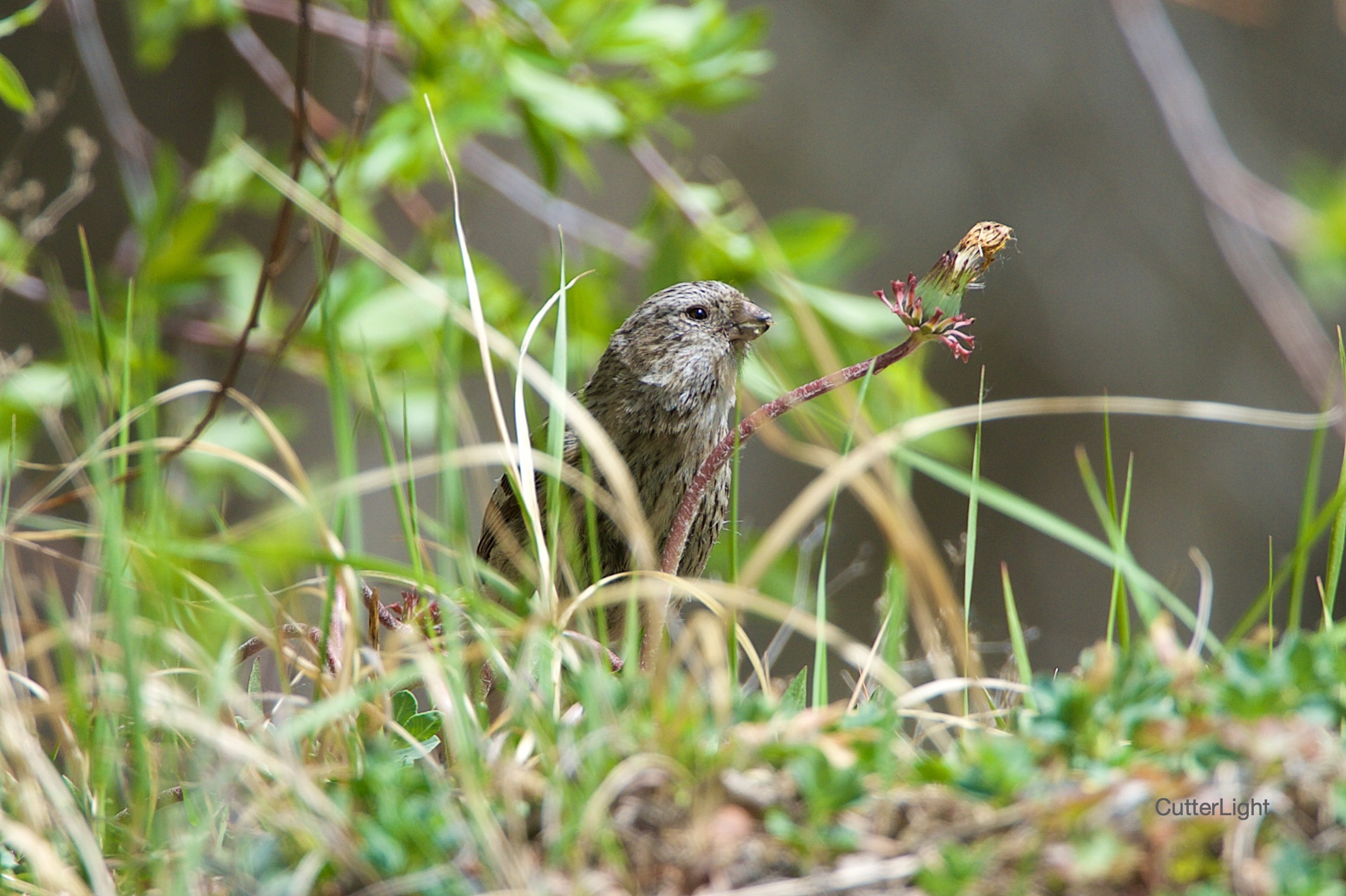
After a long winter, this striking male long-tailed rosefinch (Carpodacus sibiricus) was fattening up on fresh willow seeds near the Tuul River. 

pallas rosefinch female n

And here’s the female. Although residents of Mongolia, these birds were likely passing through Ulaanbaatar on their way to higher elevations to the north. Rosefinches are mainly seed eaters. There are several species throughout the Northern Hemisphere. 

Connected by Waxwings

Bohemian Waxwing feathers close n

Like drops of bright red sealing wax, pigment is enclosed in the translucent sheathing of extended secondary feather shafts, giving waxwings their name.

In the midst of the 11-minute walk from our apartment to our school in Ulaanbaatar earlier this week we heard a familiar “wheezing” sound from nearby treetops. The friend we were walking with must’ve thought we were crazy as I abruptly spun around and began crossing the road toward the origin of the sound. But Barbra knew what it was about. “Waxwings!” I exclaimed as I approached the tree where they were perched. Barbra confirmed the sighting. “Yep! Look at their crowns.”

Bohemian waxwing april 2015 n

For the past few days, small flocks of Bohemian waxwings have been putting smiles on our faces. On their way to nesting grounds in the conifer forests of Siberia, these flocks don’t hang around long. Until recently the southern edge of Ulaanbaatar near the Tuul River was covered in berry bushes, poplars and willows. Each year, less and less of this habitat remains as Ulaanbaatar’s human population grows…

bohemian waxwings in habitat n

…but here and there a small patch of what it used to be remains. Every little bit of this habitat is increasingly critical. Even a few berry bushes edging apartment buildings helps.

If you’ve never seen waxwings in good light, I’m not sure I can adequately describe them. Their primary wing feathers are streaked with pure white and edged in yellow the color of daffodils in sunlight. The just-dipped-in-paint sheen on these feathers is reminiscent of crayon gone over with watercolor paint. But it’s the candy apple tips of their secondary wing feathers that give waxwings their name. The red is not on feathers. Rather, it’s opalescent pigment encased in modified, translucent feather shafts.

bohemian waxwing eating red berries n

During their nesting season, waxwings often eat insects. The rest of the year, it’s berries, berries, apples, and more berries – sometimes hundreds of berries in a single day. We walk past these bushes every day and never noticed the winter-preserved berries still clinging to them. But the waxwings noticed. They need this fuel as they fly on to Siberia.

You could be almost anywhere in the Northern Hemisphere and never see a single waxwing. Ottawa, Canada; Sacramento, California; Clarion, Pennsylvania; Sapporo, Japan; – to name a few places where waxwings may or may not be. And, in the wrong light, you might pass right by them and dismiss them as robins or sparrows.

Wheezing. That’s what gives them away. If you hear birds wheezing, look closely. Get them in the right light. You won’t believe what you see.

Bohemian waxwing on wire n

The only bird with a brown crest – as though the black eye paint and warrior feathers weren’t distinctive enough.

My first sighting of waxwings occurred many years ago on western Pennsylvania’s North Fork of Redbank Creek. I was fly-fishing in early spring, and as I worked my way around a bend in the stream I came upon a leafless poplar that was as lit up as a Christmas tree with waxwings. I thought I’d never seen anything as beautiful in my life. The paint-dipped tips of their feather seemed to glow in the evening light and I stood motionless in the water, mesmerized till they suddenly filled the sky.

bohemian waxwing flight n

This photo shows that the waxwing’s red wing tips are featherless extensions of wing shafts.

In mid-winter, they light up the holly bushes on the campus of the College of Charleston where I earned my master’s degree.

In Sacramento, they filled the camphor tree in our front yard – gorging on berries, wheezing their calls to each other, brightening our day.

The birds we encountered in the lower 48 were cedar waxwings, smaller relatives of bohemians. But here we are, many thousands of miles removed from Pennsylvania trout steams, holly bushes in the Deep South and a lovely, mid-town bungalow in California.

Connected by waxwings.

Bohemian waxwing pair looking north n

A pair of waxwings look north against the pale dusk in Ulaanbaatar. They still have hundreds of miles to go before reaching the conifer forests of Siberia where they’ll build their nests and bring the next generation of waxwings into the world. Not many berry bushes here anymore, and a hunk of metal overlooking a construction site makes for a cold roost.

Crows Ice Fishing for Caddis Larvae: Tuul River, Mongolia

carion crow flock tuul  n mountains n

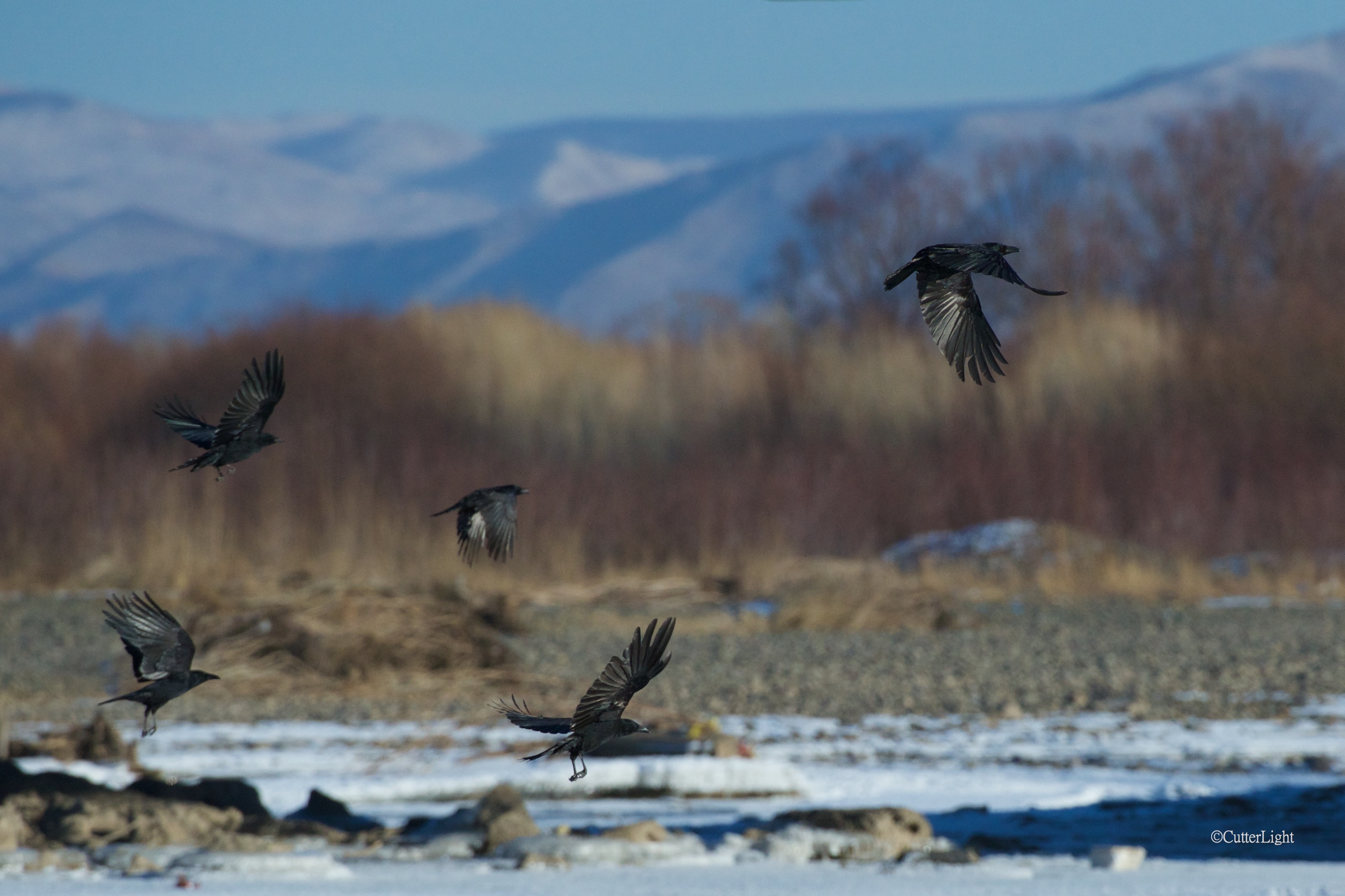
Corvids – a group which includes crows, ravens, rooks, jays, magpies and nutcrackers – fascinate. On a frigid December afternoon, we found them ice-fishing for caddis larvae in Mongolia’s Tuul River in the heart of Ulaanbaatar. (Click any of the photos for a larger view.)

The most intelligent of all birds, and with a brain-to-body-mass ratio rivaling that of the great apes and cetaceans, crows and their allies often exhibit remarkable behavior. Members of this family have been observed using and to some degree engineering purpose-specific tools – the only nonhuman animal other than the great apes to do so. There’s little doubt that certain feeding behaviors adopted by crows have been learned by watching other birds and animals.

carrion crows wings n cadis n

Note the object in the beak of the crow on the left. It’s a caddis larva casing.

The Tuul River flows through Ulaanbaatar, Mongolia’s capital city. Despite urbanization, the river’s water quality remains high – good enough to support species of trout as well as sensitive aquatic insects such as mayflies, stoneflies and caddisflies – species which spend the early part of their lives as larvae on the bottoms of clean rivers and streams. The Tuul is fast-flowing. Consequently, despite weeks on end of sub-freezing temperatures, here and there pockets of water remain open over shallow, stony, silt-free bottom.

OLYMPUS DIGITAL CAMERA

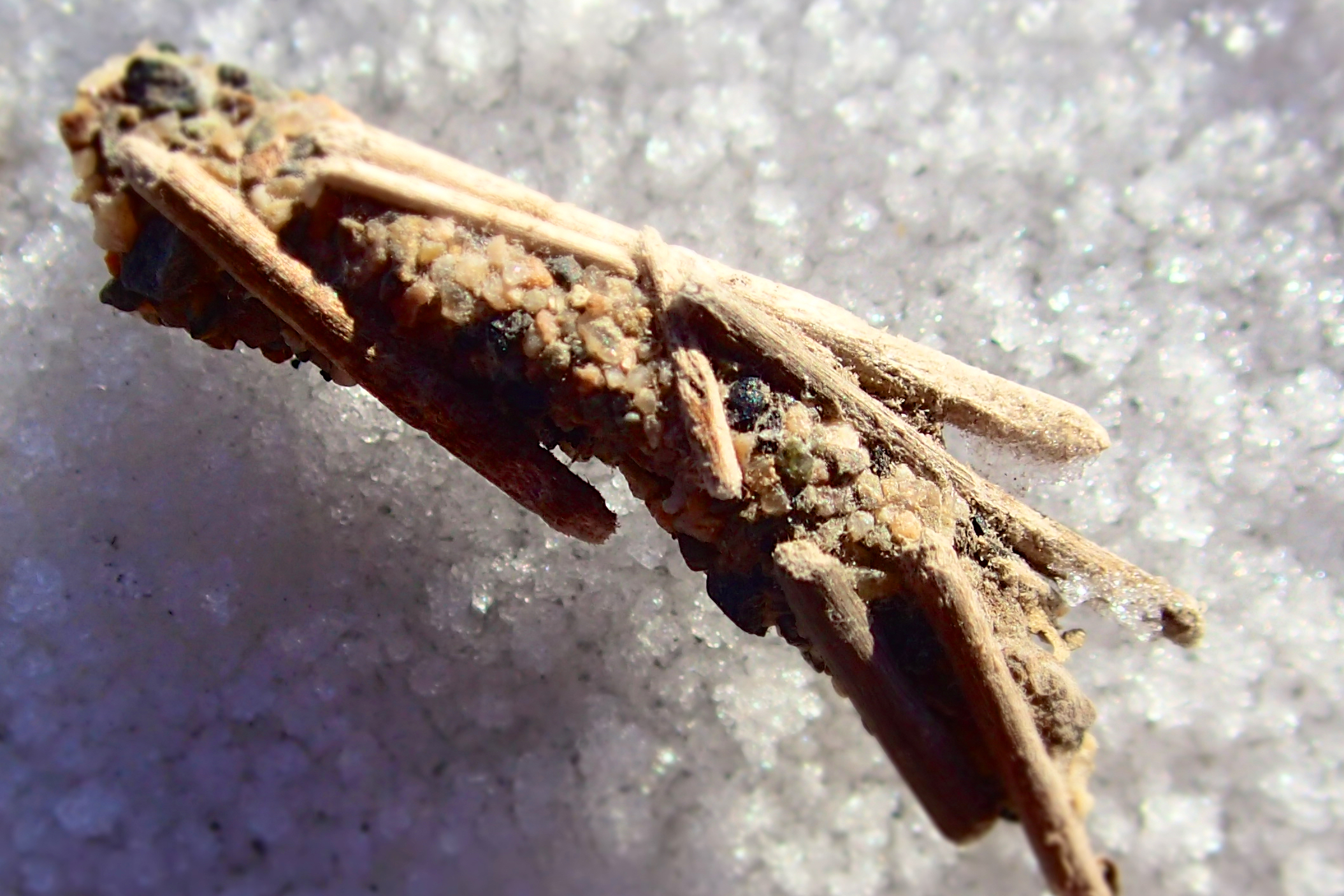
We took a cue from watching the crows and began scanning the ice for caddis larvae casings. As our eyes tuned into the proper size and shape, the empty husks appeared everywhere. This casing, constructed of tiny sticks and pebbles, is about 1.5 inches long (3.8 cm) and belonged to a member of the Northern case maker caddisfly family. 

Perhaps the crows learned of the abundance of wintertime food in these areas of open water by watching dippers – a robin-sized bird that happily plunges into pools and riffles in all seasons in search of aquatic insects and small fish. In fact, on this day we saw a white-throated dipper submerge itself in one of the riffles where the crows were feeding and come up with a small fish.

carion crow w caddis n

Here a carrion crow (Corvus corone) has his prize – a caddis larva pried from its pebble and stick casing.

Not adapted to plunge into water, the crows were fishing from the edge of the ice – thus gaining access to water not overly deep, but deep enough to provide habitat for slow-moving caddis larvae. Resourceful birds, are crows.

Birds of Mongolia: Daurian Partridge

Daurina partridge pair n

We encountered these softball-shaped Daurian partridge (Perdix daurica) in the pre-dawn of a December trip to Mongolia’s Hustai National Park.

Any day we see a new species of bird or other animal is a good day. On a recent three-day trip to Hustai, we had several such encounters. Nothing was any cuter than these relatives of pheasants and quail that would have fit perfectly in our cupped hands.

daurian partridge back n

We startled them, a covey of 14, as they were feeding on seeds on the coldest morning to date this winter in Mongolia. Maybe it was the sub zero (Fahrenheit) temperatures, or the fact that none of us – including the birds – were fully awake. But uncharacteristically they let us hang around and snap a few photos in the blue morning twilight. The orange beard-like feathers and gray side whiskers are part of their fall and winter plumage. 

Daurian partridge bokeh n

Named for the Daurian region of Russia, the average Daurian partridge is about 11 or 12 inches (28 to 30 cm) from head to tail and weighs around one half to three quarters of a pound (225 to 340 grams). The main part of their diet consists of seeds, which are abundant on Mongolia’s steppe grasslands. Insects and berries also figure into their diet, when available. Partridge are ground nesters, having developed a long-term dislike of heights (such as tree branches) when, Daedalus (father of Icarus of Greek legend) threw his nephew Perdix off the Athena hill in a fit of anger. Not wishing to experience another such fall, members of genus Perdix avoid high places to this day. So the legend goes.

daurian partridge flying away n

But they do fly, and this is the more usual view of Daurian partridge. Twice, previously, while hiking the Mongolian steppe we’ve had our startled hearts stop in our chests as a thrumming whoosh of wingbeats exploded practically underfoot. Once the birds have flushed, it’s difficult to approach them again, although you can sometimes track them down by listening for their rix, rix, rix, call as they regroup.