Little Spruce King… and something more productive than yelling at the evening news

Male Pine Siskin
Thousands and thousands of photos either culled and discarded or key-worded, retouched and placed year by year, month by month into digital folders. Still lots to go. Now into late October and early November of 2017, I hadn’t remembered that I got some nice captures of Red Crossbills and Pine Siskins that fall – finch species that generally do not appear on range maps for the Alaska Peninsula and which David Narver did not observe in his Chignik River Drainage study conducted in the early 1960’s.
With the exception of Pine Grosbeaks, Alaska’s finches – which also include White-winged and Red Crossbills, Hoary and Common Redpolls and Pine Siskins – depend heavily on cone seeds. The siskin in this photo would probably not be at The Lake were it nor for the Sitka Spruce trees transplanted as seedlings from Kodiak Island back in the 1950’s. Now mature and beginning to reproduce on their own, these spruces provide shelter and seeds for chickadees, sparrows, finches and magpies as well as a diverse array of invertebrates for all the above along with woodpeckers, wrens, kinglets and warblers. These passerines in turn provide a source of food for owls, falcons and shrikes. Want to change the world? Well, you could try yelling at the evening news on TV… or you could plant a few trees.

A Little Can Go a Long Way: A Testament to Mentorship

Paradise Sunrise – Salmon water on the Chignik River

It wasn’t so long ago that I was at the stage in life where a number of iconic figures in the art and entertainment world had begun to pass out of this life. I am far from being a celebrity hound, but as I scanned the news headlines each morning, it was always a sad and somewhat mildly shocking thing to see that an actor, singer or other icon I’d long admired had been admitted to a hospital for the kinds of illnesses that portend the end, or that indeed the end had come. The mild shock in such moments stems no doubt from the reminder that in fact we are all, all of us, “in the queue.”

More recently, feathered in among these iconic entertainment artists, the mentor-friends of my boyhood have been departing. The deaths that have hit closest have been among the men with whom I had the honor of hunting and fishing, men who I studied closely and learned from. The lessons included the proper handling of firearms, where to look in a pool for trout, various forms of woodcraft and the like, of course, but more importantly my association with these men provided vital guideposts along my own path toward – and into – adulthood.

Bill Kodrich 1933-2024

I doubt that there was anyone who had a greater influence on my young life than did Bill Kodrich. The winter when I was 12, he taught me to tie flies, the very first of which was a white-winged Coachman… I can still remember my clumsy fingers fumbling to tie in matched sections of Mallard wing. That spring at the small pond on his property, Bill let me borrow one of his fly rods as he showed me how to cast a fly line. Later, he brought me into the fold of Trout Unlimited, an organization in which my wife and I are proud to be life-time members. (Bill, who was a biology professor at Clarion State College/University, served as Pennsylvania’s TU President and in 1991 received TU’s Distinguished Service Award.

As important as those early lessons were, it has been Bill’s example that has had the greater impact. Were one to glance at my various tools, fly boxes, cookware and so forth, one might notice every drill bit accounted for and in its proper place, flies arranged in tidy rows, cookware stored thoughtfully, clean and cared for. “This is the way Bill would do it,” I’ve said to Barbra or thought to myself countless times – and will continue to do so, a fly rod wiped clean and returned to its proper place on wall pegs after a day’s fishing bringing back fond memories of Clarion and of hunting and fishing with Bill and studying his example. In fact, I find that as I pass by vegetable gardens here and there, compared with the impeccably well-ordered rows Bill attended to, all are somewhat wanting. And it’s seldom that I have a really good piece of pie and he doesn’t come to mind. “We’ve got to fuel up if we’re going to be spending the day…” hunting or fishing.

The testament of Bill’s life – of the lives of all of these mentors from my youth – is that even a little attention cast to a young person can have an impact that lasts a lifetime. It is a legacy grander and more meaningful than the largest mansion, a pile of money to the sky, or fame in any measure.

JD, Cordova, Alaska

Studio Fox

Studio Fox – Pausing to perhaps contemplate a recent meal or the next one on a wet morning in late fall, this fox and I encountered each other at the boat landing where an assortment of fuel drums, an abandoned truck and other objects made for a interesting background. Shooting with a long lens and a wide-open aperture helped create this bokehed background. Chignik River, November 27, 2017

Post Office Pinks

Pink Salmon Spawning, Post Office Creek – Locals call the pretty little stream bisecting Chignik Lake village The Crick. We thought it deserved a more honored sobriquet, and so since it cuts through a culvert and passes beneath the road near what used to be the post office, we called it post office creek. It is populated with char and sculpins and very occasionally salmon spawn there. September 19, 2017

Sharp-shinned Predator

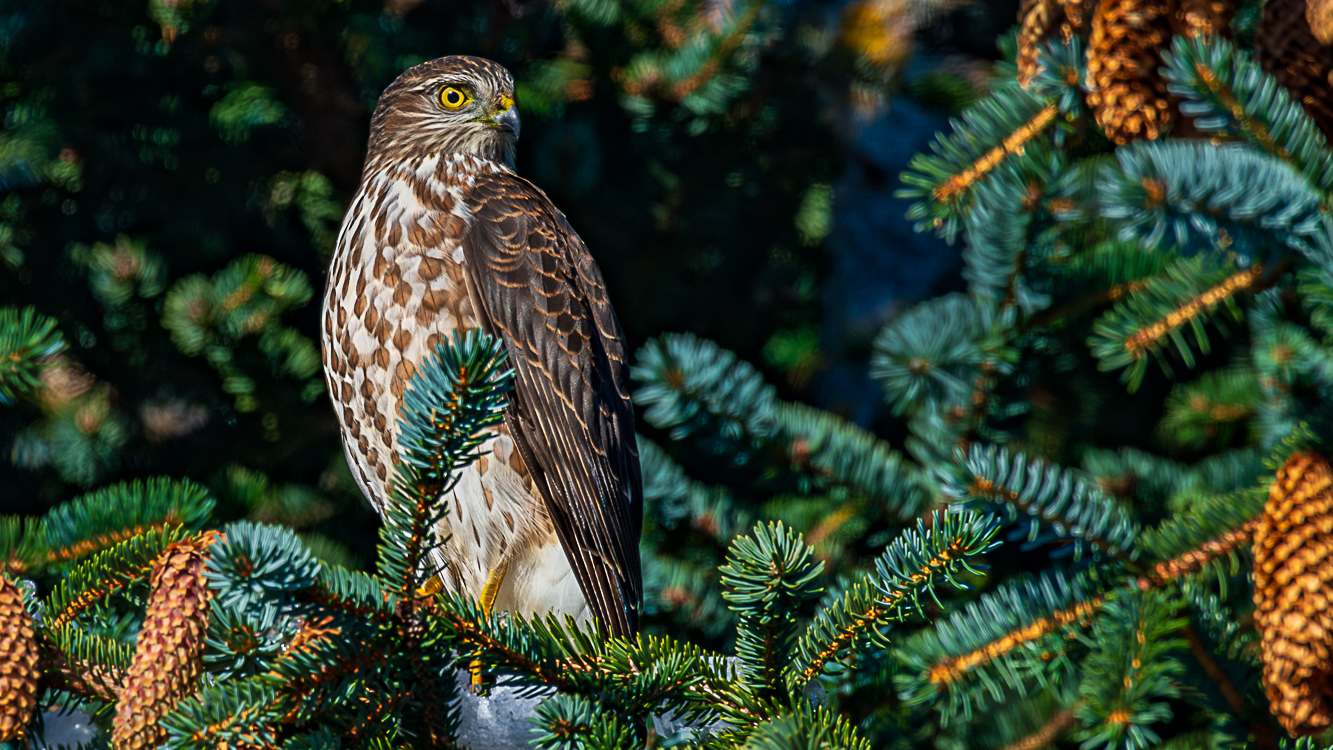
Photograph of a juvenile Sharp-shinned Hawk perched in a Sitka Spruce at Chignik Lake. This species is rare on the Alaska Peninsula.
Sharp-shinned Hawk, Sitka Spruce Grove, Chignik Lake, October 23, 2017
Rare visitors to the Alaska Peninsula, Narver did not document Sharp-shinned in his Chignik study of the early 1960’s, so this is perhaps the first documentation of the species in the Chignik River drainage. The specimen in this photograph arrived with passerines migrating south, was seen off and on for a couple of weeks, and then left. The mottled leaf-like pattern on the chest indicates a juvenile. Adults chests are more evenly ruddy.

Autumn Sign

Male Oregon Junco among Sitka Spruce Cones – Small flocks of Oregon Race Juncos, which had not previously been reported on the Alaska Peninsula, along with Slate-colored Juncos – only occasionally or rarely encountered on the peninsula, became regular fall through spring visitors during our years at The Lake. The mystery is, where were these birds coming from? Slate-coloreds nest in taiga forests two or three hundred miles northeast at the peninsula’s hip and beyond, but the Oregon’s closest summertime breeding grounds are unknown and would seem to be much further south. Juncos were not recorded during David Narver’s studies in the early 1960’s. It will be fascinating to monitor these population trends into the future… there is always more to discover. October 14, 2017

Frost in March Sunshine

Frost in March Sunshine – One of our all-time favorite foxes, Frost often slept on the sunny bank just below our home at The Lake. March 26, 2017

Goldeneyes

Photograph of a flock of a hen Common Goldeneye leading her first-year brood in flight down the Chignik River.
Goldeneyes – A flock of Common Goldeneyes flies down the Chignik River. The bright yellow on the bill tip of lead bird indicates a mature hen, so this might by a mother leading her first-year brood. Nicknamed “Whistler” for the distinctive whistling sound of their wings in flight, Common Goldeneyes are one of the Chignik’s most abundant fall, winter and spring ducks.

Water Necklace

Water Necklace – Chignik River, September 18, 202

A second bear is just barely visible in the upper left of this photograph of a healthy sow that has trapped a spawning Sockeye Salmon in her forepaws beneath the water. Anytime the salmon are running from July through November, bears can be expected along the river and lake.

Under a Broken Sky

Under a Broken Sky – Barbra swinging a Rocket Man streamer for Silvers at Paradise Bend, October 7, 2018

During the several years we fished the water at Paradise Bend (our name for an expansive area of tidally influenced braided runs and gravelled, vegetated islands), we only encountered other anglers on one occasion. Their guide had them casting in the wrong places – unproductive water unlikely to hold salmon. In due time their casts became listless, eventually gave way to billed caps lifted and head-scratching, and then to searching glances at each and beseeching looks toward the guide. They left fishless, and that was the only time we encountered anglers on “our” pool.

Paradise is a very special place, often beautifully lit by morning light, frequented by some of the world’s largest Brown Bears, traversed by moose, mink, fox, otter and wolf, shorelines decorated in season by magenta fireweed, sunflower-like arnica, marsh marigold and a dozen other showy blooms. At any time of year the water is free of ice you might hear the ratchety call of a kingfisher, and all summer long there are the songs of thrushes, sparrows and warblers to cheer the day. Gulls and eagles scavenge the islands when the fish are in, and in spring the wide, weedy shallows load up with Tundra Swans and hundreds of ducks. The ducks, particularly Mallards and Green-winged Teal, return en force in fall, and it was near Paradise that I encountered a brilliantly marked male Spotted Redshanks – a rare stray from Asia.

Tucked back in a bend off the main channel where boats never ran, it was easy to lose oneself during a morning at Paradise. Schools of newly arriving Coho pushing up tidal-bore-like bulges of smooth water as they arrived in the main pool were a thrill, and the fishing could be agreeably challenging in the clear, shallow water where we could watch the fish come to our flies. At the take, we would strip-set and then brace for long runs punctuated by cartwheeling acrobatics. There were more productive pools on the river, but none more enjoyable to fish.

Maybe even more satisfying than these periods of activity were the times in between, the water temporarily empty of salmon, the big sky, the vast landscape, bird song, rushing water and quiet… a place to let thoughts find their own way and perhaps to visit with a friend or love from the past who, for whatever reason, is now absent. There are a lot of reasons to take down a fly rod from its wall pegs and go to the water. There is the fishing, of course… but there are times when the promise of uninterrupted thought is the more compelling motivation.