Bactrian Camels, Gobi Desert, Mongolia (and the question: Should I set my digital camera to RAW or JPEG?)

Bactrian Camels in early morning light, Gobi Desert, Mongolia. October 19, 2014
See the original RAW file below.

There is not a clear date as to when we began to routinely create our images in RAW format. Most (all?) of the instructional material we had studied paid too little attention to this matter, or waffled on it, and so we didn’t appreciate the differences in the two formats.

Now we shoot everything – every image we might ever use other than strictly for ourselves – in RAW. Which is to say that while we sometimes use our phone to make a quick JPEG photo of our very fine kitty-cats Georgie and Kita for Facebook, or to take a field shot of a mushroom or flower we wish to identify, we’ve pretty much given up the idea that a JPEG file will suffice when we want to capture anything more than a quick record. We say that even though we have published photographs from original JPEG files in national magazines. And we say that knowing that at least one friend scored a national magazine cover with a JPEG phone shot.

So, yes, it’s possible to get a very nice capture in JPEG. In fact, oftentimes sports photographers shoot in JPEG – particularly when getting a photo out to a publisher in a timely manner is paramount. In a well-lighted stadium filled with agreeably contrasting colors, there may not be a need to retouch a photograph. Similarly, on a blue-sky mid-day at the beach, there may not be much – or any – advantage to capturing the scene in RAW format over JPEG.

But setting such circumstances aside, one’s odds of making a satisfying image increase if one begins with a RAW file. That same beach in soft morning or evening light or under a sky filled with storm clouds will photograph with more richness and subtlety when captured as a RAW file.

However, shooting in RAW is predicated on having the ability to retouch (process) the original image file in Lightroom or some similar program – and then committing oneself to doing so. Because the drawback to shooting in RAW is that images tend to look flat until they’ve been retouched.

This is the original RAW file of the above photograph. The sky is lighter, shadows are so dark details are lost – which also makes it more difficult to distinguish the outlines of individual camels-, the eye of the center camel is flat, there is less texture in the hair and the sunlit faces lack subtle variances. It’s all there… all of this information… in the RAW file. But it must be brought out in the retouching process.

So…

Generally speaking, if one’s objective is to take good – and perhaps sometimes even beautiful – pictures for an audience of family and friends, or simply to make a field record for one’s own use, and to do so with as few complications as possible, set the camera to JPEG, shoot away, and have fun.

If one’s objective is to more consistently create beautiful and even artistic images, set the camera to RAW, and then commit to evaluating and retouching images with editing software. Such software is the digital analog to processing film in a darkroom. Because a RAW image contains much more information than does a JPEG image, the software will provide more control when it comes to adjusting white balance, bringing out detail in shadowed areas, fine tuning color, sharpening details and controlling the amount of noise in an image.

One place the difference between RAW and JPEG most obviously manifests itself is in skies. Generally speaking, there’s not a lot that can be done to a sky in JPEG before noise – graininess, weird colors, strange lines – begins to emerge. RAW provides considerably more latitude before noise emerges… and once you begin to notice noise in images, you can’t stop noticing it.

Which brings me to this concluding observation. Whether one wishes to grow as a writer, musician, fly-fisherman, photographer, chef or in any creative activity, next to studying the accomplishments of others and applying the lessons therein, there is no substitute for mindful, purposeful self-editing. If you shoot in RAW, you will be compelled to edit your work.

Growth will come from that.

After the Dzud (зуд): Camel Skull, Gobi Desert

Camel Skull, Gobi Desert, Mongolia, October 18, 2014

A dzud (zud, зуд) is a weather-related phenomenon in arid parts of central Asia. It could be heavy snow or ice; or a lack of snow or rain; severe cold; drought. Any widespread weather pattern that prevents livestock from obtaining sufficient food or water. Mass deaths… and economic disaster for the semi-nomadic families who follow their animals – goats, sheep, yaks, camels, horses – from place to place across steppelands, grasslands and desert. Roughly a third of Mongolia’s 3.3 million people live this life – among the world’s last nomadic herdsman.

On a Frozen Sea

On a Frozen Sea, the two of us, April 14, 2013, near Point Hope, Alaska. This is about two miles from the village of Point Hope on a trail broken through huge chunks of ice, as seen, and marked here with a hook. Sea ice here is several feet thick – safe enough, but several of our local friends had stories about getting temporarily stranded when the ice they were on ice broke free from the main sheet. The gun is a precaution against Polar Bears.

I’ve enjoyed going back through photographs from our four years in Arctic Alaska. Although there are a number of additional pictures I’m reasonably happy with, the truth is that most of the images we made in those years constitute memories rather than art. As self-taught photographers, we still had a lot to learn about light, and how cameras interpret light, and composition, and optimal camera settings, lens choices and technique. Moreover, the images we made in those early days have a somewhat random feel about them as we hadn’t yet developed a vision for how we wanted to shoot and what we wanted to make images of… what stories we wanted to tell. We’d love to go back and revisit those scenes, and from time to time we discuss the possibility… but as Frost warned, way leads to way.

When we left Point Hope in the spring of 2014, we traveled to Mongolia where we lived for the following two years. We’re looking forward now to revisiting that collection. So, we hope to see you “in Mongolia!” JD

Tikigaq Sky with Horned Puffins and Thick-billed Murres

Looking out across the Chukchi Sea from the very tip of Tikigaq Peninsula.
Near Point Hope, Alaska, August 12, 2012.

It was a two-and-a-half mile walk from our home in Point Hope to the terminal point of Tikigaq Peninsula where it hooked into the Chukchi Sea. Cape Lisburne lay to the north; other rocky sea cliffs lay to the southeast. Dense colonies of seabirds – murres, puffins, various ducks, gulls and other birds – nested in these natural sanctuaries, and if you stood at the tip of the peninsula you could watch the adult birds fly back and forth all day long in the summer, in one direct bills and bellies empty, on the return their bellies crammed full of food and what they couldn’t fit in their bellies hanging from their bills. Sand Lances and other fish to be presented to nesting mates and offspring. It was a difficult hike out, a good bit of it along a pebbled beach. At that time in our lives we hadn’t yet made a study of wildflowers, but they were abundant and brightened the path. And you never new when you might come across an Arctic Fox, a Snowy Owl or something else of interest.

Hiking for any distance along a sand beach becomes work, and If you’ve ever walked far along a pebbled beach you know that pebbles make for an even more arduous hike. The ocean breeze was almost always cold at that latitude above the Arctic Circle.

Wishing at times to travel light, we did not always take camera gear.

Which was, of course, a mistake.

One morning in early fall, we arrived at the point and – not knowing what we were in for – found ourselves looking out at more birds than we had ever in our lives seen. Quite probably, more than we will ever see again. Wave upon wave of puffins, murres, kittiwakes, shearwaters and I don’t know what else were streaming out from the cliffs and capes, chicks fledged, the season over. Most of these seabirds would not return to land again until the following spring when they would begin a new nesting season. We had seen films depicting African migrations of wildebeests and other ungulates, and in Alaska of great herds of caribou, and those films were called to mind. I once, in Kentucky, found myself amidst a late spring migration of Box Turtles; I pulled my car to the shoulder and assisted over a dozen of them safely across the country road I was traveling. If I had that to do over, I’d have stayed for as long as it took and helped more…

Surely that morning on the tip of Tikigaq, Barbra and I were witness to one of the world’s greatest migration events. We felt, suddenly, a deep connection with… something… overwhelming. Thoreau’s contact, or a final couplet from Wordsworth:

To me the meanest flower that blooms can give
Thoughts that lie too deep for tears.

Tracks

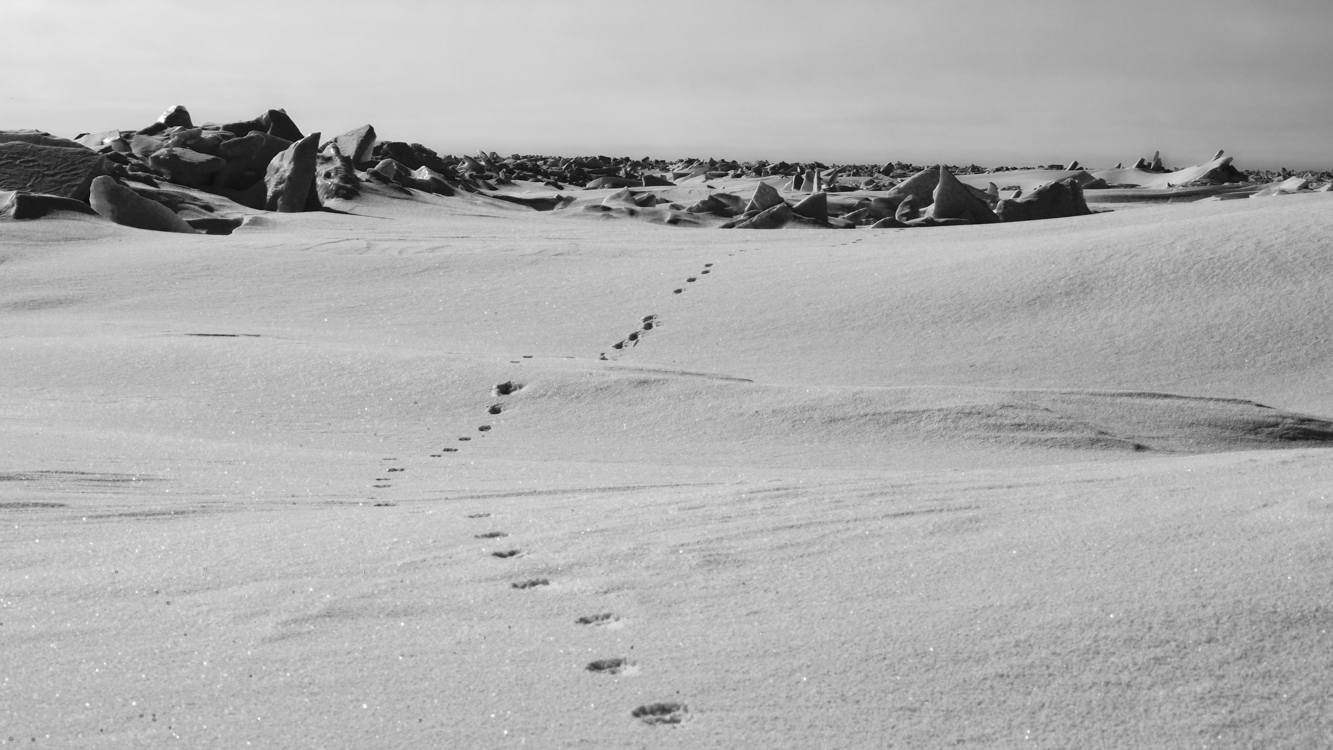
Polar Bear tracks disappear into the other worldly landscape of ice and snow on the frozen Chukchi Sea near Point Hope. The great bears continuously roam the ice in search of seals and the remains of whales that have been caught. By average weight, Polar Bears rank as the world’s largest bear. However, the Coastal Brown Bears of Kodiak Island and the Chignik River drainage on the Alaska Peninsula can weigh as much and stand taller. April 26, 2012

Sentinel

Engraved with a cross and reaching into the sky, the jawbone of a Bowhead Whale stands sentinel over a grave buried in spring snow at Point Hope, Alaska. April 12, 2012

Umiak

This umiak – a traditional whaling boat, the hull made of Bearded Seal skin stretched tight and lashed over wooden ribs – was positioned on a rack, allowing me to make a photograph of the inside, upside down. Point Hope, Alaska, March 27, 2012.

Igloo: Arctic Home made of Whale Bone, Ship Timbers & Sod

Ghost village ruins of an Inupiat home constructed from ship timbers, sod and the bones of Bowhead Whales. Tikigaq, Alaska September 3, 2011

Saltwater inundation caused by an encroaching sea forced the people of Point Hope to relocate further inland down Tikigaq Peninsula a few decades ago, but I am told that as recently as the 1970’s a few people still inhabited homes such as the one above. In fact, on at least one such structure we saw, there was a junction box for electricity. Along with these igloos (a term which refers not just to structures made of ice, but to any dome-shaped Inupiat dwelling), there were other more familiar-looking homes in old Tikigaq, but those too have long been abandoned to decay back into the Arctic tundra.

Icehenge

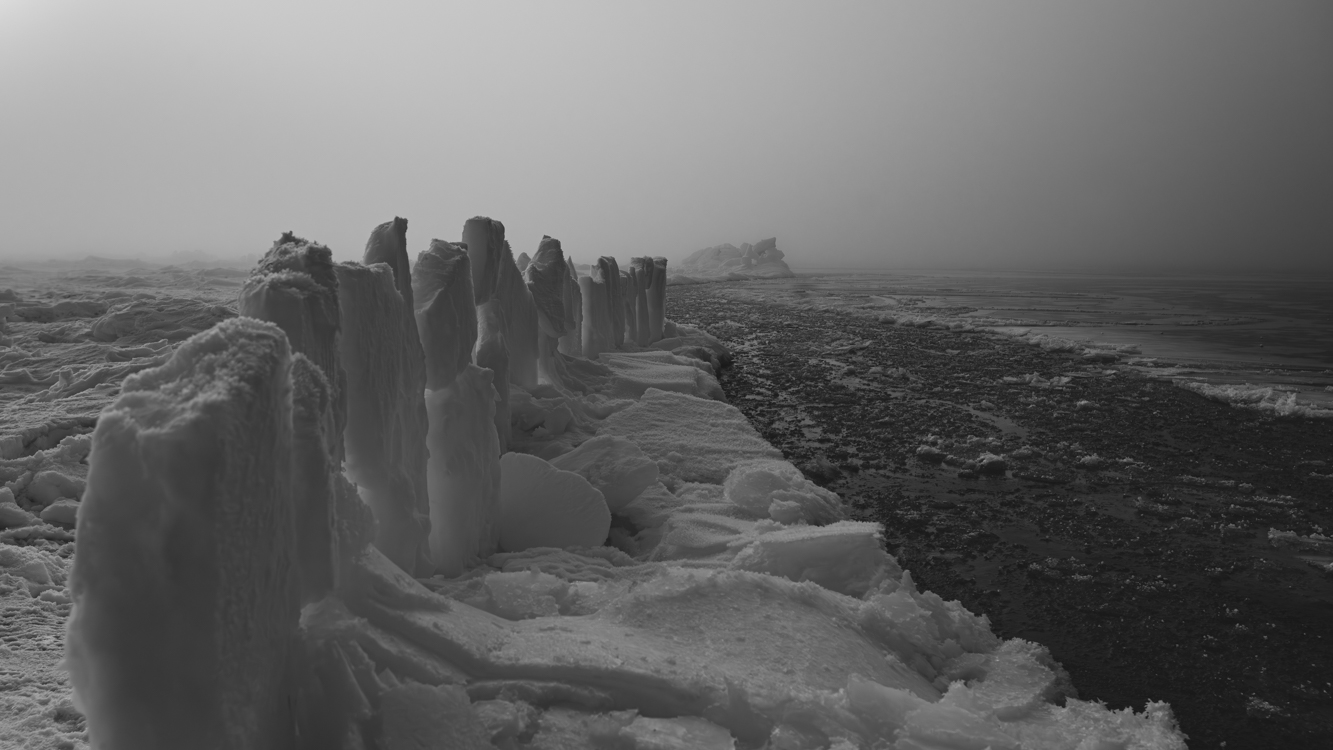
Black and white photograph of a hunting blind made of large ice slabs positioned along the edge of Arctic sea ice by Inupiat whalers.
Three miles out on the frozen Chukchi Sea, 125 miles north of the Arctic Circle, thick fog lifts to reveal slabs of ice positioned by Inupiat whalers to serve as a hunting blind along the edge of a slushy lead. Both Bowhead and Beluga Whales are taken as they migrate through these open lanes between sheets of ice. Near Point Hope. Alaska, May 3, 2012

The Catch: Bringing a Whale up on Sea Ice in Arctic Alaska

Inupiat whaling on the frozen Chukchi Sea near Point Hope, Alaska. April 26, 2012

As Bowhead Whales go, this was a small one – perhaps 10 tons or so. We had hiked approximately three miles from the village of Point Hope across the frozen Chukchi Sea to the camp where we had heard a whale had been caught. Locals had traveled by snowmachine and honda (snowmobile and ATV). There is always the danger of encountering a Polar Bear in this environment, and so we were armed. After snapping this picture I handed the camera to Barbra and took a place on the rope.

The open water in this picture is called a lead – an opening between two sheets of ice. You can see, across the water, the jumble of ice along the edge. Sea ice is often not the smooth sheet of white one might imagine. It continuously buckles, pushes up along pressure ridges, drifts apart and then presses back together. In a way, it behaves like the Earth’s tectonic plates, buckling, heaving, colliding, lifting. And so in order to make a whaling camp, trails must first be made through these places where jagged ridges of ice, individual chunks the size of cars, some much larger, must be broken through and smoothed out.

It is a lot of work to take a whale.