I dreamed about living in the forest.

A place where the mountains meet the sea.
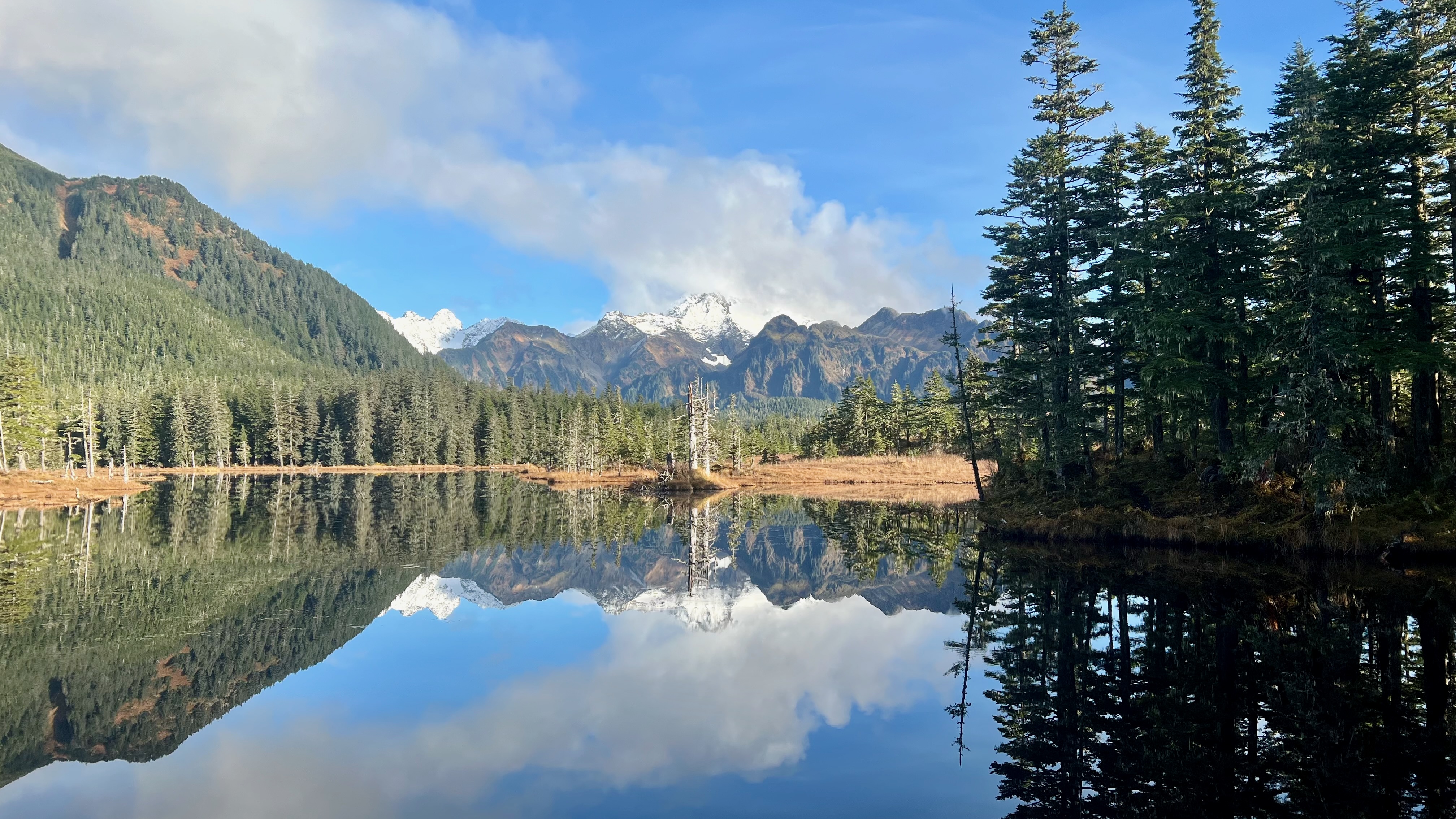
Where quiet paths allow for reflective solitude.

The dream is reality.
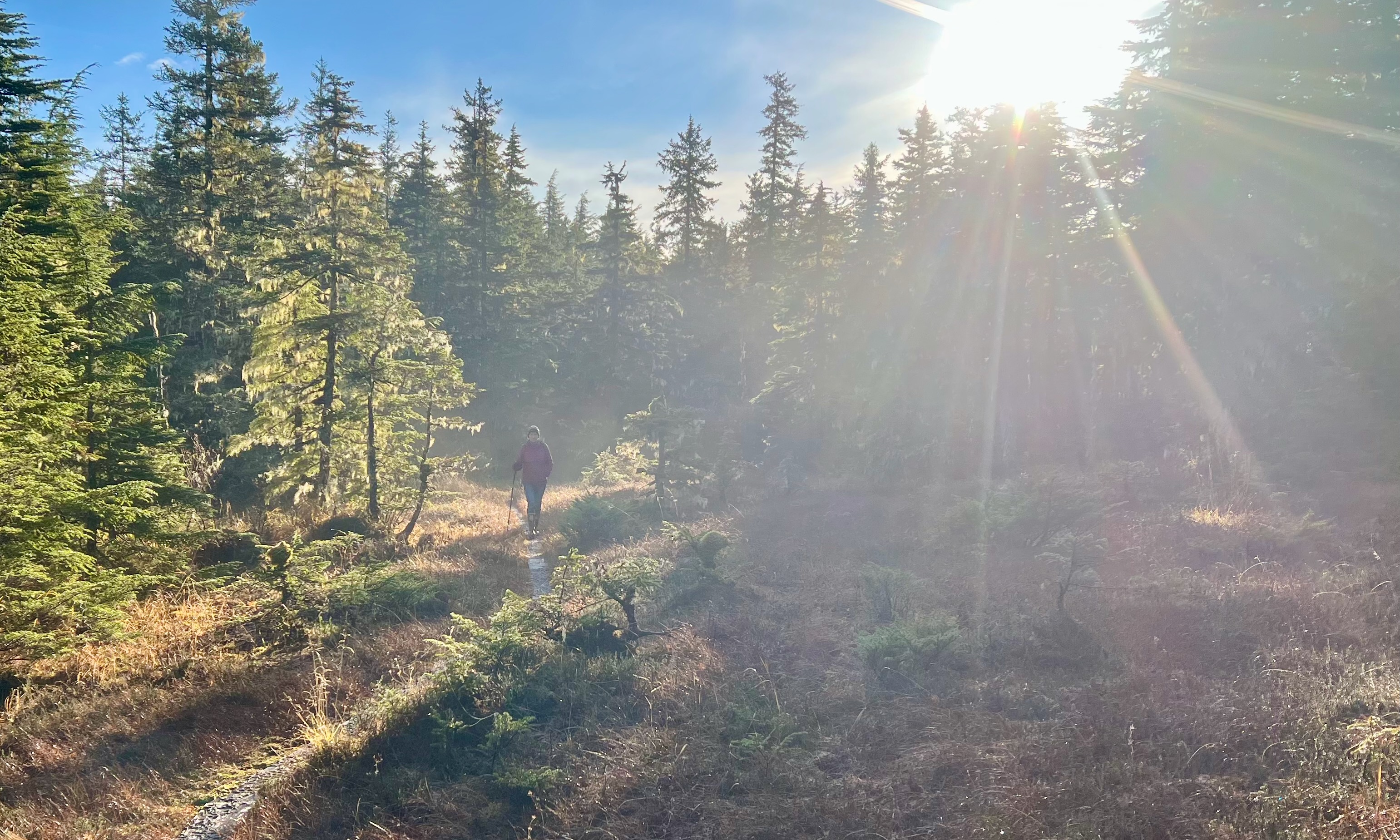
The Cali girl is no longer.

I dreamed about living in the forest.
A place where the mountains meet the sea.
Where quiet paths allow for reflective solitude.
The dream is reality.
The Cali girl is no longer.

In the photo above, we’re standing on the beach not far from where Clarks River debouches into Chignik Lake. When the lake is glassed off like this, the view from the beach in Clarks Bay gives the impression of an infinity pool, the horizon disappearing in fog or low clouds. This is the only photograph I have of a Horned Grebe at The Lake, the species indiscernible in this color rendition but the bird’s “horns” really popping in the monochromatic (black and white) version of this image.
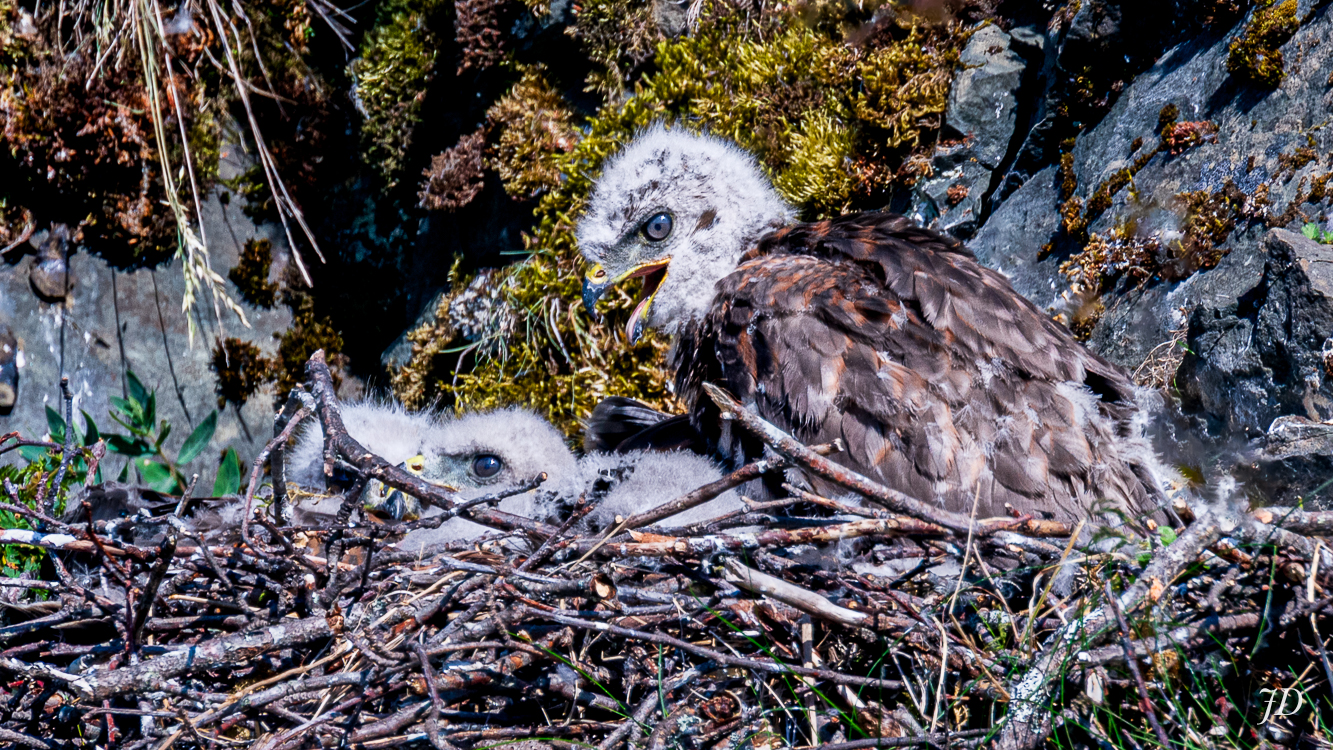
When I had the opportunity to make images of the Rough-legged Hawk nest at the cliffs along the lower Chignik River, I was still thinking of myself as primarily a documentarian. Additionally, human proximity to the nest was clearly upsetting to the chicks as well as to the parents. And so, a couple of times I waded into the river, made quick photographs, and left. Documentation accomplished.
In hindsight, it might have been worthwhile to construct a blind at a respectful distance and to thereby more thoroughly record the nesting events that occurred every summer until recently at this little ledge about 60 feet up from the surface of the river. A regret is that I never made a video of the birds. Unfortunately, in July 2021, a magnitude 8.2 earthquake rocked the Chignik area and in so doing deposited a volleyball-sized boulder squarely in the center of the nest. The little ledge had always been a precarious site – exposed at times to high winds, vulnerable to potential predation by our resident Great Horned Owls, and subject to regular skiff traffic (and associated engine noise) – and in fact the summer of the big quake after laying just one egg, for unknown reasons the hawks abandoned the nest, before the earthquake struck.
After the big earthquake, with a large rock left in the middle of the nest, the site was no longer usable. We think we discovered a new nest further up the drainage, so hopefully Rough-legged Hawks will continue to be a part of Chignik fauna.
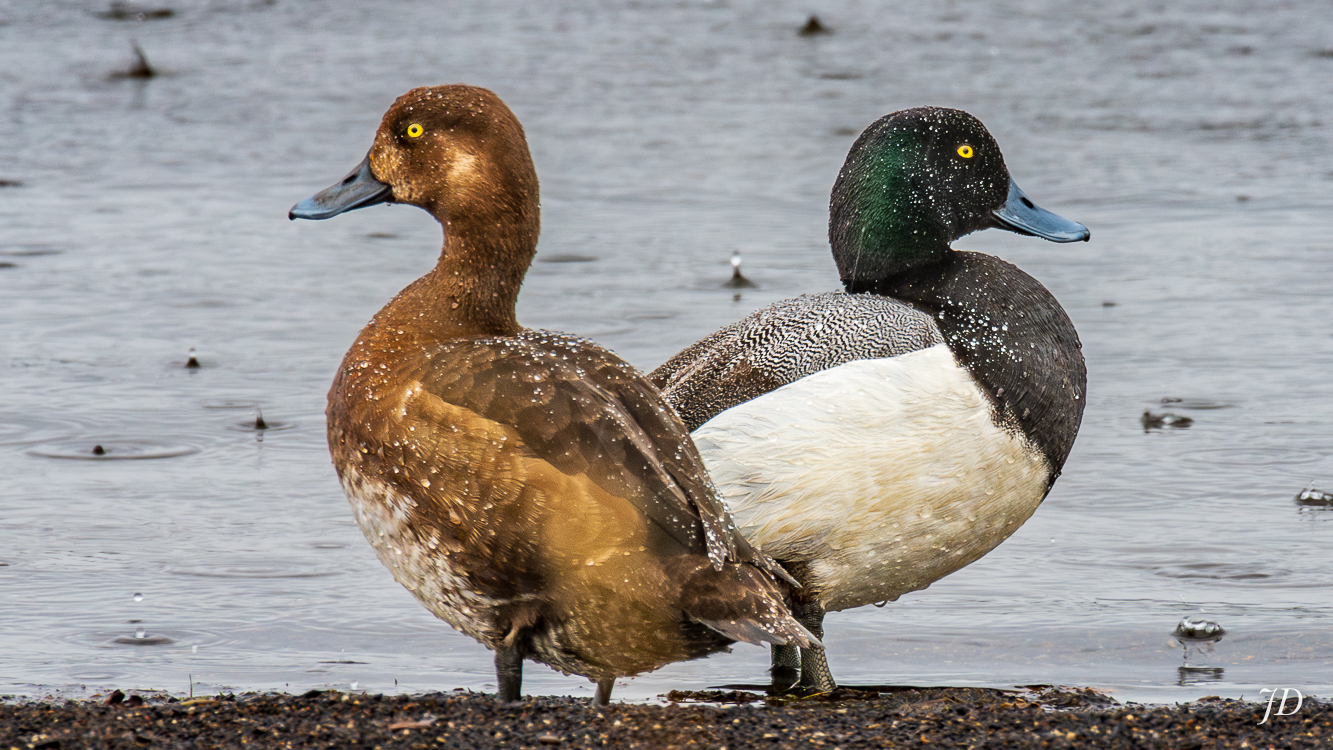
It hasn’t been until fairly recently, perhaps coinciding with a general interest in birding rather than mainly hunters looking closely at waterfowl, that the term Scaup has begun to supplant Bluebill when referring to the ducks in the above photo. These are Greater Scaup, a mated pair that paused at the lake along with several others of their kind for a little while in early June before heading off to find their own kettle pond nesting sight. There are also Lesser Scaup, very similar in appearance though slightly smaller and with a less rounded head. Though Greater Scaup were often abundant on the lake and in the river’s largest pools in winter and spring, I never encounter a Lesser there.
The term Scaup may be derived from the Scottish scalp which refers to bivalves such as clams and mussels, preferred food items for these diving ducks, though they also eat various types of aquatic vegetation. Interestingly, they are the only circumpolar diving duck – hence the European origin of their vernacular name. Their “quack” is a bit more hoarse or nasal than that of the familiar Mallard, and is often comparatively quiet. But at The Lake, it was a music we associated with spring, and we find now that we miss it.
JD

How about a caption?
Happy Monday everyone!

I’d always wanted to live where owls were my neighbors.
It was widely known that the village had owls. In fact, the village had always had owls. David Narver reported their presence in his study of the Chignik River Drainage in the early 1960’s. But no one knew, precisely, where the owls nested and roosted. I managed to unravel the mystery once and for all during our first winter at The Lake. After that, Barbra and I could fairly reliably locate at least one of our two resident owls on any given day.
But that didn’t make photographing them much easier. During daylight hours, the owls typically secreted themselves in the very thickest parts of an exceptionally healthy and dense copse of Sitka Spruce trees. Many times, only a hint of the large birds was visible – a patch of breast feathers, a vigilant eye, an alert ear tuft. In addition to the challenges presented by the dense spruce boughs, the copse of trees was situated in a hollow where the light was almost never what a photographer might call “good.” Not only did the owls bury themselves in the boughs of those trees, their favored roosts were fairly high up. And although I am fairly certain that I knew more or less exactly where the nest was, I was never able to put my eyes on it.
For awhile, I contemplated a variety of strategies to facilitate photographing the owls, but all of them involved bothering them in one fashion or another. I didn’t think I’d permanently spook them out of the grove, but I didn’t want to press them. Making a living in the wilderness by talon, hooked bill, eye and wit is tough enough without some human invading one’s personal space. Biologists (generally) no longer shoot specimens in order to “study” them, but I have to wonder about the merit of constant nest-watching and other practices involving invasive viewing of wildlife that are now in vogue.
And so although I regularly checked on our owls (they were along the way to one of our favorite fishing spots), I did my best not to disturb them. Every once in a while, they presented themselves, and when those times coincided with my having my camera along, I did my best to record an image.

To the best of my knowledge, no one has counted the number of feathers on Pinicola enucleator, – or if they have, they haven’t made their findings readily available via a Google search. At eight to 10 inches from bill tip to tail tip, Pine Grosbeaks are large as songbirds go. The smallest species of hummingbirds have slightly less than a thousand feathers; Emperor Penguins, which have huge numbers of tiny feathers to insulate them from the cold sport something like 80,000 feathers. In between these extremes, counts and estimates vary, but based on reports for specific species, something over three thousand is probably a good approximation of the total feather count for our friend in the above photograph.
JD

I was surprised this morning when I checked the Cornell Lab of Ornithology’s All About Birds site to note the absence of Tree Swallows on the Alaska Peninsula on Cornell’s range map. In fact these birds are common at least as far Southwest on the peninsula as the Chignik River drainage, particularly near settlements where nesting boxes have been established. Further down the peninsula they are listed as “uncommon,” their presence probably limited due to the lack of suitable hollow trees for nesting.
In villages throughout the peninsula the return of swallows each spring is widely anticipated as a true sign of spring. It is reported that one swallow consumes roughly 2,000 small insects (such as mosquitoes and midges) every day. Thus, a nesting box or two installed around one’s home can have a measurable impact on the population of bothersome bugs.

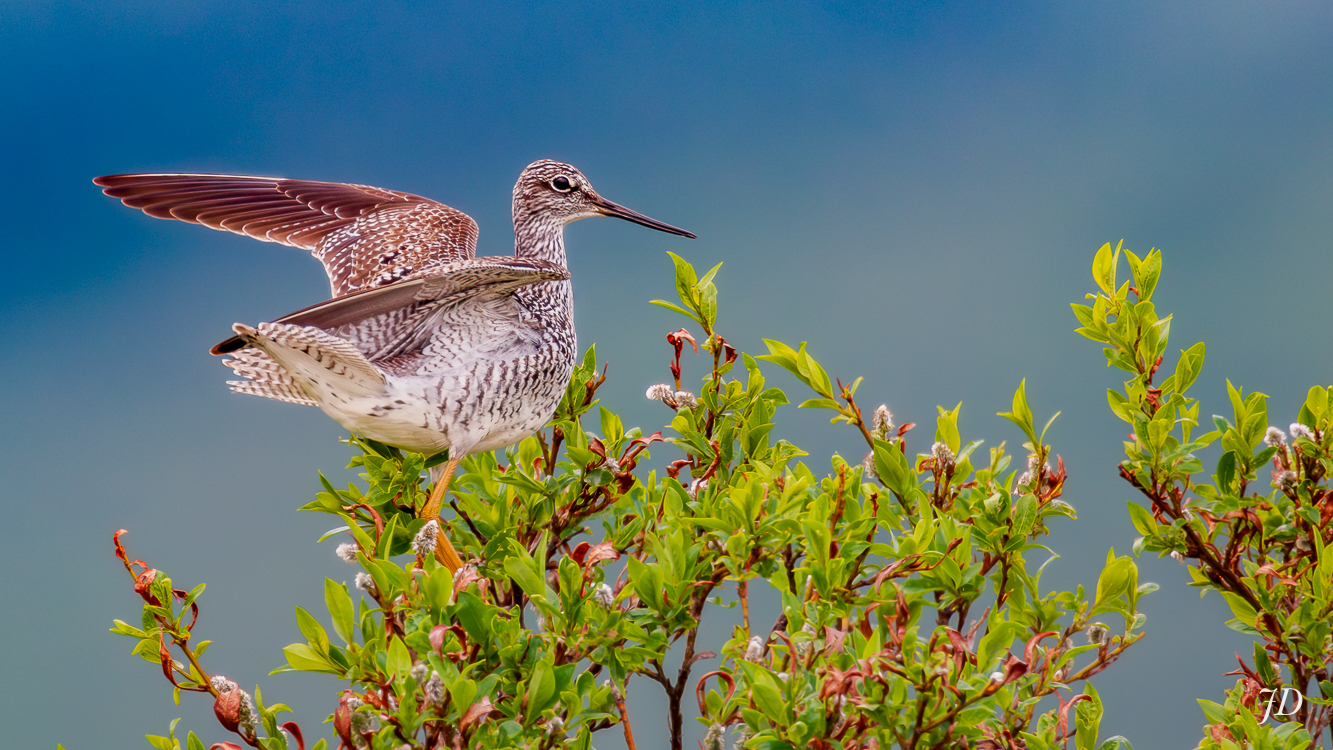
Greater Yellowlegs (as well as Lesser Yellowlegs and Wandering Tattlers) are well known as shorebirds that often perch in trees, particularly near their nesting sights, which are on the ground. They are abundant throughout the Chignik River drainage where they primarily feed on various small fishes.
 CutterLight