Unknown's avatar

About Jack & Barbra Donachy

Writers, photographers, food lovers, anglers, travelers and students of poetry

Chignik Lake in 29 Photos: Bursting

Chignik Lake Fiddlehead FernBursting

Seasonally, the Chignik calendar for spring, summer, winter and fall fits well with the actual dates of winter and summer solstice and spring and autumn equinox. So, while back in my native western Pennsylvania I thought of summertime as starting at the beginning of June, here at The Lake it doesn’t feel like summer until Chinook Salmon begin to enter the river in late June. The main exception to this view of seasonality at the Lake is that our summers are a bit truncated. Autumn comes early.

I made this photograph on June 4, 2019 on a hike to Clarks River – a trek made memorable by our first bear sighting of the year. With the school year having finished weeks ago, we had been going out every day, soaking up as much of our beloved countryside as possible before our scheduled move to Newhalen later in June. Chignik Lake’s school enrollment had dropped below 10 students; the school board had voted to close the school and transfer Barbra. A strange mix of springtime joy and melancholy stirred within our hearts. We did not want to move. But perhaps the understanding that we soon would be leaving created in us a deeper appreciation for the beauty we were surround by.

Willows had just begun to leaf out, and the year’s first flowers were emerging – salmonberries, wild geranium, pink lousewort, delicate purple violets, cinquefoil and lupine. Heavy buds hung from iris and chocolate lily stems. Fireweed was just beginning to push up through the soil in thin red shoots. Our avian spring migrants had returned, and the hike was alive with the songs and calls of swallows, thrushes, sparrows, warblers, yellowlegs, gulls and cranes. Just a few days prior, on May 28, Donny had caught the year’s first Sockeye Salmon in his net. Eagles had begun to post sentinels along the river, watching for more fish to arrive. My memory of the hike is of warmth, but I can see from a photo I took of Barbra that we were still wearing substantial coats and gloves.

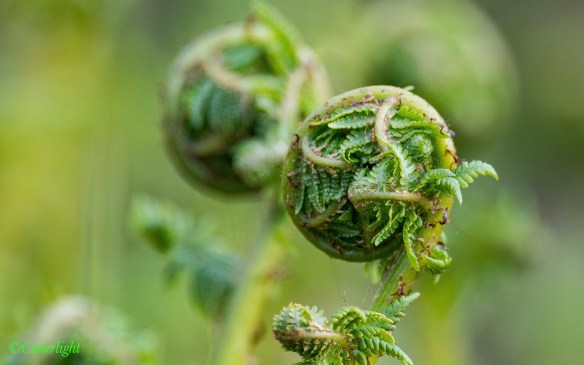
While Barbra was photographing alder catkins, (the long, golden-yellow flowers that hang from male trees), I turned my attention to the tightly furled fiddlehead ferns in the above photo. My mind was more on birds than plants, so I had affixed my wildlife lens to my camera and had even attached a teleconverter. But when I looked through the viewfinder, I liked the image so I composed the shot. There’s nothing like a long lens for creating bokeh. (Nikon D850, Nikkor 600 mm + 2.0 TC = 1200 mm, 1/25 at f8, ISO 650)

Chignik Lake in 29 Photos: Spring Spruce

Great Horned Owl Chick Chignik Lake AlaskaSpring Spruce

Until about 70 years ago, the shores of Chignik Lake had only seasonally been occupied by humans. Historically, the present-day site of the village had been a hunting and fishing camp. The first census here was recorded in 1960. Since then, The Lake has primarily been inhabited by people connected to commercial salmon fishing. Most of the permanent residents, which now number about 55, are of Native Alutiiq heritage.

Many of the original permanent residents had close ties to Kodiak Island. At 2,388 square miles (9,293 km2), Kodiak is quite large – second in size only to the Big Island of Hawaii among U. S. Islands. Much of Kodiak Island is covered in spruce forests. So when people began to permanently settle Chignik Lake, they introduced White Spruce seedlings from Kodiak. The species thrived, and now scattered throughout the village the trees grow as majestic singles, in pairs and in copses of up to 20 trees. They are a testament to the positive impact planting a few trees can have for wildlife, particularly birds. Among the beneficiaries are Great Horned Owls, a pair of which nests in one of the spruce copses.

This past spring and summer, the owls successfully fledged two offspring. In the photo above, the younger of the two siblings is perched on a White Spruce bough. Despite the needle-like spruce leaves there is a softness to this image, underscored by the downy owlet and the gentle transitions among hues of green and aqua. The plumb-colored young cones are visually surprising, I think, in a pleasant way. Although I made this photograph on June 25 – five days after summer solstice – I felt it fit perfectly in the springtime collection. Soft evening light slightly backlit and sidelit the young owl which helped prevent blowing out the white plumage. The air was still, allowing me to shoot slow and keep the ISO low – an important consideration when it comes to cropping wildlife photos and lightening areas of heavy shadow.  (Nikon D850, Nikkor 600 mm f4.0, 1/200 at f6.3, ISO 200.)

Chignik Lake in 29 Photos: Ballet

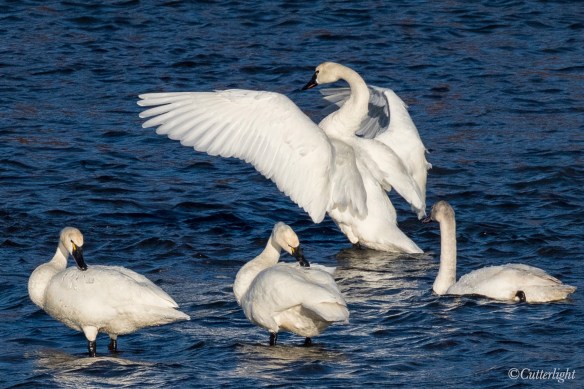
Tundra Swans on Chignik River AlaskaBallet

In spring, everyone begins watching for Tundra Swans on Chignik River and Chignik Lake. Their arrival is a sure harbinger of winter’s end. This was the scene on March 14, 2017. It had been a particularly cold winter. Ice still covered most of the lake and even the river was banked in snow and edged in ice. About a dozen swans gathered on the river at a shallow place about a mile below the lake. The location has a good bit of aquatic weeds. Along with the swans, there were Mallards, Red-breasted and Common Mergansers, Buffleheads, Common Goldeneyes, Ring-necked Ducks, Pintails and Greater Scaup.

Tundra Swans are hunted in Alaska. These swans were difficult to approach; the Mallards they were with were even more wary. The other challenge in making a photograph such as this is that by the time the sun was high enough above the surrounding mountains to provide sufficient light, it shone fairly harsh. Against the dark water, the white of the swans’ plumage was easily blown out. Although the D5 I used to take this photo is a very good camera, I hope I will get another opportunity with my D850. Even though I used a 2.0 teleconverter to achieve a focal length of 1200mm, the above image is cropped quite a bit. The capacity to crop in on wildlife images is one of the chief advantages of the D850, which has more than twice as many megapixels as the D5.

See all 29 photos at: Chignik Seasons: The Lake in 29 Photos

Chignik Lake in 29 Photos: Infinity Pool

Chignik Lake Clarks River BayInfinity
This was the view looking across the lake from the beach near the mouth of Clarks River on May 14, 2019. The lake seems to disappear in mist where sky and water meet. From the village of Chignik Lake, the hike to this location is about three miles.

In addition to the landscape, which can be stunning, this is also a good place to view wildlife such as River Otters, Harbor Seals, Brown Bears, Bald Eagles, gulls, mergansers and other ducks, loons and migrating salmon. (Nikon D850 1/200 at f/11, ISO 250, Nikkor 24-70 mm at 24 mm with a polarizing filter)

See all 29 photos at: Chignik Seasons: The Lake in 29 Photos

Birds of Chignik: Kittlitz’s Murrelet – North America’s Rarest Seabird

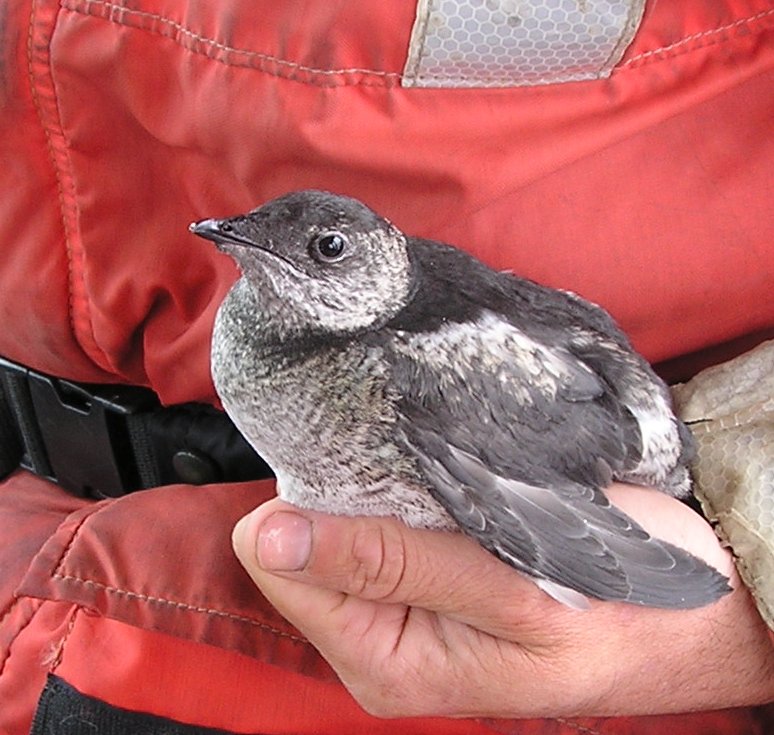
This Kittlitz’s Murrelet was caught in Kachemak Bay, Alaska (near Homer). Note the very small bill compared to the similar Marbled Murrelet. (Photo U.S. Fish & Wildlife Service on Wikipedia)

Kittlitz’s Murrelets are an uncommon, poorly studied species. Only a few nests have been located. They indicate solitary pairs (as opposed to colonial nesters) choosing sites above the tree line on the southern slopes of rugged mountains. Often the nests are located on scree fields associated with past or present glacial activity. The pair lays just one egg. The Kittlitz’s’ diet is not well known, but as bill size and shape generally indicate feeding preferences, it might be surmised that they pursue somewhat different prey than the closely related Marbled Murrelet, which has a larger, slightly curved bill.

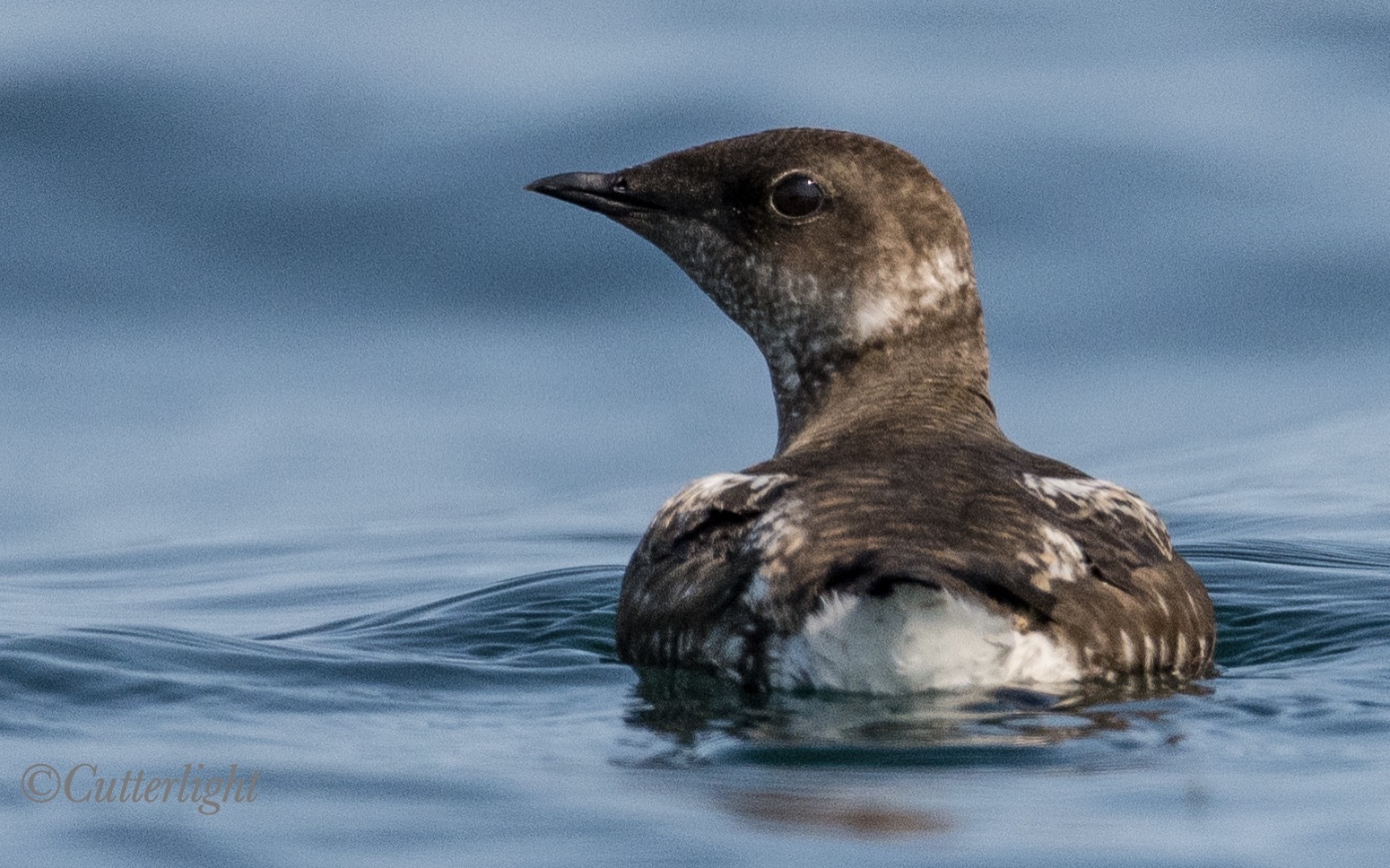
Although the specimen in the above photo doesn’t show it, in addition to a small bill Kittlitz’s Murrelets show golden-brown in their plumage during breeding season. Non-breeding birds tend toward mottled white and black much like their Marbled cousins, but in the Kittlitz’s the eye is surrounded by white whereas in the Marbled a black cap extends downward to cover the eye and the upper cheek. (See the photos in Marbled Murrelet – Seabird of Moss Nests and Old Growth Forests.)

This Kittlitz’s Murrelet shows a bit of golden-brown in its breeding plumage. Again, note the very small bill. Diving birds, they are known to prey on fish such as sand lances and herring as well as on crustaceans. (Photo U. S. Fish and Wildlife Services)

These are small birds, only about 9.5 inches from bill to tail. We will continue carefully checking the murrelets we encounter in Chignik Bay and Chignik Lagoon in hopes of getting a clear photograph. This is one of the rarest seabirds in North America. There aren’t many good photos of this species, and none at all that I could find of a Chignik bird. On the upside, our local coastal waters support abundant populations of both sand lances and herring which appear to be among the Kittlitz’s preferred dietary items, particularly during the nesting season. It is believed that about 14% of the Kittlitz’s population breeds on the Alaska Peninsula.

Due to this this species’ association with glaciers during breeding season, Kittlitz’s Murrelets appear to be particularly vulnerable to the impact of global warming trends.

Kittlitz’s Murrelet Range Map: Alaska Department of Fish and Game

Kittlitz’s Murrelet Brachyramphus brevirostris
Order: Charadriiformes
Family: Alcidae
Genus: Brachyramphus – from Ancient Greek brakhús = short + rhámphos = beak
Species: brevirostris – Latin: short-beaked

Status in Marine Waters near Chignik: Uncommon

David Narver, Birds of the Chignik River Drainage, summers 1960-63: Not observed as this is a marine species

Alaska Peninsula and Becharof National Wildlife Refuge Bird List, 2010: Uncommon in all Seasons

Aniakchak National Monument and Preserve Bird List: Present

Table of Contents and Complete List of Birds of Chignik Lake

© Photographs, images and text by Jack Donachy unless otherwise noted.

For a list of reference materials used in this project, see: Birds of Chignik Lake

Birds of Chignik: Marbled Murrelet – Seabird of Moss Nests and Old-Growth Forests

Chignik Marbled Murrelet

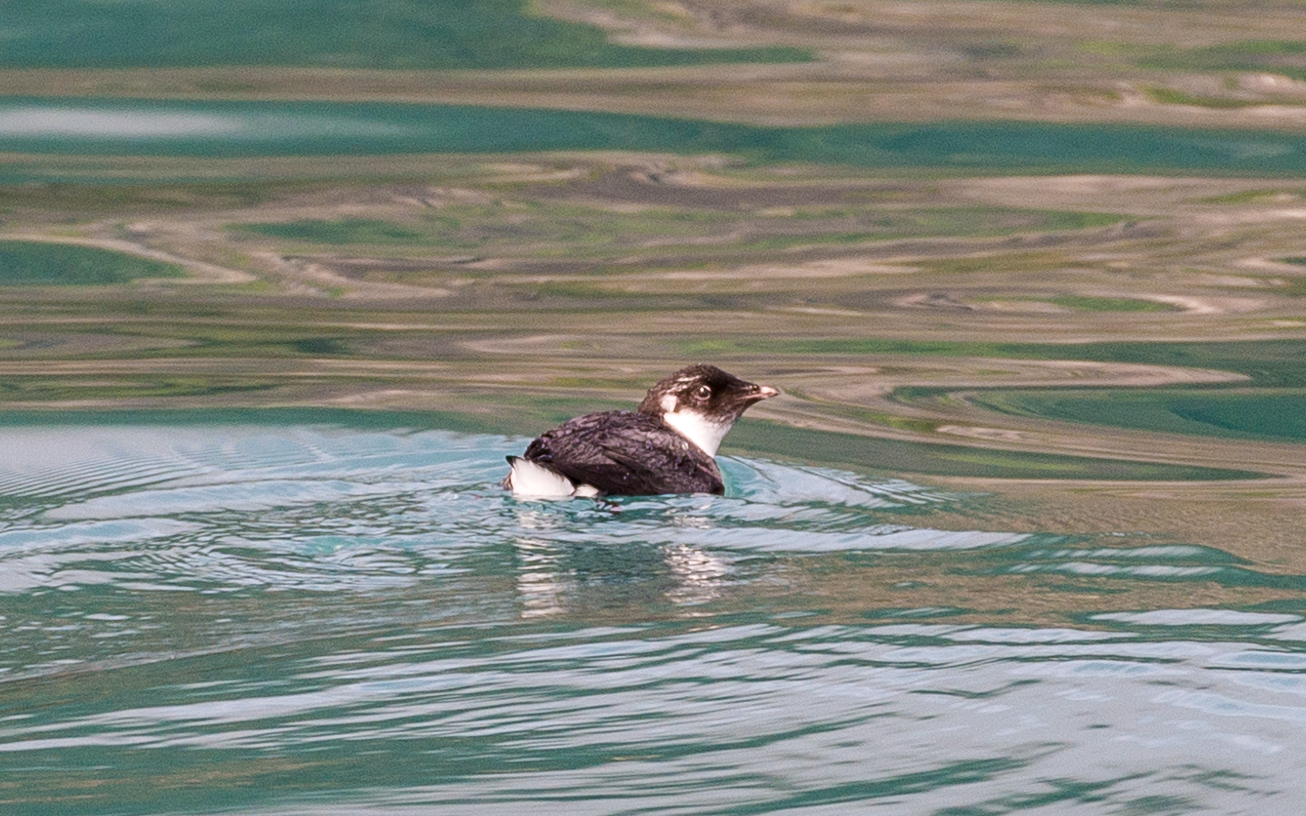
Although rarely present in great numbers, Marbled and Kittzlet’s Murrelets can often be observed in the estuarial waters of Chignik Lagoon and along the rocky coast of Chignik Bay. (Chignik Bay, July 28, 2020)

Before I began this project, it never occurred to me that forest habitat might be critical to a seabird. Yet such is the case with the Marbled Murrelet. Although Russian explorers first identified this species in 1789, it’s nesting habits remained a mystery until 1974. Hoyt Foster, a tree-trimmer working high up on a Douglas Fir in California’s Big Basin Redwoods State Park noticed a ball of fluffy down in a mossy tree branch. He carefully wrapped the bird and took it to a biologist who identified it as a Marbled Murrelet chick.* Thus, a great mystery in avian biology was solved, and yet another very good reason was added to the growing list of reasons to preserve the remaining remnants of the West Coast’s old growth forests. Of particular importance to murrelets are those coastal forests growing within about 45 miles of rocky coastlines from northern California through southeastern Alaska.

Marbled Murrelet, Kenai Fjords, Alaska. The light-colored bill makes me think this is a recently-fledged specimen. Fully grown, this species measures just under 10 inches on average – small as seabirds go. (July 22, 2012)

In addition to moss covered tree branches, a smaller number of Marbled Murrelets lay their solitary egg amidst rocks on talus slopes and among boulders. Either way, the nests are unadorned and inconspicuous. Both parents feed the chick, generally returning in twilight or darkness to avoid leading predators to the nest. Like other diving seabirds, their diet consists of fish and other small animals they might catch in nearshore ocean waters.

Cascade Mountains, Oregon: photo by Matt Betts, April 12, 2016

When you think of nesting Marbled Murrelets, think of ancient trees, early morning fog sifting through fir and redwood limbs covered in thick moss and a small, vulnerable seabird nestled into that moss, her body warming one tiny, downy being

Marbled Murrelet Range Map

Marbled Murrelet Range Map: with permission from The Cornell Lab of Ornithology, Birds of the World

Marbled Murrelet Brachyramphus marmoratus
Order: Charadriiformes
Family: Alcidae
Genus: Brachyramphus – from Ancient Greek brakhús = short + rhámphos = beak
Species: marmoratus – Latin: overlain with marble

Status in Marine Waters near Chignik: Not abundant but frequently encountered in Chignik Bay and Chignik Lagoon; Infrequently encountered on Chignik Lake, particularly in Clarks River Bay

David Narver, Birds of the Chignik River Drainage, summers 1960-63: Uncommon on Chignik lake

Alaska Peninsula and Becharof National Wildlife Refuge Bird List, 2010:Uncommon in all Seasons

Aniakchak National Monument and Preserve Bird List: Present

*See: Frost, Garrison, A Seabird in the Big Trees, Audubon Audublog, June 3, 2013

Table of Contents and Complete List of Birds of Chignik Lake

© Photographs, images and text by Jack Donachy unless otherwise noted.

For a list of reference materials used in this project, see: Birds of Chignik Lake

Birds of Chignik: Common Murre – “The Flying Penguin”

Common Murre Alaska Gulf

The barring on this murre’s flank indicates a Common Murre. Thick-billed Murres, a close relative, have unmarked flanks. Standing about 15 to 18 inches tall, these somewhat penguin-like birds are close relatives of the Great Auk, a bird that stood 30 to 33 inches tall and went extinct in the mid-1800s. (Photo Resurrection Bay, Alaska, July 2012)

I haven’t yet managed to get a good photo of Chignik Bay’s murres, though we see them from spring through fall on excursions out onto salt water. Chowiet Island, located about 68 miles from Chignik Bay, is a known breeding site for this species.

When not nesting, murres are birds of the open sea. In fact, one of the most astonishing wildlife scenes we’ve ever witnessed was on a day in late summer when we hiked out to the tip of the peninsula at Point Hope. Apparently our hike coincided with the end of the breeding season. We stood on the beach and watched in awe as thousands upon thousands of murres and other seabirds poured from nearby sea cliffs and streamed passed us toward the open sea where they would spend the coming winter months. Having brought along no cameras, we drank in the moment, doing our best to commit the image to memory.

murres and puffins, Tikigaq Point Hope

At the tip of the Point Hope Peninsula 200 miles above the Arctic Circle, a birder can stand on the pebbled shoreline of the Chukchi Sea and watch murres, puffins, loons, ducks and other seabirds fly back and forth from nesting sites to feeding grounds throughout the nearly endless Arctic day. Flying from right to left, the birds in the photo are returning to nests, as evidenced by sand lances hanging from the bill of one of the puffins and one of the murres. You can bet that the rest of the flock have stomachs and gullets crammed full for waiting mates and youngsters! (August 20, 2012)

Unfortunately, the combination of a warming earth (and warming seas), oceans filling up with plastic and overfishing are taking their toll on murres. Although they remain abundant in most regions, numbers appear to be declining almost everywhere. The concern with any species that thrives as part of a crowd is that a threshold might be crossed after which numbers plummet drastically. We’ve seen this with avian species such as Eskimo Curlews and Passenger Pigeons as well as (I suspect) populations of salmon. Some species simply do better when there are lots of them.

Teuri Island Murres Flowerbed

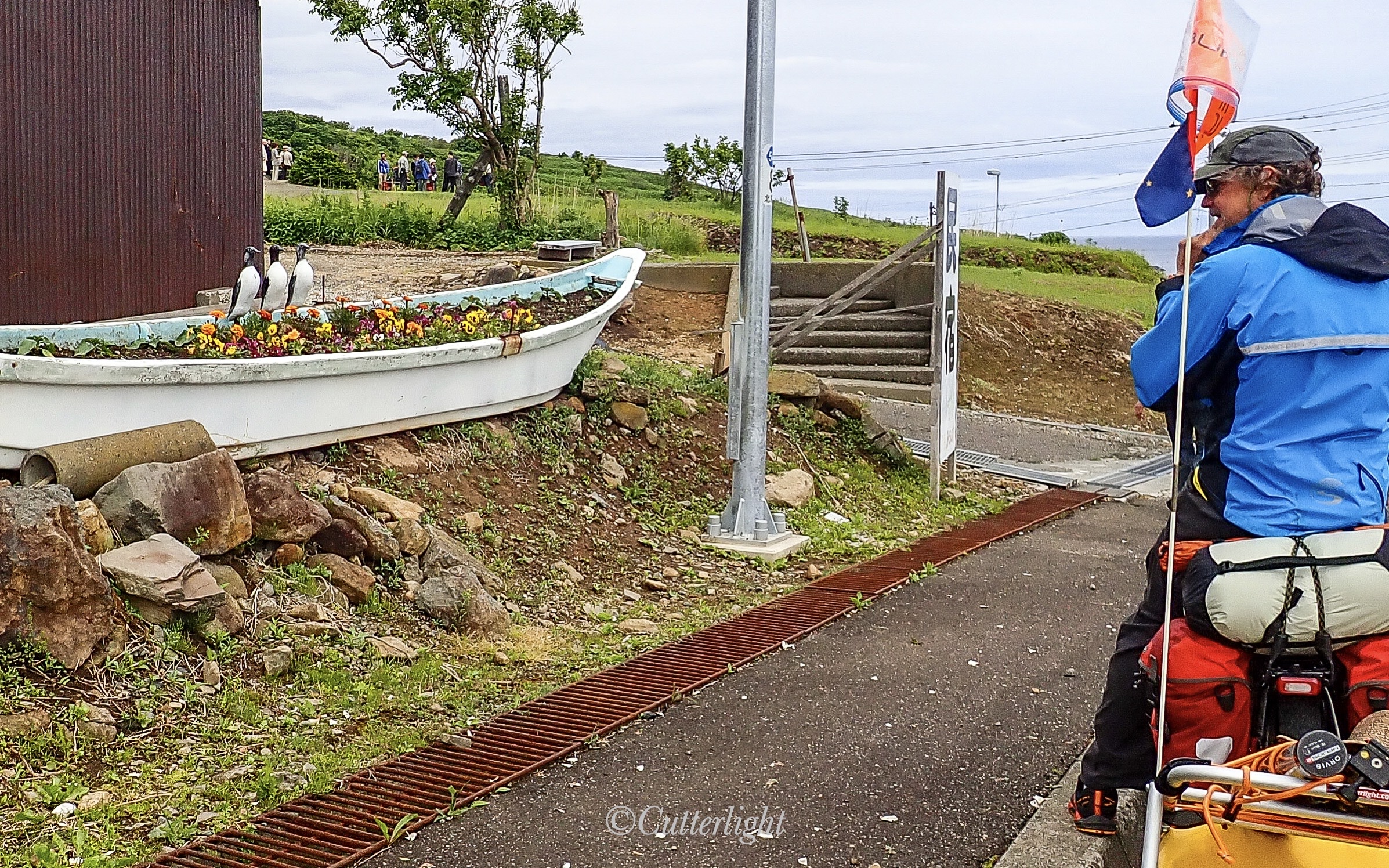
As recently as 1963, there were an estimated 8,000 Common Murres nesting on Teuri Island off the coast of Hokkaido, Japan. When we visited the island in 2018, there were only eight. For certain species, when numbers become too low predation overwhelms the individuals that remain. This appears to be the case with Teuri’s murres. The few remaining birds are no match for the island’s Slatey-backed Gulls and aggressive Large-billed Crows. At some point, restoration efforts become nearly futile. Teuri’s murres are celebrated in art and literature and in decorative memorials such as this skiff converted into a flower garden. 

murres on sea stack near Homer Alaska

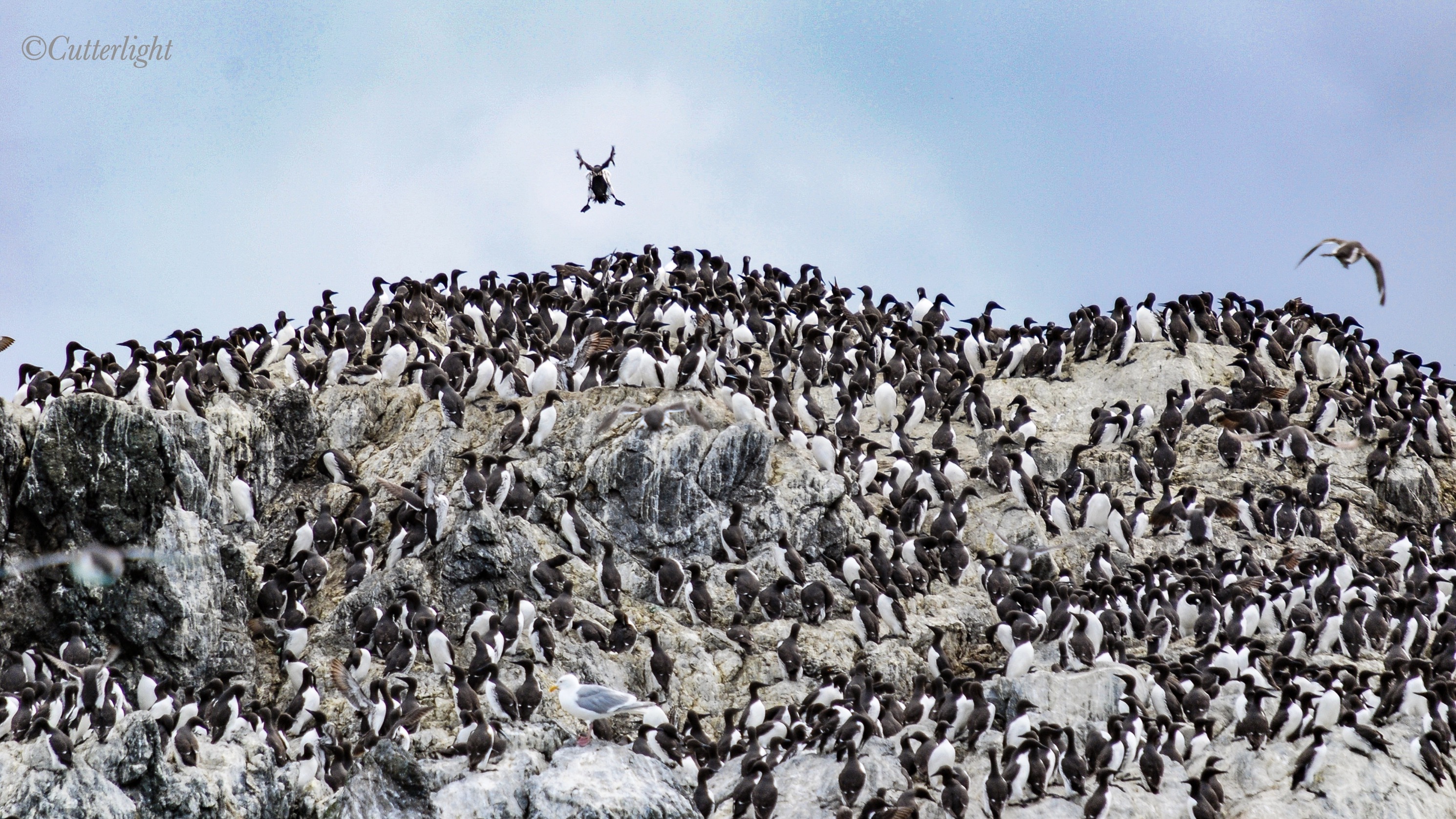
It truly is a joy to encounter a large colony of seabirds. These murres have crowded onto a sea stack near Homer, Alaska. (July 2009)

Common Murres on Sea Cliffs Kenai Fjords Alaska

Although they remind one of penguins, murres are actually members of the auk family. Capable of diving to depths of 150 feet or slightly more, they pursue fish, squid and krill as they “fly” through the water. (Kenai Fjords, Alaska, July 2013)

I’m looking out the window at an icy Chignik Lake as I write this on a blustery day in January, but I’m anticipating a calm morning at sea this coming summer when Barbra and I might be able to get a halibut for the cooler along with some good photos of our local murres.

Range Map Common Murre

Common Murre Range Map: with permission from The Cornell Lab of Ornithology, Birds of the World

Common Murre Uria aalge
Order: Charadriiformes
Family: Alcidae
Genus: Uria – from Greek ouriaa for a waterbird
Species: aalge – Danish aalge from Old Norse alka = auk

Status in Marine Waters near Chignik: Common

David Narver, Birds of the Chignik River Drainage, summers 1960-63: Not observed, as this is a marine species

Alaska Peninsula and Becharof National Wildlife Refuge Bird List, 2010:
Common in Spring, Summer & Fall; Uncommon in Winter

Aniakchak National Monument and Preserve Bird List: Present

Table of Contents and Complete List of Birds of Chignik Lake

© Photographs, images and text by Jack Donachy unless otherwise noted.

For a list of reference materials used in this project, see: Birds of Chignik Lake

A Moment of Bliss: Otters On Ice at Chignik Lake Alaska (Short Video)

When Chignik Lake freezes, the magic begins. The ice hasn’t been solid enough for us to venture out on, and we’re heading for warmer weather – so it may not happen this year. Nonetheless, we’ve been enjoying watching some of our local River Otters from shore. Cute and inquisitive beings, the do quite a number on the lake’s population of finger-sized sculpins. Watching these otters glide through the water and slip gracefully into the ice lake makes for an entertaining break in your day. Hope your day is going well! Happy New Year from Jack & Barbra at The Lake!

An Incalculable Loss: Tragedy at Chignik Lake

Fred Shangin and Nick Garner

Fred Shangin, left. Nick Garner, right. They don’t cut men from finer cloth. Watermen through and through, from the headwaters of the Chignik to the unpredictable Alaska Gulf and Bristol Bay, Fred and Nick were two of the most skilled boatmen in the world. We were honored to have them take us under wing and teach us. We are asking our readers to make a contribution in the name of Fred and Nick to the Alaska Dive Search Rescue and Recovery Team.*

Christmas Day here was wonderful. To imagine a holiday at The Lake – Halloween, Easter, The Fourth of July, Christmas – place yourself in a small town 50, 60, 70 years ago, in a gentler, quieter world, far less commercialized, less politicized, more intimate. It snowed all day. Multiple invitations were issued back and forth to come share food and cheer, and for those who felt uncomfortable visiting due to Covid… or for whom age has made going out on a snowy day difficult… heaping platters of turkey, ham, moose, beef, salmon, side dishes and desserts were delivered. The day was a snapshot of life in our tiny village.

How quickly a scene… or a small boat… can flip, leaving the world upside down.

Despite the prospect of incoming weather, the following day three of our men took a skiff up the lake, an eight mile run. The boat the men took was also carrying a snow-machine, the Alaska term for snowmobile. The plan was to look for moose or caribou to replenish the village’s stock of meat.

Weather was coming from the southeast. From that direction, winds have an unobstructed eight miles to build waves as they blow up the lake to the sometimes treacherous northwest corner. Near the lake’s outlet at the village of Chignik Lake, the water can be calm while up in the northwest corner messy, white-capped three footers seem to come from all directions as they bounce off the sheer mountains that crowd the shoreline. Sudden williwaws pouring down those same mountains can turn those three-foot waves into erratic four footers. That’s a lot of sea for a small boat – enough to upend such a vessel.

And so it is that the village lost two great men in the prime of their lives, and we lost two dear friends. Fred was a particularly close friend. In fact, he was much more than a friend. He was our nearest neighbor, our guardian angel and perhaps the most generous and capable man we’ve ever known – and the happiest, truly a man who had found his place in this life. Unbelievable that the guy Barbra sometimes called Superman had perished like that.

Fred was one of the guys who kept the diesel generators running that supply The Lake with electricity; the guy who texted and called me, relatives and friends every day to check in and see what we were up to or to invite us along on one of his adventures. He’d run his skiff down the river and out onto the ocean to set halibut skates (similar to trot lines) and crab pots (which he and Nick welded together from rebar and chicken wire); he was the guy who organized hunting trips for moose and caribou. He was the guy who set nets for salmon and liberally shared his catch. When Fred got halibut, everyone got halibut. When Fred got crab, everyone got crab. When Fred and his crew got a moose… well, you get the idea.

He taught us how to spot the caribou that go up on the ridges of the lower mountains on warm summer days, miles across the lake, mere specks we’d overlooked till Fred pointed them out. He appreciated my photographs, and so I’d regularly get texts and calls from him: Bear on the beach with 2 cubs, or Wolf on the airstrip or Looks like a dandy day there Jack. Good day to go out and take some pictures.

Nick, too, was a friend, though we were only just beginning to get to know each other well. Like Fred, he had a wide range of skills and we admired him greatly. Both were loving, devoted family men. To the village, they were excellent providers as well as the kinds of men who would do anything to help a friend or neighbor. Fred was 42. Nick was 39. In our village of Chignik Lake, a community of only 50 or 60 residents, the loss of these two great men is incalculable. The entire village is in a state of disbelief, shock and sadness.

A fitting tribute to these men would be a contribution to the Alaska Dive Search Rescue and Recovery Team.* Thank you so much for contributing whatever you can give.

*The Alaska Dive Search Rescue and Recovery Team is a donation funded, all volunteer, unpaid, 501(c)(3) Non-Profit Corporation. Donations are tax deductible.
   Only through charitable donations can their volunteers receive the specialized training needed to perform hazardous missions. It also ensures they can maintain their extensive rescue gear cache and equipment trailer that are required to perform missions around the state.