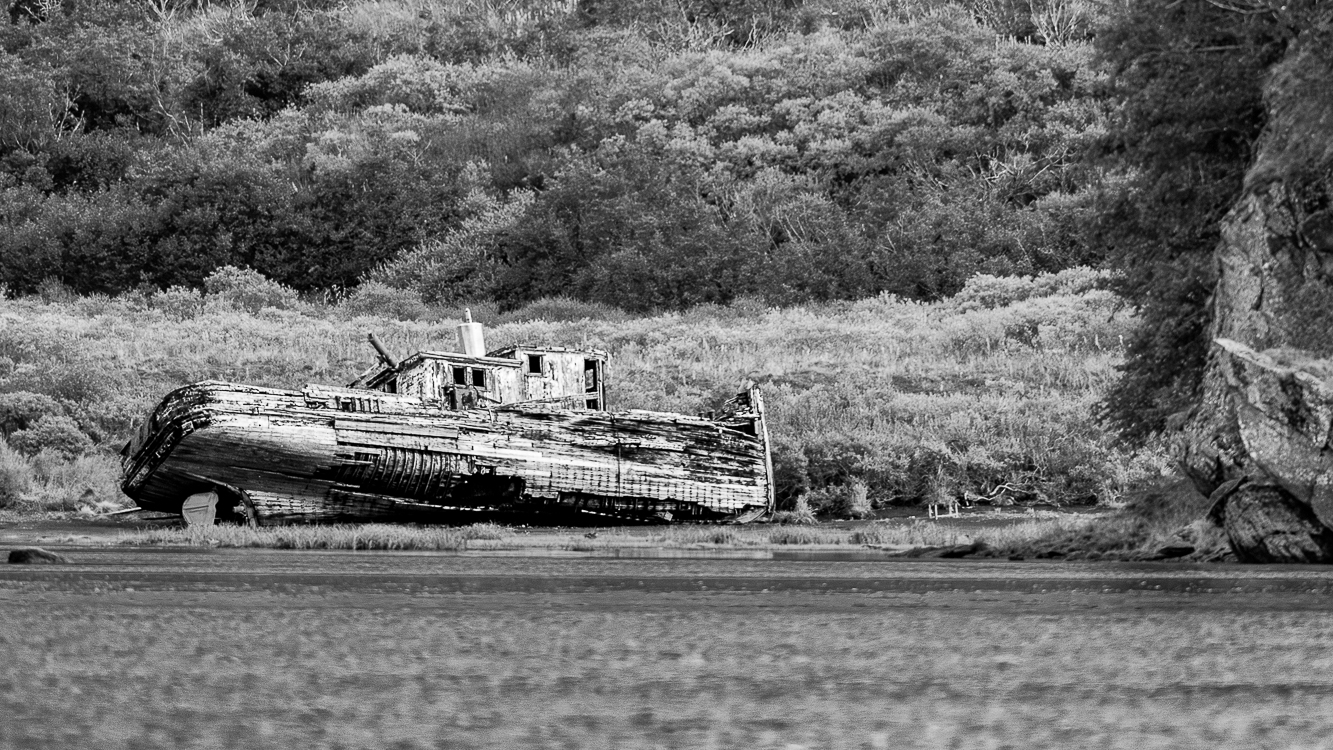
Back in the Day: Wooden Salmon Seiner, Chignik River (and a note on the perils of passing up photographs)

Back in the DaySalmon Seiner from the wooden boat era in the Chigniks
Chignik River, September 23, 2016

Concurrent with publishing this photo, I’m putting out a request on other social media asking my Chignik friends for more information on this vessel. I don’t know a lot about boats, but I’m fairly certain that this is a salmon seiner, perhaps built sometime in the 1940’s or 1950’s. It was aground, as you see here, about two miles up from the salt chuck when I noticed it tucked into the back of a wide river cove accessible only on high tides. The tide was out, the person whose skiff I was riding in was in a hurry to get down to Chignik Bay, so I settled for this passing shot. I always intended to go back and get additional photographs, but it never worked out. Years later, I saw what appeared to be the same vessel on a beach at Chignik Bay – perhaps towed there by someone who valued its history.

The lesson here, such as a lesson exists, is to be careful… mindful… about passing up shots – even if the composition is imperfect. No doubt every serious photography has in their memory banks a list of pictures that they passed on and later came to regret not getting. You arrive at a new locale, note a species of bird that is new to you, assume that they must be abundant there, pass on the shot and never see another bird like it. You keep telling yourself you’ll make a portrait of that special friend – and never create the right moment. Or you tell yourself that you’ll come back to make a photo of the stunning landscape before you. But way leads to way and you never return.

While no one can get every shot they’re presented with, some of the ones we pass on haunt us. They become very much like those big fish that got away, growing larger over time… until all those photos and fish meld into a single image of a monster of a Japanese Sea Bass emerging from the surf, shaking her massive head, and then dark tunnel vision as the white jig breaks free from her jaws and comes springing back through the air as your knees turn to rubber – that Sea Bass my own personal metaphor for In my life as a photographer: a rare Spotted Redshanks flitting around me as I cast flies to Chignik River Salmon, assuming the bird to be more common than it is; a Parasitic Jaeger stuffed so full of fish it could barely fly perched near me on shore the first time I hiked out to Tikigaq Point, again, making the assumption that this would be a regular occurrence I’d have other opportunities to capture; portraits of my friends and neighbors at The Lake… the “some other day” I was going to photograph them never arriving.

So, imperfect as this photograph is, I’m glad I got it when I had the opportunity. A boat like this will never again be seen on the Chignik.

I’ll update this post if I discover additional information.

Subsistence Salmon Beach Seining on Chignik Lake

This short video shows a group of Chignik Lake residents beach seining for Sockeye Salmon along the shores of Chignik Lake. The salmon thus harvested were later distributed to village members.

I didn’t have the lenses I might have preferred to have with me, and I have just barely begun the journey into videography, but on a recent hike up the lake to the mouth of Clarks River, an opportunity presented itself. Jake and Jamie pulled up to the beach in Jamie’s skiff and in a few minutes were joined by several other friends and neighbors who had traveled upcountry by honda. The plan was to do some beach seining along the lakeshore for Sockeye (Red) Salmon, with the request that since I was there, would I take some photos? 

I’d made the hike in hopes of finding interesting macro shots, or perhaps a moose or bear in a landscape setting. The 105mm prime lens attached to my camera wasn’t ideal for the shoot at hand, but it was the lens in hand – neither long enough to adequately capture the bear that was fishing at the mouth of Clarks when I first arrived, nor wide enough to capture the sweeping landscape the netting operation was set against. 

Nonetheless, I really got into recording this event, which has been occurring here in the Chigniks in one form or another for thousands of years. In fact, if you look closely along lake and river beaches where salmon harvesting has long occurred, you might get lucky and find stone artifacts such as the ones in the photo below.

From upper left, counterclockwise: The notched ends in the first three stones indicate that they were used as weights along the lead line – the bottom line – of a fishing net. The oblong object in the upper right is an ulu-like knife that would have been used to split salmon carcasses before they were hung to dry. It is still quite sharp. The two center pieces are arrowheads. 

Most of the time in most places, salmon spawn over clean gravel or small rocks in clear-flowing rivers and streams. Sockeye Salmon, however, often spawn along lake shorelines where upwelling in the form of small underwater springs is present. There doesn’t have to be a stream as long as enough water is seeping up through lakebed gravel in water a few feet deep. There the female Sockeye will scrape out her nest, her redd, with her tail, deposit her eggs which a male at her side will fertilize, and then push gravel back over the eggs to protect them while they incubate. Shortly after they’ve spawned, all the adult salmon will die. Their decaying carcasses provide a vital source of nutrition for the various zooplankton and small insects upon which their young will feed until they’ve matured sufficiently to migrate out to sea.

This past season, beginning in late May or early June, over half a million Red Salmon ascended the Chignik River. While many spawn in the lake itself, many others spawn in the Chignik River as well as in several tributary streams and rivers. These salmon, along with the Pink, Chum, Coho and Chinook that also run the Chignik, are foundational to life here. They provide food for our abundant bears, eagles, otters, seals and other wildlife, provide a nutrient base for the lakes and rivers, and, with the help of Brown Bears, become fertilizer for berry flats, wildflowers and other vegetation which, in turn, feed everything from mushrooms to mice to caterpillars to songbirds. It would be no exaggeration to say that every living thing along the Chignik is connected to salmon. That includes the 50-some residents of Chignik Lake, among which Barbra and I are two.