Hawk Chicks

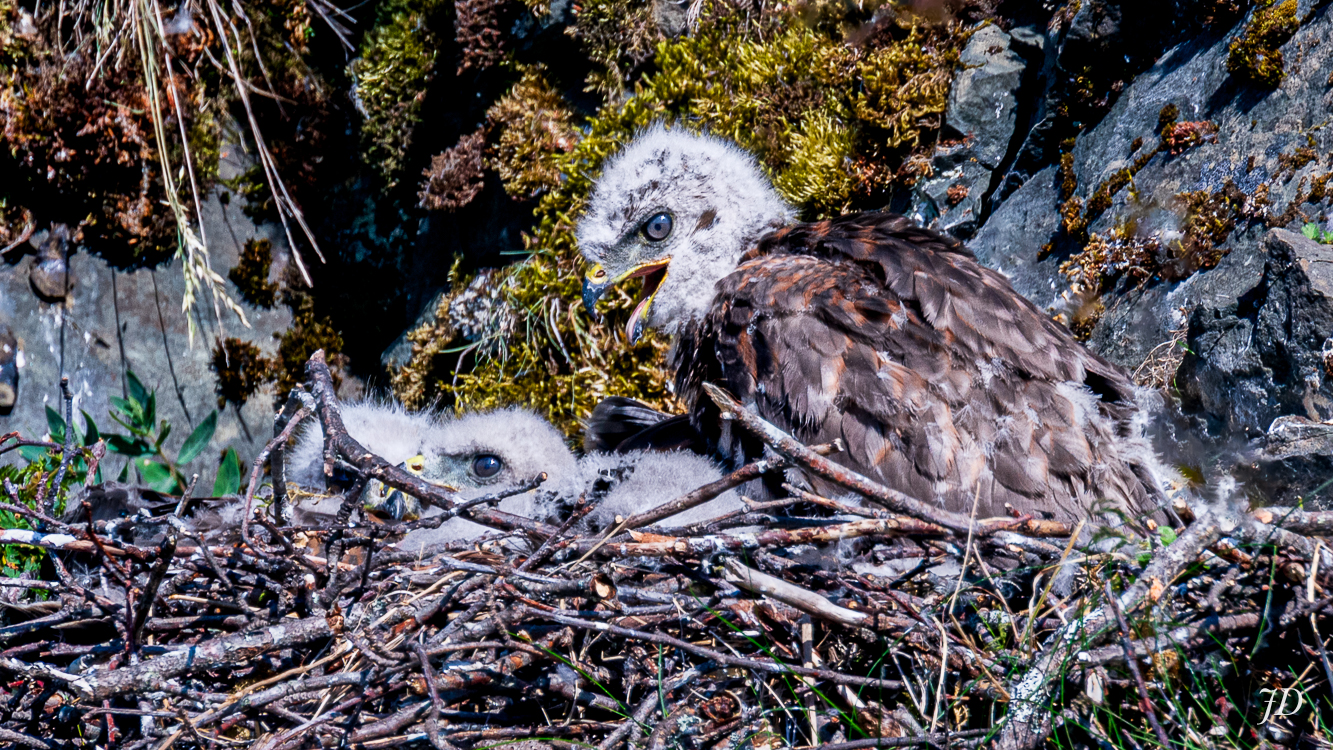
Rough-legged Hawk Chicks
Chignik River, Alaska Peninsula, July 14, 2020

When I had the opportunity to make images of the Rough-legged Hawk nest at the cliffs along the lower Chignik River, I was still thinking of myself as primarily a documentarian. Additionally, human proximity to the nest was clearly upsetting to the chicks as well as to the parents. And so, a couple of times I waded into the river, made quick photographs, and left. Documentation accomplished.

In hindsight, it might have been worthwhile to construct a blind at a respectful distance and to thereby more thoroughly record the nesting events that occurred every summer until recently at this little ledge about 60 feet up from the surface of the river. A regret is that I never made a video of the birds. Unfortunately, in July 2021, a magnitude 8.2 earthquake rocked the Chignik area and in so doing deposited a volleyball-sized boulder squarely in the center of the nest. The little ledge had always been a precarious site – exposed at times to high winds, vulnerable to potential predation by our resident Great Horned Owls, and subject to regular skiff traffic (and associated engine noise) – and in fact the summer of the big quake after laying just one egg, for unknown reasons the hawks abandoned the nest, before the earthquake struck.

After the big earthquake, with a large rock left in the middle of the nest, the site was no longer usable. We think we discovered a new nest further up the drainage, so hopefully Rough-legged Hawks will continue to be a part of Chignik fauna.
Paired Bluebills in Spring Rain

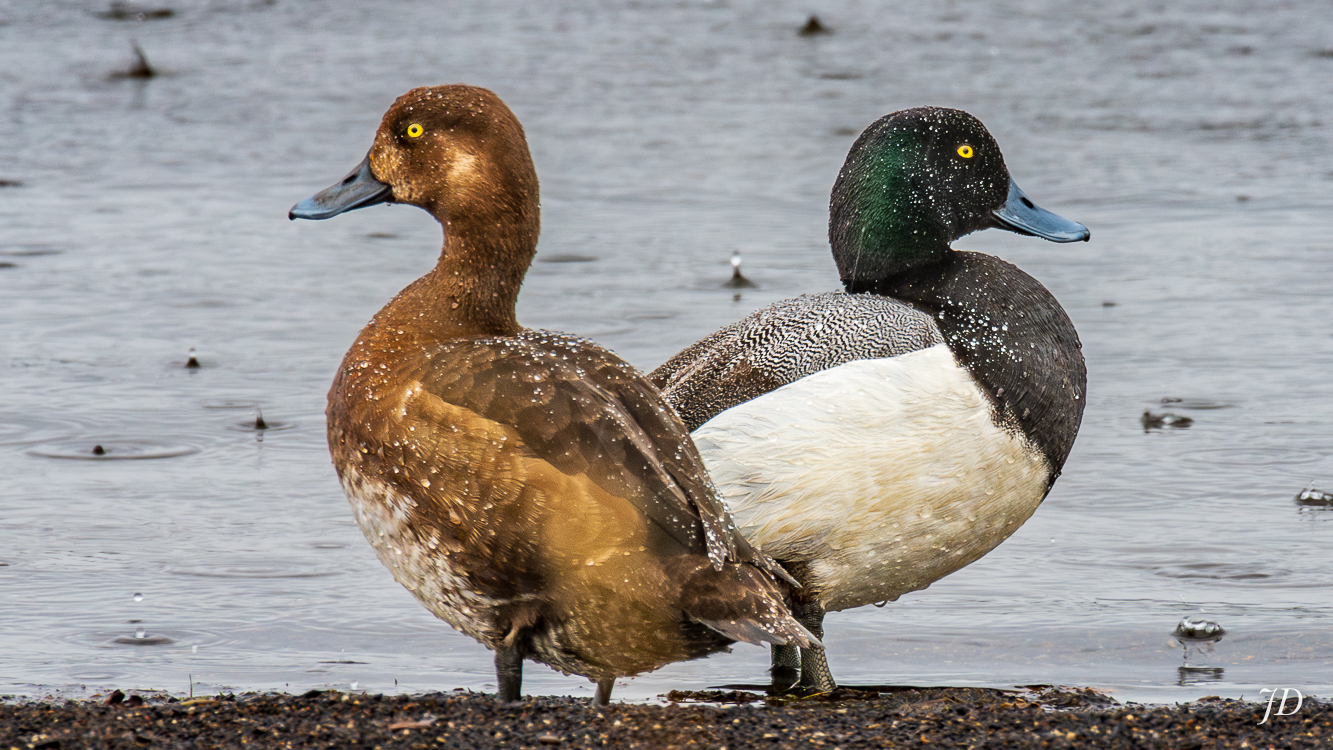
Paired Bluebills in Spring Rain
Female (left) and male Greater Scaup, Chignik Lake, Alaska Peninsula, June 2, 2020

It hasn’t been until fairly recently, perhaps coinciding with a general interest in birding rather than mainly hunters looking closely at waterfowl, that the term Scaup has begun to supplant Bluebill when referring to the ducks in the above photo. These are Greater Scaup, a mated pair that paused at the lake along with several others of their kind for a little while in early June before heading off to find their own kettle pond nesting sight. There are also Lesser Scaup, very similar in appearance though slightly smaller and with a less rounded head. Though Greater Scaup were often abundant on the lake and in the river’s largest pools in winter and spring, I never encounter a Lesser there.

The term Scaup may be derived from the Scottish scalp which refers to bivalves such as clams and mussels, preferred food items for these diving ducks, though they also eat various types of aquatic vegetation. Interestingly, they are the only circumpolar diving duck – hence the European origin of their vernacular name. Their “quack” is a bit more hoarse or nasal than that of the familiar Mallard, and is often comparatively quiet. But at The Lake, it was a music we associated with spring, and we find now that we miss it.

JD

Caption?

The Triplets
Chignik Lake, Alaska Peninsula, June 22, 2020

How about a caption?

Happy Monday everyone!

You Comin’?

You Comin’?
Coastal Brown Bears, Chignik River, Alaska Peninsula, June 19, 2020

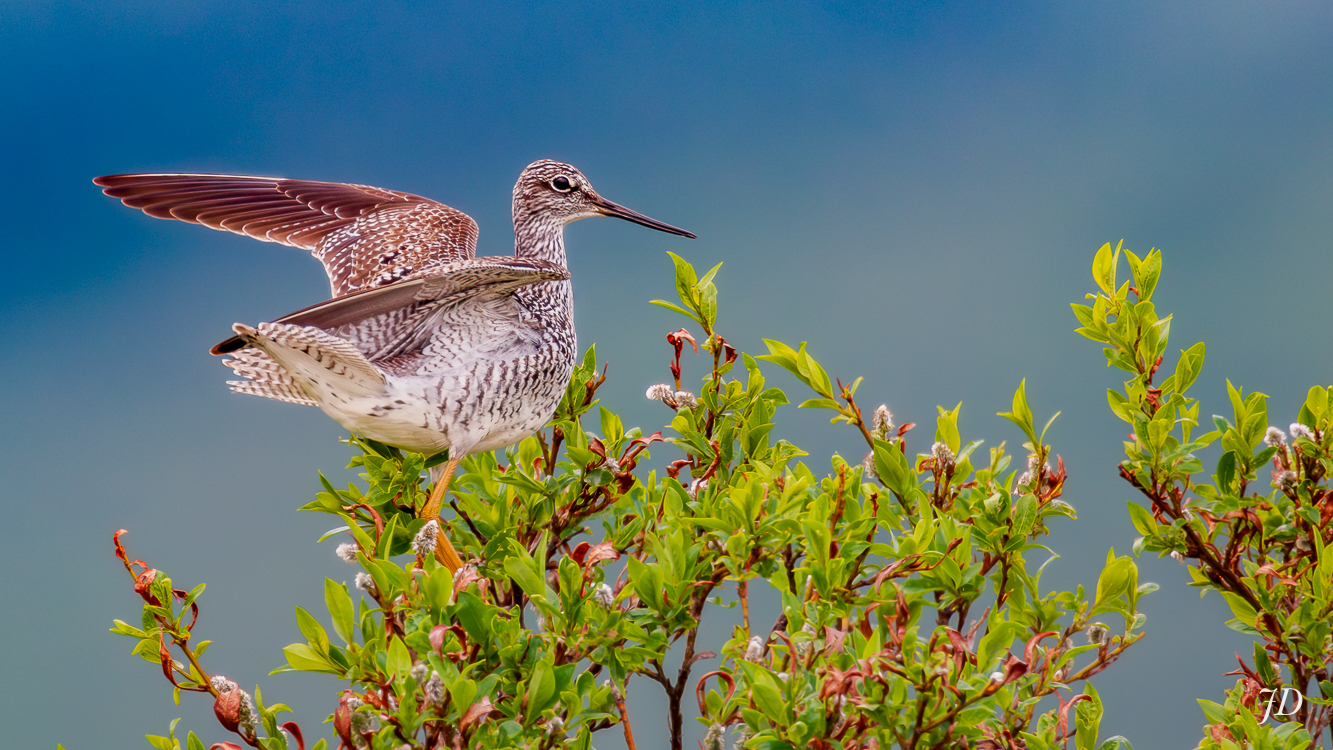
Treetop Shorebird

Treetop Shorebird
Greater Yellowlegs, Chignik Lake, Alaska Peninsula, June 14, 2019

Greater Yellowlegs (as well as Lesser Yellowlegs and Wandering Tattlers) are well known as shorebirds that often perch in trees, particularly near their nesting sights, which are on the ground. They are abundant throughout the Chignik River drainage where they primarily feed on various small fishes.

The Dandelion Jungle

The Dandelion Jungle
Male Pine Grosbeak (Pinicola enucleator), Chignik Lake, Alaska Peninsula, June 14, 2019: Note his bulging crop – stuffed with dandelion seeds.

I can’t remember a time, ever, when I understood lawns. “We’d have more animals around our house if it was more like the rest of the woods and fields around here,” I once observed to my father. “We don’t want more animals around here,” came the reply. My antipathy toward lawns grew when for a brief time as an adult I owned a home where it was the neighborhood expectation that I keep the yard regularly mowed. And thus, for a while, I joined the ranks of suburban farmers, periodically harvesting a crop of grass. But at least I had the sense to use a mulching mower, thereby returning the clippings to the soil rather than gathering them and thus necessitating an endless need for ever more fertilizer.

The only place at The Lake appointed with a lawn was the school. I suppose it made some sense to keep those grounds trimmed as the yard was a popular play area for children. Fortunately, neither weedkillers nor fertilizer was part of the scene (though after each mowing the maintenance crew insisted, pointlessly, on raking up the clippings – and so it can be assumed that year upon year the soil there loses some nutrition). But thanks to the absence of poisons, all kinds of wildflowers volunteered themselves among the blades of grass: wild strawberries, willowherb, avens, yarrow, and around the edges even lupine and an occasional chocolate lily found a place to put down roots. But best of all I think was the spectacular carpet of dandelions the yard acquired each spring. And fortunately, we were able to prevail upon the lawn crew to delay mowing until well after this event.

All winter long, redpolls, siskins and Pine Grosbeaks – took advantage of feeders, alder cone seeds and spruce cone seeds. And then, when the dandelions went to seed, these finches would descend on the lawn and gorge themselves on nutritious, oily dandelion seeds, filling the yard with their happy chatter.

Hidden World

Hidden World
Male Orange-crowned Warbler, Chignik Lake, Alaska Peninsula, June 2, 1019

Chin Scratch

Chin Scratch
American Robin, Chignik Lake, Alaska Peninsula, May 20, 2019

Having long associated American Robins with manicured lawns in the Lower 48, I was mildly surprised the first time I encountered the species along the Chignik River. They were not reported in David Narver’s Birds of the Chignik River Drainage study based on his observations in the early 1960’s, and although they are considered common further up the peninsula, from Aniakchak National Monument and Preserve (which encompasses much of the Chignik Drainage) all the way to Izembek National Wildlife Refuge near the peninsula’s western tip, the species is either not documented at all or is listed as only an occasional migrant.

For the most part, that’s how we encountered them at and near The Lake – a few birds passing through in mid-spring, late summer and early fall. But, they seem to gradually be establishing themselves along the Chignik. In two years, at least one pair remained late into spring, well after the peak of the dandelion bloom. We thought that in at least one of those late springs a pair of robins had attempted to nest. However, the weather became persistently cold, rainy and windy and there was no indication of success.

Along with the weather, abundant magpies and ravens – well-known nest predators – might be limiting factors to breeding robins. Nonetheless, it is likely only a matter of time before American Robins become established as regular nesters on the peninsula, particularly in villages such as Chignik Lake where lawns provide easy access to the earthworms they like to forage on.

JD

Eagle with Spring Hillside

Eagle with Spring Hillside
Chignik Lake, Alaska Peninsula, May 20, 2019

Sam’s Boathouse, located along the shore of Chignik Lake and visible from our dining/living room windows, provided a favorite perch for eagles, ravens, magpies, gulls and occasional kingfishers. In the right light, the hillside across the lake could render a beautiful palette of colors.

Home: More Nesting Boxes than Human Houses

Female Violet-green Swallow
Chignik Lake, Alaska Peninsula, May 15, 2019

One of the most charming aspects of life at Chignik Lake is that scattered throughout the village there are more homes for swallows than for humans. Each spring the arrival of the first swallows is anticipated with almost as much enthusiasm as the arrival of the year’s first salmon.

The relationship between Native Americans and insect-eating birds such as Purple Martins and swallows precedes the arrival of Europeans on the North American continent. Audubon as well as observers who preceded him reported hollow gourds appointed with an opening hole and hung around camps and villages as nesting boxes for these birds. A single swallow or martin consumes about 2,000 small insects a day. That’s enough to make a real dent in populations of mosquitoes and biting midges. So, one could purchase a powered mosquito trap for several hundred dollars – thus emptying the air of the bugs nesting birds need to feed themselves and their offspring – or one could install nesting boxes, achieve the same bug-limiting effect, and create a sustainable cycle wherein swallows and martins return each year to mate, fill the air with their happy chirps, and clean out the bug population while raising a brood. The wooden boxes will long outlive the mechanical trap, and when the box does finally expire it won’t leave behind yet another plastic contraption to add to the local dump or landfill.

Three species of swallows inhabit the Chignik River drainage. The smallest are the little brown Bank Swallows. They make their nesting tunnels in sandy banks along or near the river and are fairly abundant. With the help of humans and nesting boxes, Tree Swallows, the largest of the three species, also thrive. Violet-greens are less common, perhaps outcompeted for boxes by the larger Tree Swallows. Barn Swallows, which can be found in villages further up the peninsula, haven’t yet made their way to The Lake.

There are good DIY nesting box designs available online and in books, and they can also be purchased ready-made. There is also good information available regarding controlling European Starlings and House Sparrows which can be a problem in some areas; these invasive species are infamous for taking over nesting boxes and even killing the desired swallows.

So… what are you waiting for? It’s probably too late in the season to attract new nesters this year, but if you hang a box or three now, a year from now they’ll be appropriately weathered and attractive to newly arriving migrants. A mated pair of birds happily rearing their chicks brings cheer to any property.