Good Morning Alaska Peninsula Brown Bear, Ursus arctos gyas. Chignik Lake, October 3, 2018
Alaska Peninsula Brown Bears share the same genus and specific name as Grizzly Bears of interior Alaska, Canada and the Lower 48: Ursus arctos. They differ only in the subspecific name: gyas in the case of these Peninsula Brown Bears; horribilis for Grizzlies.
I present this image here at a 16:9 ratio because that works well on most screens. But when I print it to show, I will print it as a square and ask that it be hung at eye-level, as a kind of mirror. There is more going on behind those eyes than where the next meal is coming from.
And yes. My heart was pounding wildly to find myself suddenly this close…
Western Sandpipers, Hartney Bay, Cordova, Alaska, May 3, 2024
This was the scene about six miles from the heart of Cordova this past Friday morning, and this is but a sliver of the many thousands of shorebirds that stop for a short while to fuel up and rest on tidal mudflats near the town as they make their way to nesting grounds further north. Figuring in nearby barrier islands and additional flats in the Copper River delta, some five million shorebirds represented by several species will visit the Cordova area over a few days in early May. While they are here, these Western Sandpipers will double their weight. The delta is absolutely critical to the health of these avian populations as there are only a few places in the world that offer the sheer biomass of invertebrates and biofilm these birds require in order to complete journeys that in many cases cover thousands of miles. Look for a more indepth article on this incredible migratory event in the coming days.
Killers: Father and Daughter, Training Day Chignik Bay, Gulf of Alaska, May 6, 2018
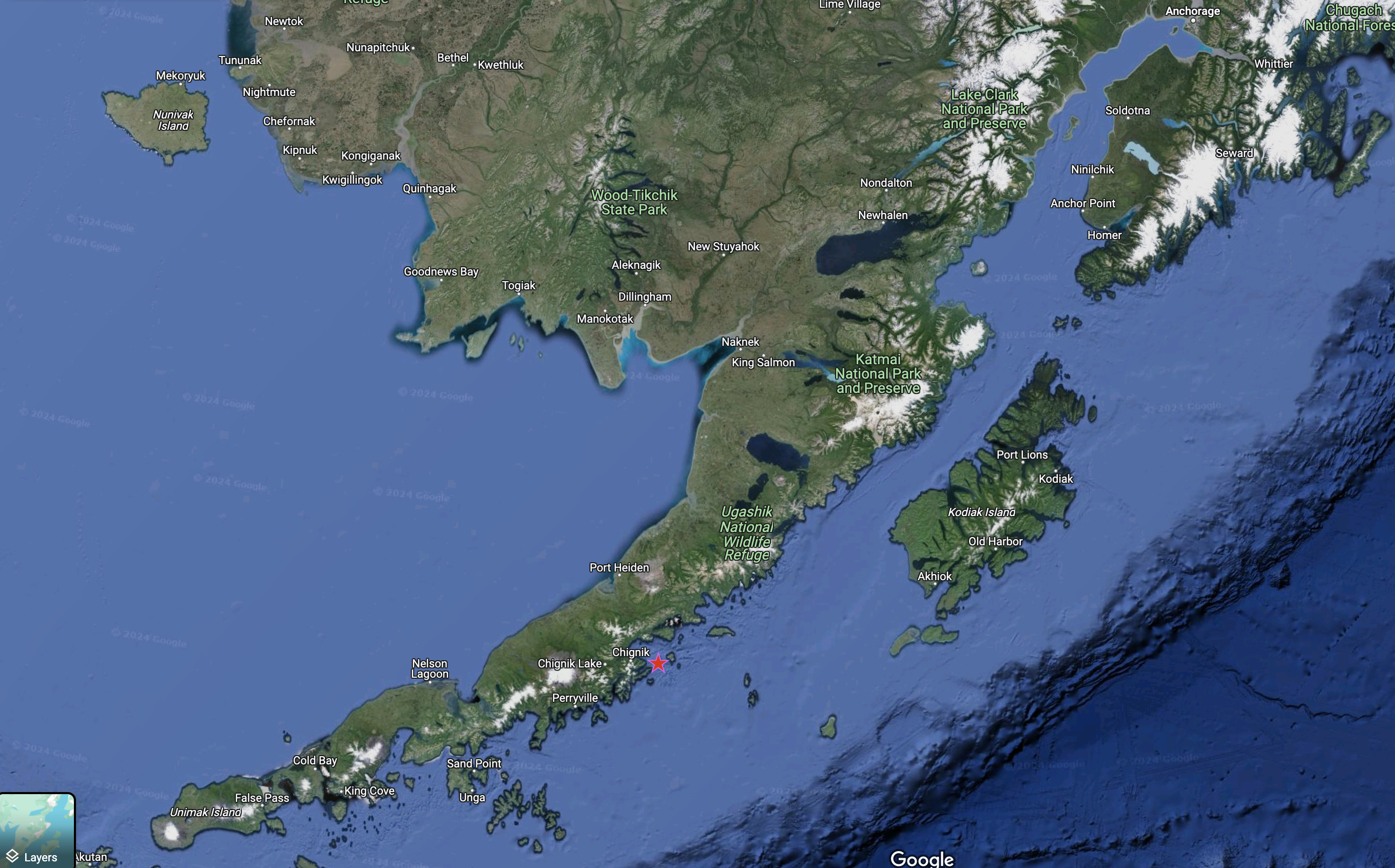
The above photograph is of an adult male and a young female Orca. Killer Whales in the vernacular. Actually, not true whales, but the world’s largest dolphins. They were part of a family of four which also included an adult female and a much younger calf, perhaps also a female. I had been invited along on a crabbing and halibut fishing excursion by my friend Fred Shangin. We were headed to Castle Bay, which meant skiffing from the village of Chignik Lake six miles down the Chignik River, then six miles through Chignik Lagoon, out around Dark Head and then 10 miles down the Alaska Peninsula to Castle Bay. In the above photo, the Orcas are about three miles offshore not far from the seaside village of Chignik. See the Google Maps below:
Anchorage is in the upper right. The red star halfway down the Alaska Peninsula indicates the general area of Chignik and the site of the Training Day photograph above.The purple line indicates the navigational course Fred took us on that day.
These are Transient Orcas, members of the Gulf of Alaska, Aleutian Islands, and Bering Sea (GOA/AI/BS) population.1 As Transients, their primary source of food is marine mammals. When we encountered this family, Fred idled the skiff engine and for the next half hour we watched the parents teach their daughters about hunting seals. First, with the daughters following closely, the adults cruised in tight to the rocky shoreline where they corralled and caught a seal. Rather than kill it, the female gently took the hapless pinniped in her mouth. Barely holding it by her front teeth, she swam out into open water where the adults continued to teach the youngsters lessons they would need to survive.
Training Day, Fred called it.
I was still pretty new to photography and had never shot anything like the scene that unfolded. Lots of mistakes. Several times the male, which was enormous, swam right beneath our little skiff and then emerged, impossibly close, to check us out. At other times the female and even the older of the two daughters came in close, again looking us over. I managed to make a mess of what would have been incredible closeups of these great beings. In fact, the entire family, very much aware of us, seemed at times to be showing off as they taught and learned their own unique art of hunting. However, despite my excitement and fumbling I managed to get a number of interesting pictures, a few of which are difficult to look at if one has any empathy for the little seal.
Once the first seal was finally dispatched (the female performed the messy coupe de grace), the male caught a larger seal for himself. I’ll probably publish additional photos of this remarkable, seldom-witnessed event in the coming days.
1Alaska Department of Fish and Game, Killer Whale (Orcinus orca) Species Profile
Groucho Crossbill – Unlike their White-winged cousins which generally remain high in the crowns of conifers, Red Crossbills such as this female often forage on the ground. Prior to our study, Red Crossbills were absent from three of the four Alaska Peninsula checklists I was able to find and were listed only as an “accidental” (very rare or one-time occurrence) on one list – the Izembek National Wildlife Reserve list. However, the species became somewhat regular wintertime visitors at The Lake in our years there, due of course to the maturation of transplanted Sitka Spruce trees and a succession of years of abundant cone production. As these trees are now beginning to reproduce on their own, it can be expected that various finch species will expand their range down the peninsula. I’m making progress with the Chignik Lake photos, finally well into the 2018 folder. Chignik Lake, January 17, 2018.
Sunset over Mount Veniaminof at Black Lake – January 3, 2018
Veniaminof was active on and off in the years we lived at The Lake. There were times when, while out fly-fishing the river, we could hear it rumbling, it’s smoking cone just over 20 miles to the west. In this photograph from a remote cabin on Black Lake near the headwaters of the Chignik, the volcano is even closer – perhaps just 20 miles distance. The forecast during our stay on Black Lake had been for fair weather, but shortly after sunset the evening one of us took the above photo we were hit with a huge out-of-nowhere storm packing freezing temperatures and winds in excess of 100 miles per hour. The little cabin rattled and rocked and we dug deep under a pile of blankets and sleeping bags, hoping the shelter would hold together. It did. That morning we woke to calm and a lake locked in thick ice. Our way out – back to the village, was by boat – a mile down the lake, seven miles down Black River and then seven more miles down Chignik Lake. No cell service. We were locked in, solid.
We procured a backcountry permit at the park office, took a shuttle bus a ways into the park, debarked and backpacked into the landscape in this photo to spend a couple of nights. The only sign of people we came across was a plastic lens cap from a camera – something accidentally lost, not littered. Caribou and Dall Sheep, Wolf prints and Wolverine tracks… A Grizzly Bear caused us to change our course… Short-eared Owls cruising low, nesting Willow Ptarmigan hens – the males waking us at first light with their call of Potato! Potato! Potato. Tree Sparrows flushing from tiny ground nests where clutches of blue-green & brown eggs were crowded together. We came across Caribou antler sheds; a moose rack attached to a skull suggested a successful hunt by wolves. In 1846, Thoreau needed only to travel from Concord, Massachusetts to Maine’s Mt. Katahdin* to immerse in the vital contact with wilderness he sought. During the 2022-2023 season, 105,000 tourists traveled to Antarctica – up from just 5,000 only a few years prior… which was up from somewhere near zero not so long before that. Even Alaska’s remote, far-north rivers are typically floated by multiple parties each year. Not long ago I came across a recent piece of video depicting an unimproved campsite I overnighted at on youthful floats down my native Clarion River. The site was seldom used in those days, nearly pristine, and you could nice-sized large trout in the pool and the riffle water that flowed by. The contemporary video showed trampled vegetation, fire pit scars, bags of trash…
There are no doubt as many definitions of wilderness as there are human expectations of what might be present or absent in such a place. The one certainty is that wilderness is becoming more difficult to find, to immerse in, to discover and explore. My recollection of reading Thoreau’s account of his attempt to ascend Katahdin is that at some point the climb (or was it the descent?) was terrifying. Perhaps therein lies a piece of what wilderness means… a place cut off from civilization, where things could go wrong, and if they do, you’re on your own. There’s something liberating in it.
*Thoreau’s account of his journey to Mt. Katahdin can be found in his book The Maine Woods.
I’ve gone around knocking on hollow trees most of my adult life, hoping a flying squirrel or owl would pop it’s head out. And then one day, it happened!
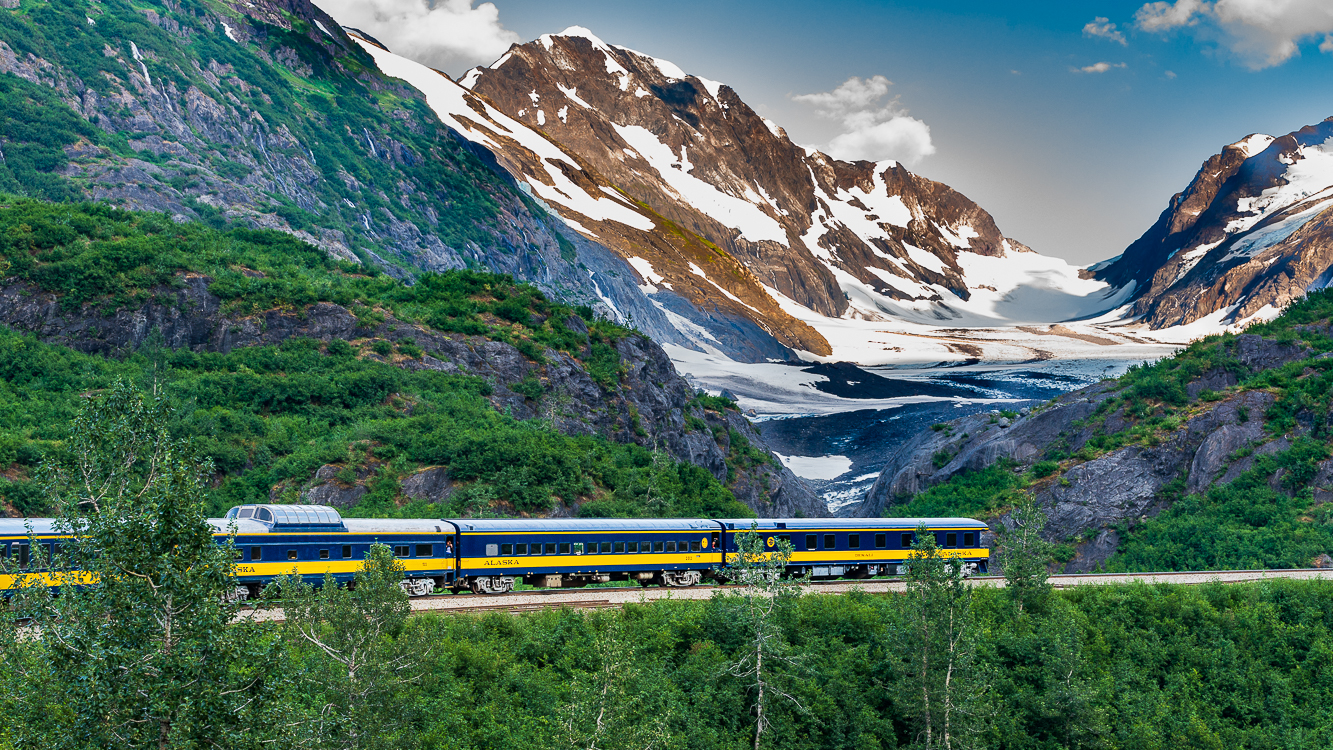
The Denali Express somewhere between Seward and Anchorage. Hands free travel through a big scoop of Alaska’s iconic scenery. Well, hands free till they’re occupied with a Margarita and a halibut sandwich.
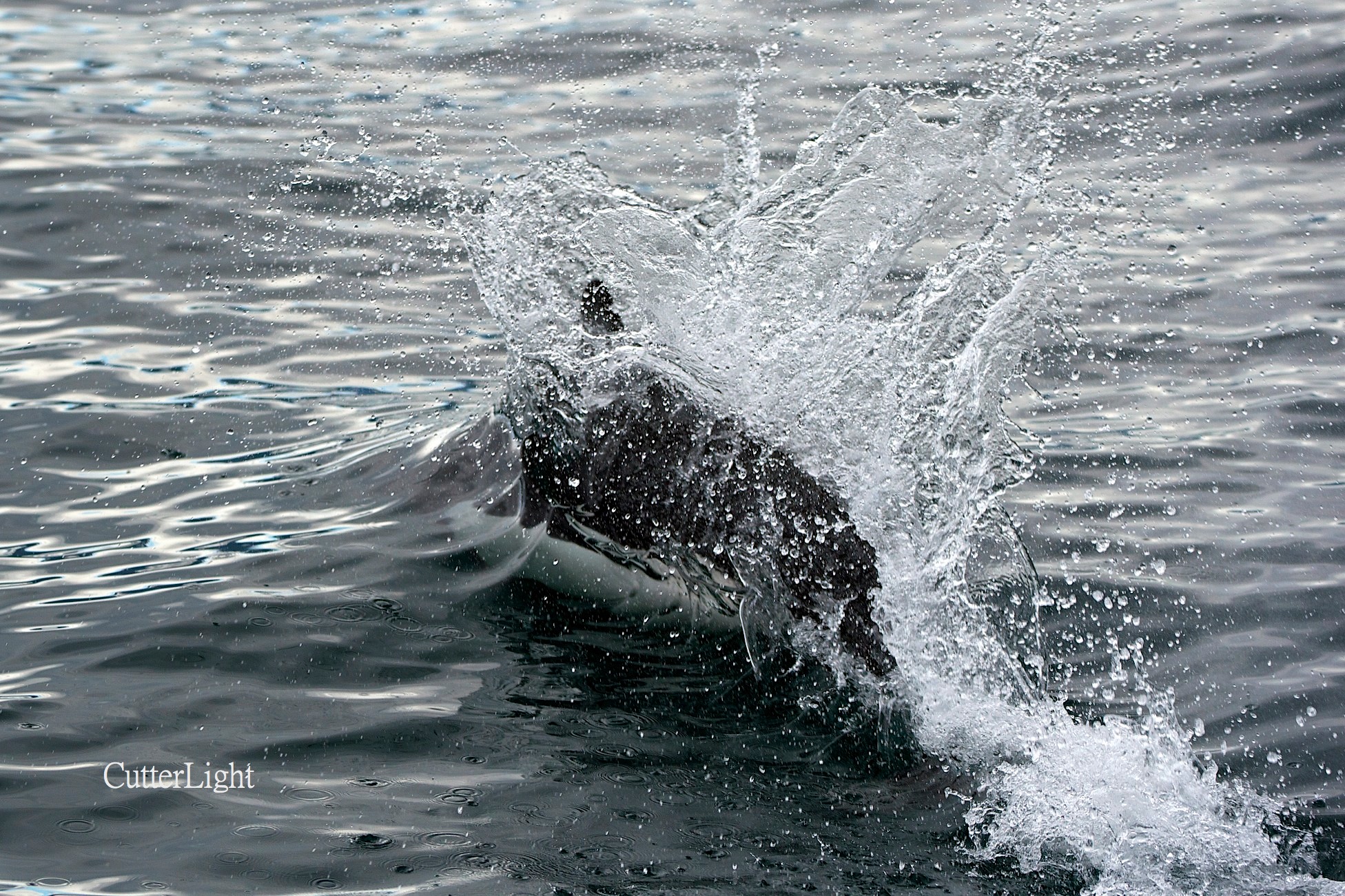
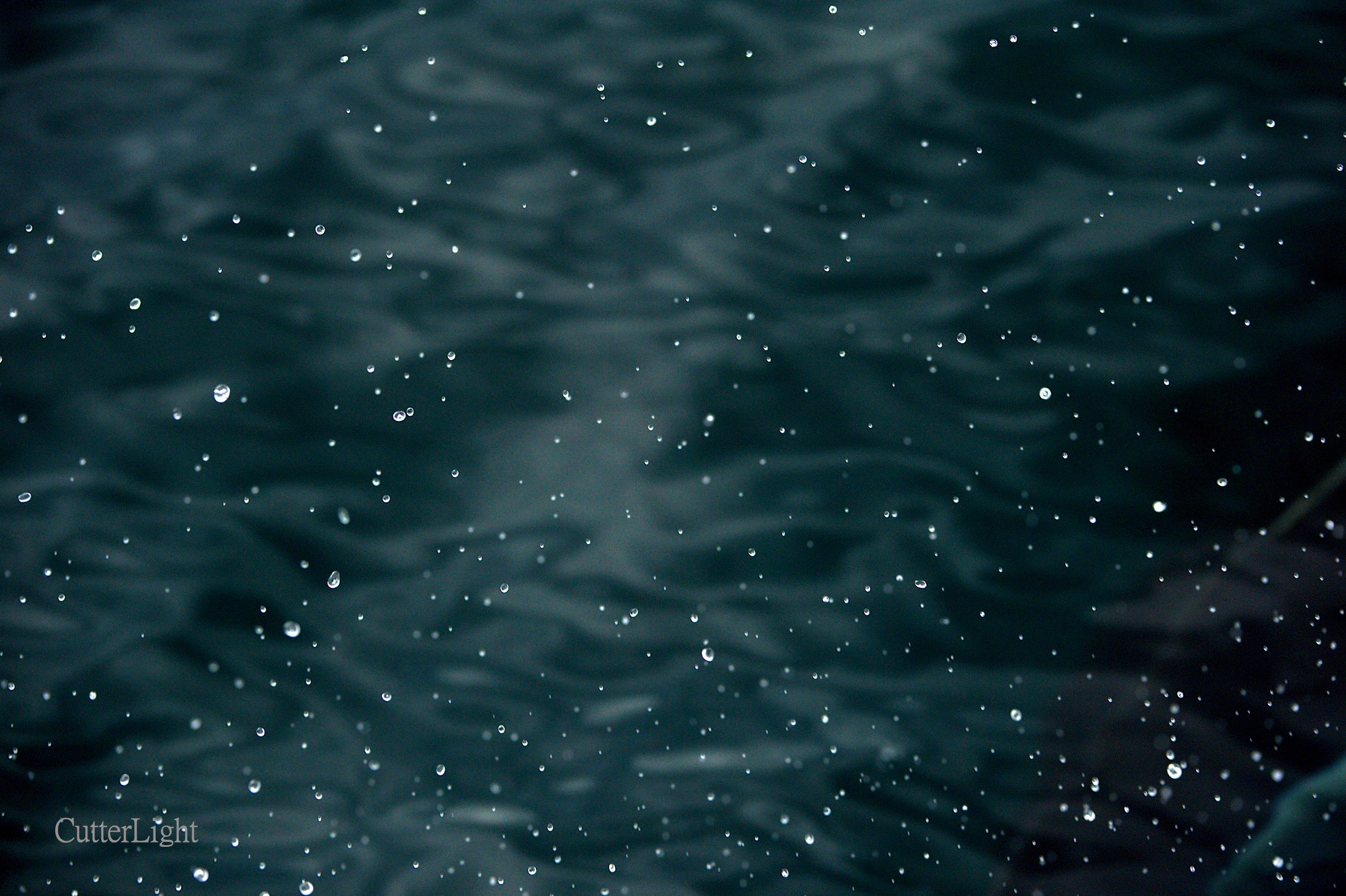
You might see a plume of ocean spray, a glimpse of black and white and if you’re close enough, you’ll hear a burst of expelled air as one of the speedsters of the sea comes up for a breath. Playing in the boat’s wake, Dall’s porpoises create ephemeral pieces of art out of seawater, light and air.
Water & Light Mohawk. Dall’s porpoises are capable of keeping pace with boats cruising at over 30 mph (55 kph), a speed that places them with or perhaps slightly ahead of Orcas and Pilot Whales as the sea’s fastest cetaceans.
Folded Glass. In Alaska’s seas, a steady diet of herring and other small fish help keep the population robust. Males, which attain larger sizes than females, can grow to a length of about eight feet and attain weights just under 500 pounds.
Black and Silver. Typically traveling in pairs or in packs up to a dozen or so animals, tell-tale water spouts in the distance are a sign that the porpoises are in the area. If their stomachs are full and the speed of the boat is just right, they may come zipping across the water to play.
Watercolor Brush. Dall’s porpoises can seem to appear out of nowhere, and before long they disappear again.
Farewell Waterburst. Currently, populations of Dall’s porpoises are doing well. They prefer to swim over deep (500 feet), cold water along the continental shelves ranging from southern Japan, as far north as the Bering Sea, and along the west coast of America as far south as Southern California. As a species, they would benefit from international cooperation to conserve the fish stocks they rely on for food and to ensure that they are not accidentally caught in fishing nets.
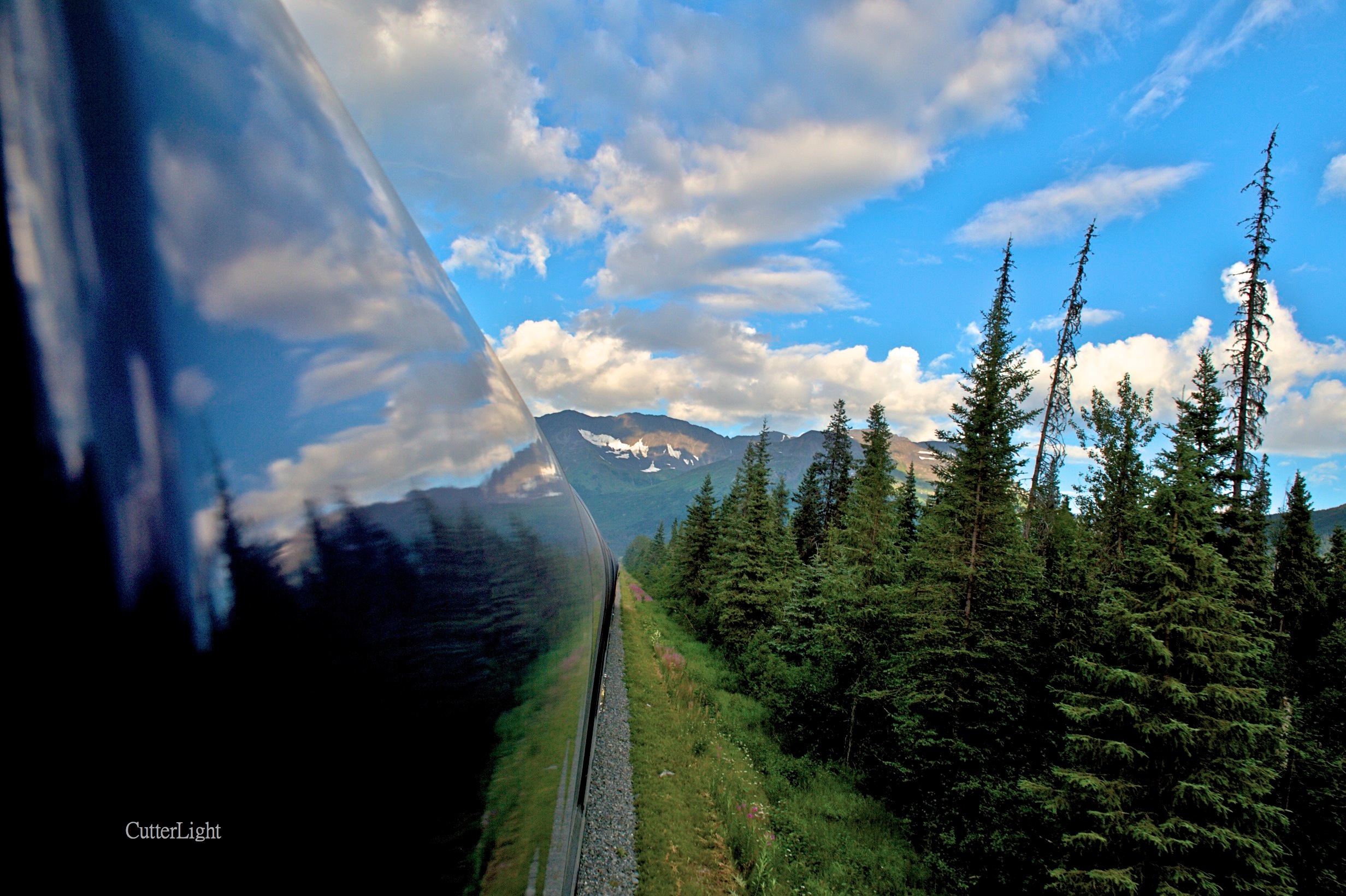
The mid-summer sky is reflected on one of Alaska Railroad’s GoldStar coaches on the Coastal Classic train. Mountainsides of magenta fireweed and, mixed forests, moose, Dall sheep, eagles and glaciers (and sometimes bears and caribou) were part of the 114 mile train trip between Seward and Anchorage.
Trains are magical. Whether we’re talking about Northern California’s quaint Skunk Train or Japan’s lightening fast, silky smooth shinkansen (bullet trains), we love the rhythm and glide of moving through the countryside on steel rails. As we brought our summer to a close this year, we decided to take the train from Seward. We departed at 6:00 PM and four hours later arrived in Anchorage energized and relaxed.
Fireweed, startling in its vibrance, lines the tracks along the Coastal Classics route through Kenai Peninsula forests and mountains.
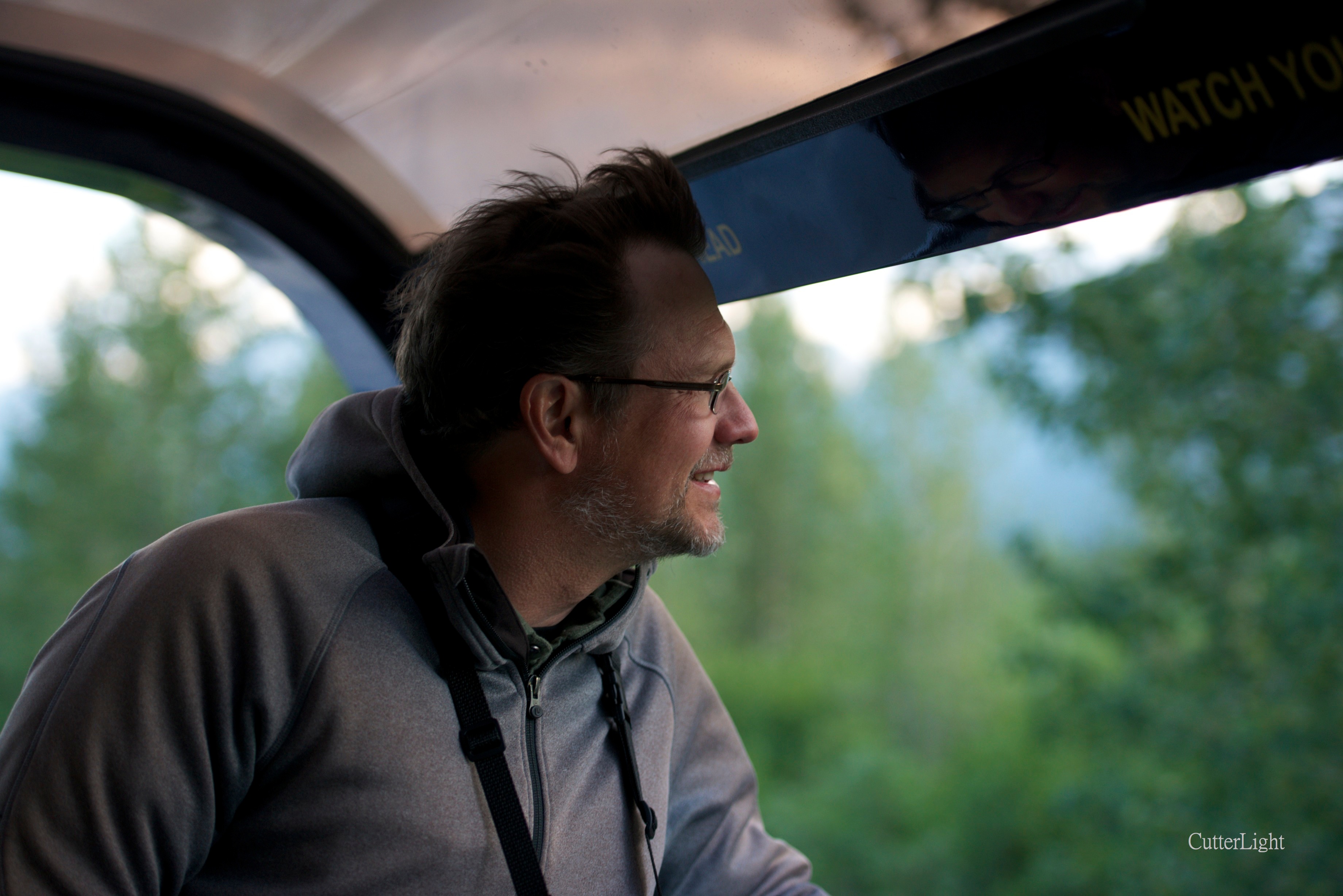
Large windows and the freedom to get up and walk around are part of what make train travel so pleasant. After a very good meal of almond-crusted Alaskan cod accompanied by a glass of wine, we made our way to the rear of our GoldStar car where an open deck allowed us to take in the sights, converse with fellow passengers, and enjoy the warm (for Alaska) summer air.
The Coastal Classic passes by three large glaciers: Trail, Spencer and (above) Bartlett.
Scanning the terrain for animals from the observation deck of one of the double-deck GoldStar cars, we saw moose, eagles, beaver lodges and Dall sheep. Bears – both grizzly and black – and caribou are also frequently sighted. We’re already looking forward to taking the train from Anchorage to Seward when we return in May next year.
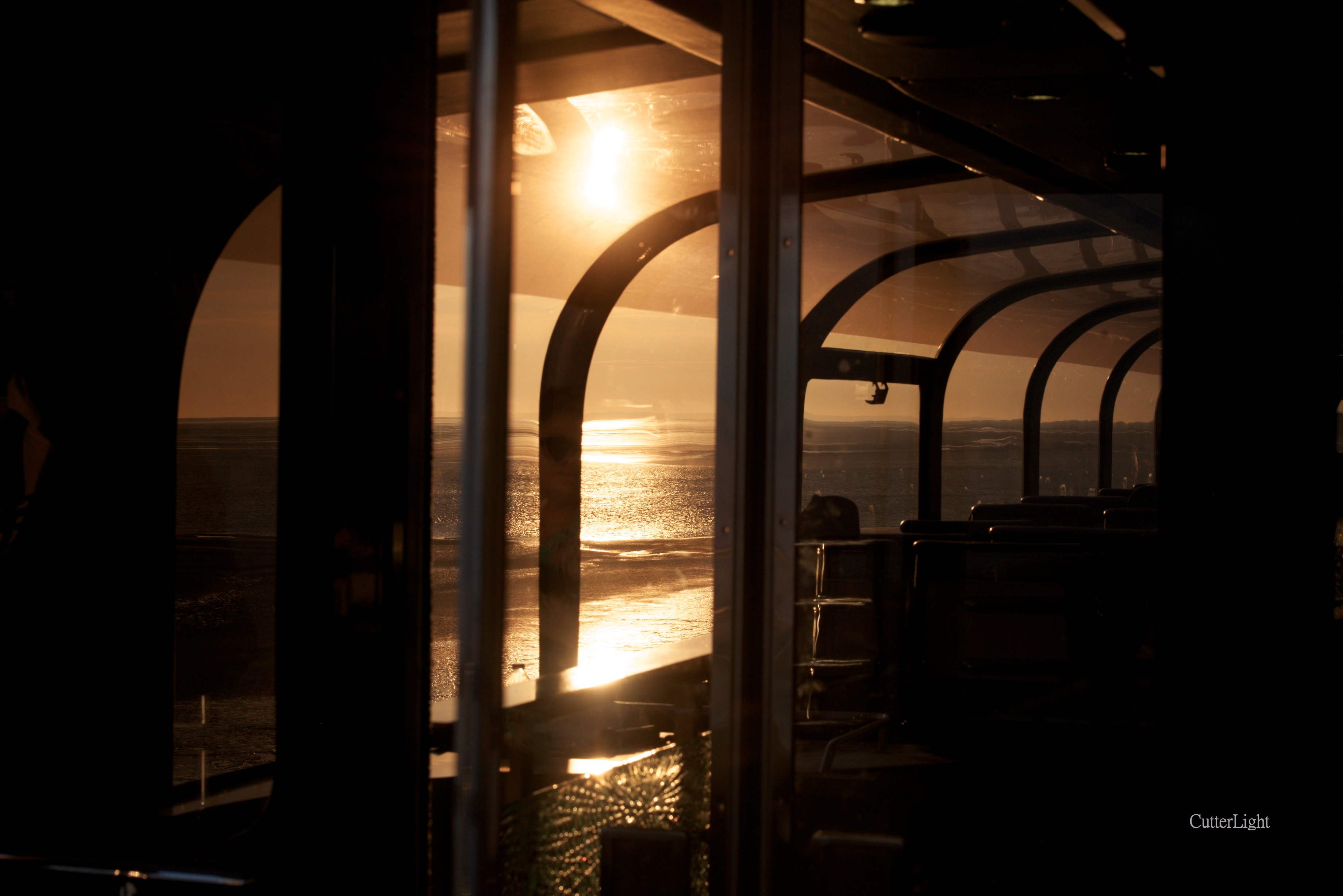
The evening sun reflects off Cook Inlet though the car’s upper deck windows. After a wonderful four-hour trip, the train pulled into the station at Anchorage. Early the following morning, we boarded a plane for the Alaskan bush and our other home.








 CutterLight