
View from our First Place: Chignik Lake Files
2

It has been a daunting task, going through not merely thousands, but tens of thousands of photographs Barbra and I have taken during the 16 years of our marriage. In the early days, I did not shoot. It took Barbra’s coaching to instill in me the confidence to pursue a photography dreams I had set aside long before I met her.
Recollections grow blurry with time. Add to that the fact that we often didn’t see what we may think we saw; that frequently we didn’t experience what we thought we experienced. Anyone who has ever faithfully kept a journal and then gone back later to reread events recorded there will invariably think to themself, “Huh… that’s not the way I remember it,” a firmly held memory tripped up by one’s own written record. No one can accurately write about their own life and pretend that it is some sort of self-biography.
All memoir is fiction, and rightly belongs in that section of the bookshop or library next to other novels. It is folly to call memoir “autobiography” and tuck up next to the truer stuff of biography. With that understanding, we proceed.
Four months into my 12th year, the fall of 1971, I discovered on my father’s bookshelves A. J. McClane’s McClane’s Standard Fishing Encyclopedia and International Angling Guide a 1,057-page tome that changed my life and in retrospect provided a vital stepping stone along a path that led to The Chignik. Filled with angling lore, photographs, fish recipes, fly patterns, fly-rod theory, and species by species, state by state, country by country descriptive synopses it was, from the time it was published in 1965 on through the 1970’s, the one volume virtually every serious student of angling had on their shelves. The color plates featuring dozens of flies, accompanied by recipes for their patterns, made the book a must all by themselves. It was from that book, at the age of 11, that I learned to tie an Alaska Mary Ann, a fly of no meaningful application on the Brook Trout and stocked Rainbows and Browns of my Pennsylvania youth, but which I kept in my fly box as a kind of talisman holding within its wisp of white calf tail wing, jungle cock eye and silver tinsel ribbing a life I dreamed of.
I wasn’t permitted to be in the small library where McClane’s was shelved, but arriving home from school each day well before my parents returned from their teaching jobs at the local state college gave me an hour or so of privacy with this wonderful book before the sound of the kitchen door opening signaled me to spring up from the oriental carpet where I’d been kneeling over the book, return it to its place, quietly ease the den door shut, slip out of the room and sprint up the stairs to my bedroom. Minutes later, I would come back down the stairs and find my parents in the kitchen. All the while my younger sisters would have been in the downstair TV room, glued to and hypnotized by reruns of Gilligan’s Island and similar fare.
Anyway, at some point it came to me that 1) angling connected the world as did virtually no other pastime, far more widely and passionately practiced than anything else I could think of and that 2) A. J. McClane, editor-author of this massive compendium of angling expertise, angling editor of Field and Stream magazine, regarded as the foremost angling journalist of his time, would not live forever. Someone would become the next A. J. McClane.
Why not me?
My first mistake in attempting to embark on this journey was to share this dream with my parents. She put a needle in the balloon of my hopes with a single syllable laugh. He dismissed my aspirations with the same two-word opinion he voiced anytime I expressed a hope or goal. You’re delusional.
Nonetheless, when I mentioned to him the book I’d found and asked to borrow it, he allowed me to take it to my room. I doubt he had ever read more than a few pages out of it and probably hadn’t touched it in years. So the book became mine, and I pored over it. That Christmas, I once again engaged in the annual futility of asking for a for Christmas present. I wasn’t allowed to cook in her kitchen, so for the immediate future I had no means of beginning to acquire McClane’s culinary skills, but a friend of my father’s had recently taught me to tie flies and to cast a fly line and I was getting the hang of all that. I needed a camera. The little bit of money I’d made painting my godfather’s garage that summer had already been spent on clothing for school. So I asked my college educated, college teaching parents for a camera. “That’s all I want,” I told them. “I need a good camera. Don’t get me anything else. Just a good camera.” I supplied them with a specific model that was popular at the time. I suppose the term for what I was hoping for would be an “enthusiast’s” camera – something of sufficient quality to learn with.
I should have know better, having been through this charade with them every Christmas of my sentient life. That year, in addition to the usual packages of underwear (for Christmas… sigh… I should have given her a dusting cloth and a can of Pledge), there was the usual assortment of stuff I had no use for – enough of it that, added together, it would easily have paid for the camera I had pleaded for along with many rolls of film.
There was a camera… a Kodak Hawkeye Instamatic II… a ridiculous “all plastic” model from which it was impossible to coax a decent image. The camera was a promotional gimmick available for free at department stores. Purchase a couple rolls of film and a couple more of “magic cubes” flashcubes, and Kodak made money off of it. I have an image in my head of showing the camera to an uncle who was a skilled amateur photographer and the way he silently turned it over in his hand as though trying to make sense of it while searching for something positive to say, finally concluding that there was nothing to say before simply saying “Here you go,” as he handed it back to me and turning a quizzical look toward his sister. That spring, on a trip to Washington, D.C., I saw seven and eight year olds with the camera. It was of no use to me.
Lacking the means to pursue McClane-esque dreams on my own and with no support to be had from my parents, I honed my expertise in one of the great gifts I learned living with them: the art of turning my attention elsewhere. Along any path, on any journey, one is likely to encounter obstacles. The ability to find a path around those obstacles, to continue moving forward in life, cannot be overestimated in its value. Resilience. Head up, looking for an open window when a door is closed. My parents did not mean to teach me this art; I’ll never know exactly what their intent was. But the art of moving forward is the finest thing I learned while negotiating my way through life with them.
Years passed. Decades. I never completely got the idea of photography out of my head… but it seemed that the older I got, the more trepidation I had about picking up a camera and beginning to learn. When a friend invited me to attend a photography exhibit during a visit to L.A., the art I was looking at seemed so far beyond anything I might be capable of that, then in my 40’s, I concluded I would never by a photographer.
Enter Barbra.
When I began seeing her, she was shooting with digital bodies matched with an assortment of lenses. She’d taken classes at the college level, and in the pre-digital era had converted a closet into her own darkroom. It was all way beyond me, but I couldn’t conceal my curiosity. Cueing off my obvious interest, she repeatedly encouraged me to give it a go. With feelings tugging me in contradictory directions, initially I demurred. Months passed before I worked up the courage to finally ask her to show me how her D90 worked.
That seems like a lifetime ago. Year by year, new skills, new knowledge and growing enthusiasm have led to acquiring ever more sophisticated gear – and, in this digital age – an ever growing body of images. Using Lightroom (think of it as a digital darkroom with a searchable database and library) to retouch and catalog these images, I’d been doing a steady job of keeping up with our pictures till a disaster of the most fortuitous kind struck.
While transferring Lightroom files to a new computer, we wiped out all the key-working and all the edits. Countless hours of work vanished.
Turns out, that was a good thing.
Because my original key-wording was a mess. I didn’t initially understand that “key word” is best thought of as a, single, word. So I had photos tagged with long phrases, and hence a long list of keyword phrases which resulted in a headache of cluster and a difficult to search data base.
The photo retouching I had done in those days was subpar as well. Practice makes better. The more retouching I performed, the better I became at it. Not only that, my eye developed. Even before we lost all those edits, looking back on my files I was beginning to see that my early edits needed work – that in many cases, I would be better off resetting the photo to its original state and starting over.
So…
At this point, I’ve gone through our scanned photos, wedding photos, Sacramento Days, Alaska-Canada Highway, Seward Summers, Shishmaref, Point Hope, Mongolia, San Francisco. Along the way, I eliminated thousands of pictures, key-worded and retouched the keepers… and continued learning.
At last, I have reached the tens of thousands of images we created at The Lake. My view is that if a picture is worth keeping, it’s worth cataloging so that it can readily be located, and it’s worth retouching (cropping, adjusting exposure, hue, vibrance, contrast, sharpness) to bring out its best qualities. I have a friend whose father left behind, at death, thousands of photographic slides. “What am I supposed to do with this?” he said, mild exasperation in his voice as he motioned towards cabinet drawers jammed full of uncatalogued slides.
Either hire someone to go through and curate them or make a bonfire, I suggested.
I can’t bring myself to add up how many photos are yet to be finished. When climbing a mountain, a glance at the summit should be enough; after that, it is best to keep one’s eyes on the path just ahead.
Seven year’s of images from the Alaska peninsula, plus our bicycle trek in Hokkaido and other summertime adventures during those years. But it’s good work, the kind that puts a smile on my face as I revisit happy memories. I confess that I teared up when I opened the first image from our Lake years – an aerial landscape of endless, jagged, snow-capped peaks as we flew down the Alaska Peninsula for the first time to live among Alutiiq Native Americans in a tiny wilderness village along one of the world’s last, great, seldom-touched salmon rivers. The extraordinary fly-fishing that followed; the bird project; the flowers and wildlife and landscapes and people.
I’ll continue to post a photo each day or so from this massive library – a sample of those that I really like. My hope is to finish sometime this spring, at which point I’ll be ready to move forward with the next project.
At the age of 64, the “delusions” persist.
A landscape seen by fewer than 100 living people….
The Hike Up Flattop
There’s a small mountain behind our village. We call it Flattop, though once you reach the peak you find that it is somewhat rounded. Although reaching the summit constitutes an elevation gain of only about 1,200 feet (a quarter of a mile; four football fields), because it is the foreword-most mountain facing the village, the summit provides an unobstructed 180 degree view sweeping from the corner of Chignik Lake to one’s left where Clarks River enters, down the lake and through the village, and then down the Chignik River all the way across the estuary to the next village, Chignik Lagoon, a vista encompassing about 12 miles. But in fact, the view is more grand even than that, for one can see mountains 20 miles beyond Chignik Lagoon where a portion of the Alaska Peninsula curves out into the Alaska Gulf, and while gazing across Chignik Lake the landscape disappears in haze over Bristol Bay. Keeping in mind that a few steps beyond the last house in the village one is entering a landscape fewer than 100 living people have seen, the view from Flattop is even more exclusive.
The roundtrip hike from our home to the summit and back is fairly rigorous. We begin by following the community’s main thoroughfare, a dirt road that curves along the lakeshore, crosses a small, willow-crowded stream inhabited by char, and then branches off to the left past a few houses beyond which is a honda trail. For about two miles, the trail alternately cuts through stands of scrub alder and willow, open tundra, and shoulder-high grasses, fireweed, ferns and salmonberry brakes.
The trailhead leading up Flattop is easy to miss if you don’t know where to look. People – young men who are hard on their machines – very occasionally take their quads up the mountain, though scarcely often enough to beat back the jungle-thick vegetation waiting to reclaim any seldom-used path in this part of the world. Not long ago, a neighbor was lucky to get clear in time to avoid injury when the mountain took control of his honda. His quad is now somewhere on Flattop’s steep flanks, hung up in alders, unrecoverable. One’s own two feet are the more prudent – and satisfying – option for ascent.
In the early morning of September 17, we entered the trailhead through a field of tall grasses and fireweed gone to downy seed, colored with autumn, made dripping wet with low fog. As we gained elevation, the grasses, ferns and flower stalks gave way to thick stands of salmonberry bushes. It wasn’t long before our pants were soaked and our water-resistant boots were saturated through to squishy socks. Sunshine in the forecast promised dry clothing once we climbed beyond the vegetation.
Landmark by landmark, salmonberry brakes began to thin. Alders grew smaller and more wind-twisted. We ambled through openings where, back in early June, we’d come across patches of heathers and wildflowers – vaccinium, geranium, yarrow, paintbrush, candle orchid, fireweed. At times we lost the faint trail, the path buried in tall, thick grasses or barely discernible through tangled tunnels of gnarled alders. Just as the sun broke free from mist and crested the summit we emerged onto the first treeless scree, the sudden warmth and open landscape a joy, handfuls of lingonberries, tart, sweet, energizing.
As we continued up the slope, I studied the loose scree for signs of the Weasel Snout, lousewort, Alpine Azalea, Alp Lily, Pincushion, Moss Campion, Roseroot, avens, saxifrage and Purple Oxytrope I’d photographed in June, but aside from a few lupine still clinging to periwinkle-colored blooms, the rest were gone, the few remaining leaves various hues of yellow, red and orange. Near the top we were surprised to find blueberries, wind-stunted bushes hugging thin soil, leaves crimson, berries big and frost-nipped sweet.
We had chosen a day when the forecast predicted calm air, offering the hope of mountains mirrored in a glassy lake and pleasant loafing at the top. We scanned the lakeshore and flats for moose and other wildlife, but aside from a few Black-capped Chickadees, Pine Grosbeaks, a sparrow or three and clouds of midges dancing in filtered sunlight, animals were scarce, though near the summit my spirit bird, a Northern Shrike, materialized from out of nowhere to hover a few feet above my head in order to puzzle me out. Bear tracks all the way at the top. Moose tracks and fox tracks along the way. Lynx scat… maybe.
The video is best viewed on a large screen. As you watch, notice the round, snow-crowned summit just barely peaking out from behind foreground mountains in the view across the lake. That’s Mount Veniaminof, an occasionally active volcano 24 miles southwest of Chignik Lake. The earth’s curve over that distance causes it to appear to be only as tall as the closer 3,000 foot peaks. But in fact, Veniaminof touches the sky at 8,225 feet. We hear it rumble from time to time and have occasionally woken to a smoke-clouded sky or a fine dusting of volcanic ash on new snow in the village.
The corner of the lake to the left, in front of those mountains, is where Clarks River debouches. A major salmon spawning tributary, in September Clarks offers spectacular, nearly untouched fly-fishing for returning Coho Salmon.
Then, looking up the lake through the gap in the hills and mountains, the landscape disappears into haze. Black River flows into Chignik Lake here, beyond which is miles of Black River itself, and then the upper lake, Black Lake. Past that is a vast area of boggy tundra and kettle ponds all the way across the peninsula to the ghost village of Ilnik and the coast where sandy barrier islands, The Seal Islands, front Bristol Bay.
Following the landscape to the right, the lake narrows as it flows past the village of Chignik Lake, a community of about 50 to 55 people, most of whom are of Alutiiq heritage. The large white buildings in the middle are the school gym (left) and the school itself (right) where Barbra teaches. Just as the village ends, the lake narrows further, picks up speed and becomes Chignik River. A narrow dirt road follows the river downstream and terminates at a boat landing across from the fish-counting weir, the buildings of which are just barely visible. There are no roads beyond this one, which terminates on its other end at the airfield.
I included a photograph looking downriver and across the estuary, locally referred to as the lagoon. The image zooms in on the village of Chignik Lagoon, the community closest to Chignik Lake. With no roads nor even trails linking the communities, the river and estuary serve as the highway. Virtually everyone in The Chigniks owns a skiff or two.
The end credits roll over a black and white photograph I made from Flattop’s summit in early June.
Hiking with us on this day were school faculty members new to The Lake: Melody Wiggins, Jacob Chapman and Melody’s son, Micah. Barbra is on the right in the group photo.
JD
This short video shows a group of Chignik Lake residents beach seining for Sockeye Salmon along the shores of Chignik Lake. The salmon thus harvested were later distributed to village members.
I didn’t have the lenses I might have preferred to have with me, and I have just barely begun the journey into videography, but on a recent hike up the lake to the mouth of Clarks River, an opportunity presented itself. Jake and Jamie pulled up to the beach in Jamie’s skiff and in a few minutes were joined by several other friends and neighbors who had traveled upcountry by honda. The plan was to do some beach seining along the lakeshore for Sockeye (Red) Salmon, with the request that since I was there, would I take some photos?
I’d made the hike in hopes of finding interesting macro shots, or perhaps a moose or bear in a landscape setting. The 105mm prime lens attached to my camera wasn’t ideal for the shoot at hand, but it was the lens in hand – neither long enough to adequately capture the bear that was fishing at the mouth of Clarks when I first arrived, nor wide enough to capture the sweeping landscape the netting operation was set against.
Nonetheless, I really got into recording this event, which has been occurring here in the Chigniks in one form or another for thousands of years. In fact, if you look closely along lake and river beaches where salmon harvesting has long occurred, you might get lucky and find stone artifacts such as the ones in the photo below.

From upper left, counterclockwise: The notched ends in the first three stones indicate that they were used as weights along the lead line – the bottom line – of a fishing net. The oblong object in the upper right is an ulu-like knife that would have been used to split salmon carcasses before they were hung to dry. It is still quite sharp. The two center pieces are arrowheads.
Most of the time in most places, salmon spawn over clean gravel or small rocks in clear-flowing rivers and streams. Sockeye Salmon, however, often spawn along lake shorelines where upwelling in the form of small underwater springs is present. There doesn’t have to be a stream as long as enough water is seeping up through lakebed gravel in water a few feet deep. There the female Sockeye will scrape out her nest, her redd, with her tail, deposit her eggs which a male at her side will fertilize, and then push gravel back over the eggs to protect them while they incubate. Shortly after they’ve spawned, all the adult salmon will die. Their decaying carcasses provide a vital source of nutrition for the various zooplankton and small insects upon which their young will feed until they’ve matured sufficiently to migrate out to sea.
This past season, beginning in late May or early June, over half a million Red Salmon ascended the Chignik River. While many spawn in the lake itself, many others spawn in the Chignik River as well as in several tributary streams and rivers. These salmon, along with the Pink, Chum, Coho and Chinook that also run the Chignik, are foundational to life here. They provide food for our abundant bears, eagles, otters, seals and other wildlife, provide a nutrient base for the lakes and rivers, and, with the help of Brown Bears, become fertilizer for berry flats, wildflowers and other vegetation which, in turn, feed everything from mushrooms to mice to caterpillars to songbirds. It would be no exaggeration to say that every living thing along the Chignik is connected to salmon. That includes the 50-some residents of Chignik Lake, among which Barbra and I are two.
Rule of Tonnage
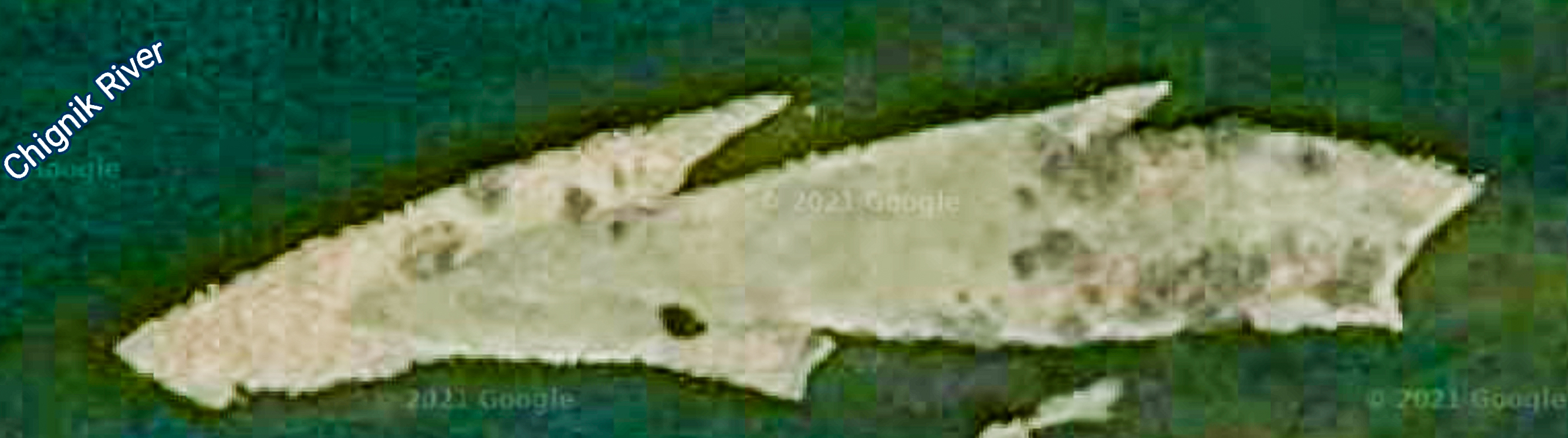
We had parked our scow near a familiar cottonwood growing on a 270 yard long, fish-spear-shaped island in a pool we call Devil’s Flats. The Flats are a massive 16 acre piece of water featuring two islands of substantial size and every kind of promising salmon water an angler might imagine. The cottonwood tree sits at the tip of what might be thought of as a backward-angled barb on a spear. There is a shallow eddy behind the barb which offers a secure place to leave a boat anchored to the bank.
We’d walked downriver to a second barb extending out into the water – a good place to set up for an evening of fishing. Our backs were to the river as we assembled our rods, laced up our lines and chose flies. Behind us, fresh Silvers, colored-up Reds and a few nearly spawned-out Pinks finned languidly in water the color of clear, liquid emeralds. It was the Silvers that had drawn us to the pool, ten to twelve pound fish still bright from the sea.
I was, as usual, talking when Barbra interrupted me with a sharp, hoarsely-whispered, “Listen!” I knew instantly what to listen for. Directly in front of us just out of view behind the island’s dense growth of willows, thick grasses and flowering plants gone to seed was a bear and there was little doubt that it was heading straight for the point of land where we had set up.
Casting about for a course of action, the best I could come up with was the proposal that we simply back away. “He probably just wants to fish,” I offered. Suggested. Hoped.
“Hey bear! We’re here!” I called out as we began backing into the river. Barbra joined in the familiar call of “Hey bear!” as, fly rods in one hand, the other on our holstered cans of bear spray, we felt our way backward, searching for firm footing among slick riverbed rocks in our hobnailed boots. Spare rods, the net, fly boxes and a backpack were on the shore where we’d left them. The snapping and cracking of autumn-browned vegetation grew louder as the bear drew closer. We both remember thinking that we hoped he didn’t step on our rods.
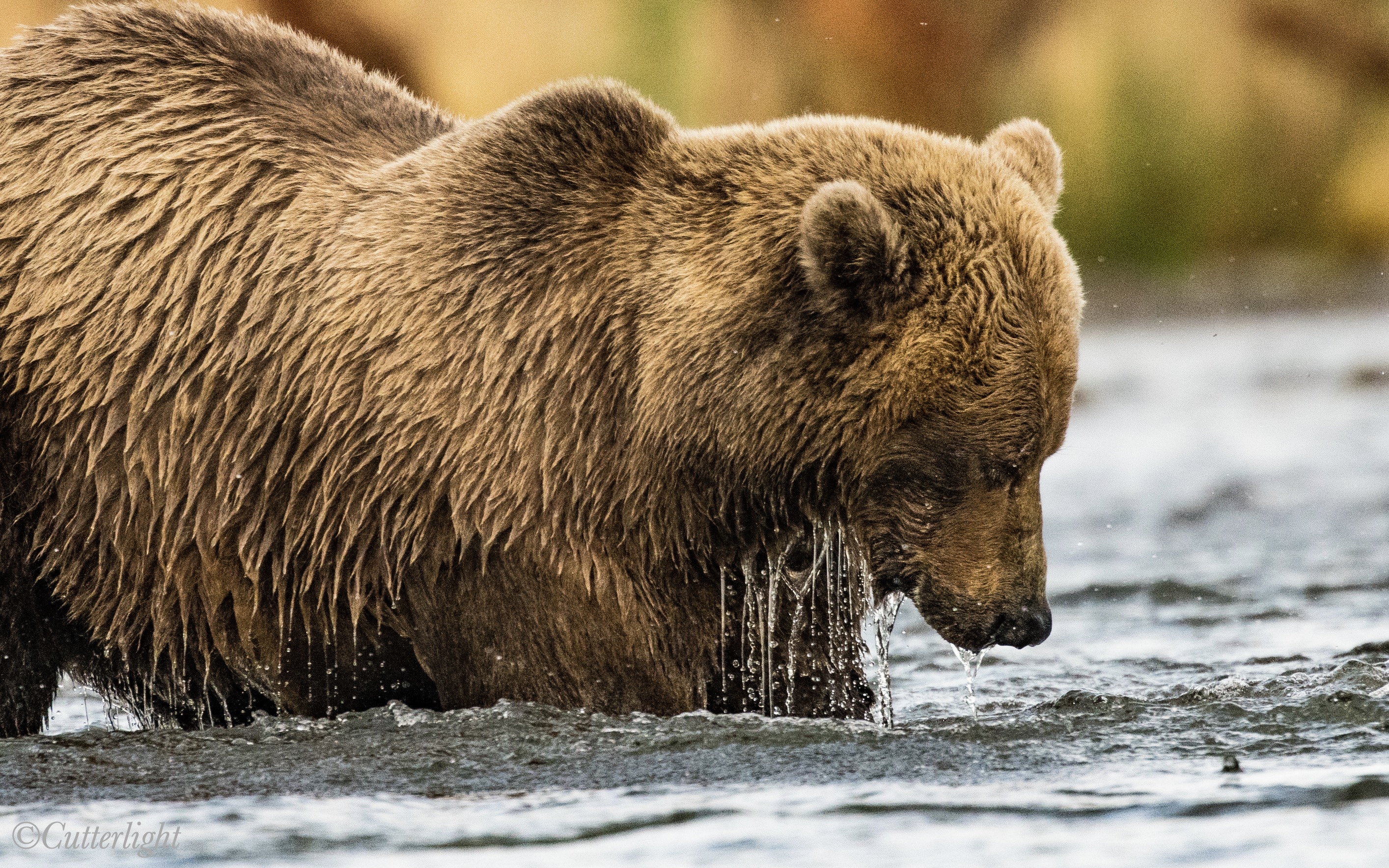
Suddenly, 900 pounds of hungry bruin emerged from the brush. I’m hesitant to apply human emotions to bears, but he squinted at us as we stood out in the water making our strange (but non-threatening) vocalizations, then he surveyed the gear strewn across his path, and then he shifted his look back to us with what appeared to be a mixture of confusion and annoyance – weighted heavily toward annoyance. He finally gave a little huff, entered the river where it eddied behind the barb of the spear, splashed forward to trap something with his forepaws, stuck his head into the water and came up with a male humpy fixed squarely between his jaws. His efficiency was laudable. Water cascading down his face, the salmon wiggling wildly in his mouth, the bear gave us another look. He seemed to be gauging our reaction to his catch. Assured that we weren’t going to contest his meal, he moved into shallow water and tore into the fish. “Look at the size of those claws!” I whisper-shouted to Barbra. We were in water only knee-deep, as close as we’ve ever been to a feeding bear.
When that snack was finished he waded a few feet downriver and repeated the trick. Another pink, this one a female. He nimbly held it between his enormous paws and took a might chomp. Ripe eggs burst from her belly. The bear, which initially had emerged only a few feet from us, was dozens of yards downriver by the time it caught its third salmon, a crimson-bodied, green-headed Red. With the pool crasher finally at a safe distance, our breathing and heart rates began returning to normal.
“Rule of tonnage!” Barbra exclaimed with a laugh as we waded ashore. The reference is to a nautical phrase we picked up in our sailing days. While not a law, per se, it is an acknowledged matter of practicality that a smaller vessel (us) is well advised to make way for a larger vessel (the bear) when on the same course. Arriving at the bank we traded fly rods for cameras, however the bear had continued moving downriver and by now wasn’t offering much of a photo opportunity. But we’ve got the story of that encounter and photos from other days at Devil’s Flats that recall the memory and our sense of awe at being so close to such a magnificent animal and the smiles – “Rule of tonnage.”
Conditions have to be just right to get quality images of bears on the Chignik. Optimally we hope for a fair weather evening coinciding with a falling tide. As the sun drops into the valley, it floods Devil’s Flats with soft light so that downriver subjects are bathed in gold. A falling tide concentrates the salmon, making it easier for bears to successfully fish. I made this photography on September 18, 2020. (Nikon D850, 600mm f/4 with 2.0 TC, 1/600 at f/8, 1200mm, ISO 2000)
Fish Spear Island

Return to Clarks River
Each September we pick a day when the forecast is for clear skies, pack up our gear, and head up the lake to Clarks River. In years past, we hiked a three-mile honda trail across a rolling landscape of tundra, berry bogs, salmonberry brakes, meadows and dense stands of alders and willows. This year, we took our scow up the lake and beached it on the sandy shore near the mouth of Clarks.
The Silver fishing here can be phenomenal, though it is seldom as easy as the fishing further downriver. By the time they’ve arrived at Clarks, the salmon have been in the river awhile. Although many are still silvery bright, we’ve found them somewhat less inclined to come to our flies than are newly-arrived fish. Nonetheless, basking under blue skies while presenting flies to 10-pound fish cruising the lake’s shoreline is a pleasant change from swinging streamers in river current. We can often see the takes as a salmon peals off from the pod of fish it is swimming with and turns to inhale whatever combination of fur and feather we’re offering.
At some point, the urge to explore the lower reaches of Clarks River itself overtakes us. As we make our way across the sandy beach and then along the well-worn bear path following the river, we never cease to be amazed by evidence of just how many bears fish here. The trampled, matted down vegetation strewn with salmon parts suggests more of a bear highway than a bear trail. There are always a few eagles hanging around, seals, gulls, mergansers and other ducks, and we’ve come across the tracks of otter, mink, moose, wolf and wolverine.
The salmon are always there in September, so many that at times they seem to carpet the rocky river bottom. Every so often a fresh school of fish enters the river, and when they do they sometimes come in such numbers that the wake they push before them looks like a tidal bore. As with the lake, in Clarks’ extraordinarily clear water, the fishing is not a given. But with the right fly, thoughtful casting and patience, we manage to coax a few. The challenge is part of the enjoyment, as is the knowledge that most probably ours will be the only flies any of these salmon ever see.
It is difficult to make a good photo of Clarks itself and the salmon we catch there. During early morning in September, the mountains that cup Clarks keep it in shadow. By the time the sun rises above those jagged peaks, it shines very bright. The process reverses itself as evening approaches, the valley abruptly transitioning from bright to dark in moments as the sun disappears. Barbra made the above photo in the evening of September 12 along the lakeshore just below Clarks. Shirtsleeve fishing in Alaska in September is not a thing to be expected, but each year we’ve picked a day or two, made the trek to this pristine river, and lucked out. (Nikon D800, 24-70mm f/2.8, 1/1000 at f/8.0, 31mm, ISO 400)

Flattop
It is not an easy hike. Nor is the trail, now overgrown with disuse, easy to find. But one fall day a couple of years ago, a visiting friend and I made the climb to the top of Flattop.
This is the view looking across the lake and across the Alaska Peninsula toward Bristol Bay. Clarks River, a spectacularly clear, nearly pristine spawning tributary, enters the lake just out of view to the left. To the right, the lake narrows and passes by the village of Chignik Lake and then tapers further as the water picks up speed and becomes Chignik River. If you look closely, you can just make out the airplane landing strip on this side of the water near the right-center of the photo. (Nikon D5, 24-70mm f/2.8, 1/160 at f/22, 24mm, ISO 320)

Orbs
Some years they are abundant. Other years less so. But the appearance of small, brown spiders and the circular webs they weave are a seasonal marker indicating the transition from summer to fall at The Lake. These webs, often spun among the dry, gray-brown stalks of Cow Parsnip, are yet another sign Barbra and I have come to associate with Silver Salmon season on the Chignik.
I made this image on September 21, 2016, the day before the autumnal equinox. It had been not quite two months since we’d first arrived at The Lake. As is true of many other photographs I took back then, there are technical and compositional shortcomings in this capture. And yet, there are elements in this picture that I like, and it brings back memories of a beautiful fall day and a pleasant hike along the trail to Clarks River. Looking at this image, I can almost see the clouds of midges that hung in the air that morning as the sun rose, the air warmed and iced over puddles began to thaw. There was color everywhere – scarlet geranium leaves, fat blueberries sugary with frost, perfectly ripe cranberries against the green of their foliage and fireweed leaves in all the colors of an autumn forest in western Pennsylvania. I took a picture of an icy bear track that morning, and of a frost-bitten shrew, perhaps caught and discarded by a shrike or a fox, discarded on the path. There was wolf scat on the trail, clumped with hair, fresh. On the way home, a flock of southern-bound robins landed in a copse of alders – a surprise, the first of that species I’d seen at Chignik Lake.
It was a good day. I think it is this power that has alway drawn me to still images… that a single photograph can cause one to smile, and in a moment the tension is released from one’s shoulders and a little sigh of contentment passes from one’s chest.
Summer’s End
Our first year in Chignik Lake, we attempted to cram ourselves into a tiny, one-bedroom apartment. We were soon spilling out of it, prompting a move to a slightly larger home. In addition to offering more square footage, our present place serves as a terrific wildlife viewing blind. Situated just 30 yards from the lake, we’ve seen 13 mammalian species from our living room/dining room windows. Add to that loons, ducks, falcons, eagles, cranes, snipe, passerines and other avian species, and the view out the picture windows is kind of like having the National Geographic Channel on 24/7. When the Coho are in, we can actually see them from our place, prompting us on several occasions to drop dinner forks, pull fly rods down from their wall pegs and have a go at the migrating salmon. At night, sometimes ambling bears pass by so close that we can hear their paws crunching in the sand outside our open bedroom window.
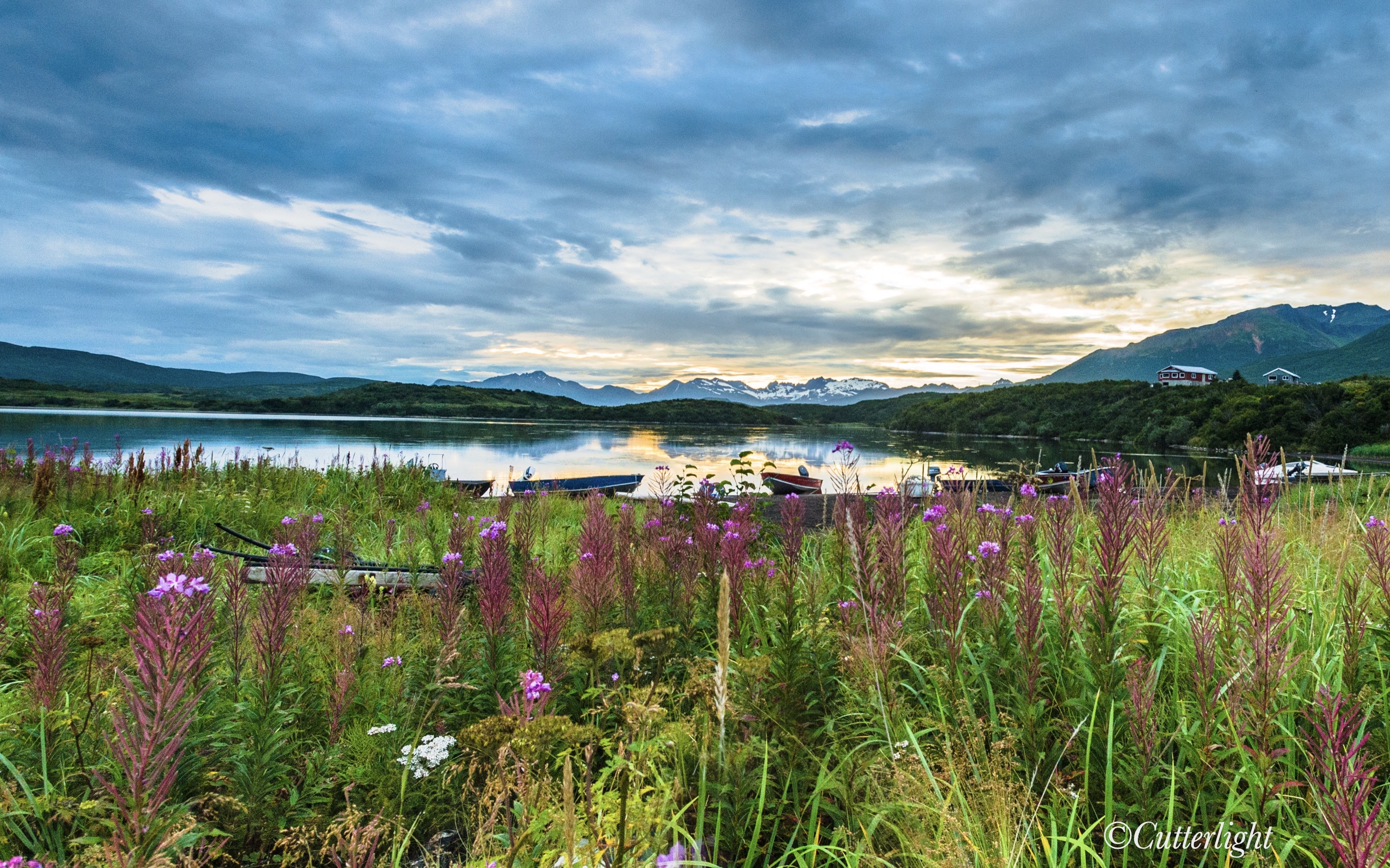
But the view from the windows of our first place was also lovely, and although it didn’t offer the wildlife viewing our current home offers, a very cute, high-spirited ermine once ran right over the toe of my boot as I entered the mud room. Here was the window view on August 15, 2016, our first month at The Lake. I was just beginning to get into more serious photography at the time and made several technical mistakes in composing this picture. Yet, it remains one of our favorites. (Nikon D4, 17-35mm f/2.8, 1/320 at f/9.0, 17mm, ISO 1600)
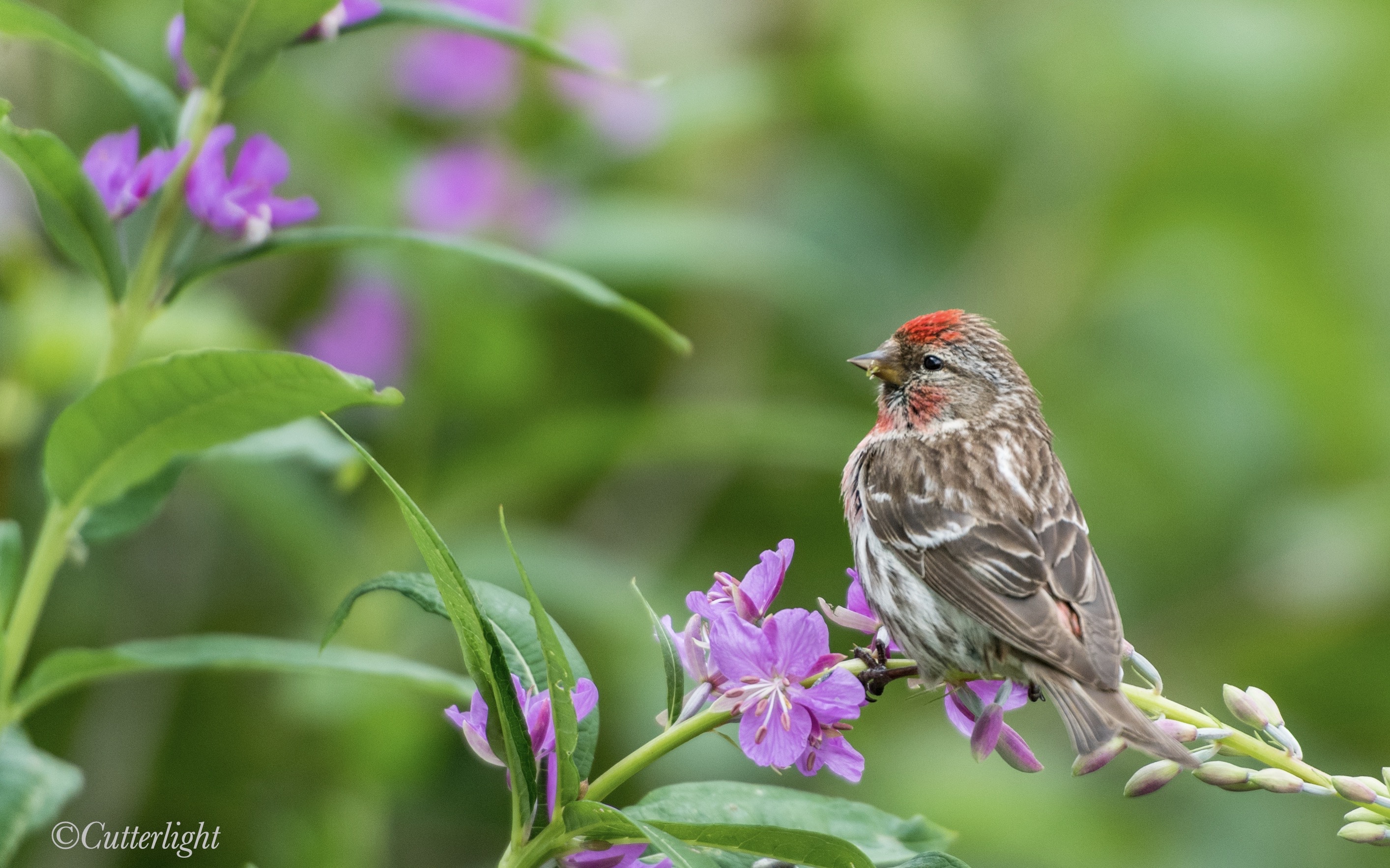
Fireweed
The first Fireweed shoots emerge in late May or early June. At that time, the dew-soaked four or five inch shoots are crimson red with a touch of purple, perhaps showing a hint of tangerine when backlit by the morning sun. This is the perfect time to clip a few at the base and sauté them as you would asparagus to be served with the evening’s grilled halibut.
From the moment those first crimson leaves emerge, we watch, marking spring, summer and fall by the stages of the Fireweed’s growth. By the end of June the plants have grown tall enough to brush against the tops of our Muck Boots as we follow bear trails to the river in search of Sockeyes, but they are flowerless and inconspicuous, overshadowed by Yellow Paintbrush, Nootka Lupine, Yellow Monkeyflower and Wild Geranium. A sister species, River Beauty, is already splashing gravel bars with fuchsia, reminding us that it is time to start searching the Chignik’s deeper pools for Chinook. The world is alive with activity. There will be fuzzy-headed Rough-legged Hawk chicks peaking out over their nest at The Bluffs, swallows gliding above the lake and bears which emerged winter-skinny from hibernation will be filling out on fat Red Salmon. The summertime sun barely sets; it is difficult to force oneself to turn in at night.
Come mid-late July, Fireweed crowns are nodding with buds. Any day now, the blossoms will burst into four-petaled, magenta-pink flowers. High summer at The Lake. Skiffin’ season.* From this point on, we will mark time not so much by clocks and calendar dates, but by whether or not we’re hungry or tired, how many salmon have been counted at the weir, how much the year’s new bear cubs have grown and the ascension of Fireweed blossoms as they progress to the top of the crown.
Toward the end of August, only a few petals cling to the tops of the plants. Below those petals is a progression of slim, red, bean-shaped seed pods growing heavier each day. Silvers have begun entering the river en force, marking the start of two months of remarkable fly-fishing. The newly arrived salmon are thick with muscle, spirited and dime-bright. But by mid-September, they will begin to show hints of autumn’s reds, golds and muted greens. The first fireweed seeds ride fall breezes on cottony parachutes – “Fireweed snow” we call it. Looking to the mountains, it is at about this time that we will see termination dust powdering the peaks.*
Summer’s end.
—————————————-
I made the above photography on August 6, 2020 shooting from my living room window. The house itself serves as a blind. The photo shows how Fireweed blossoms begin blooming at the base of the crown, buds yet to bloom further up the stalk. The bird is a Common Redpoll. (Nikon D800, 70-200mm f/2.8 with 2.0 TC, 1/1250 at f/6.3, 400mm, ISO 1,000.
*skiffin’ – skiffing; boat-riding.
*Termination Dust is an Alaskan term referring to the first snow in the mountains, signifying the end of summer and the beginning of fall.
 CutterLight