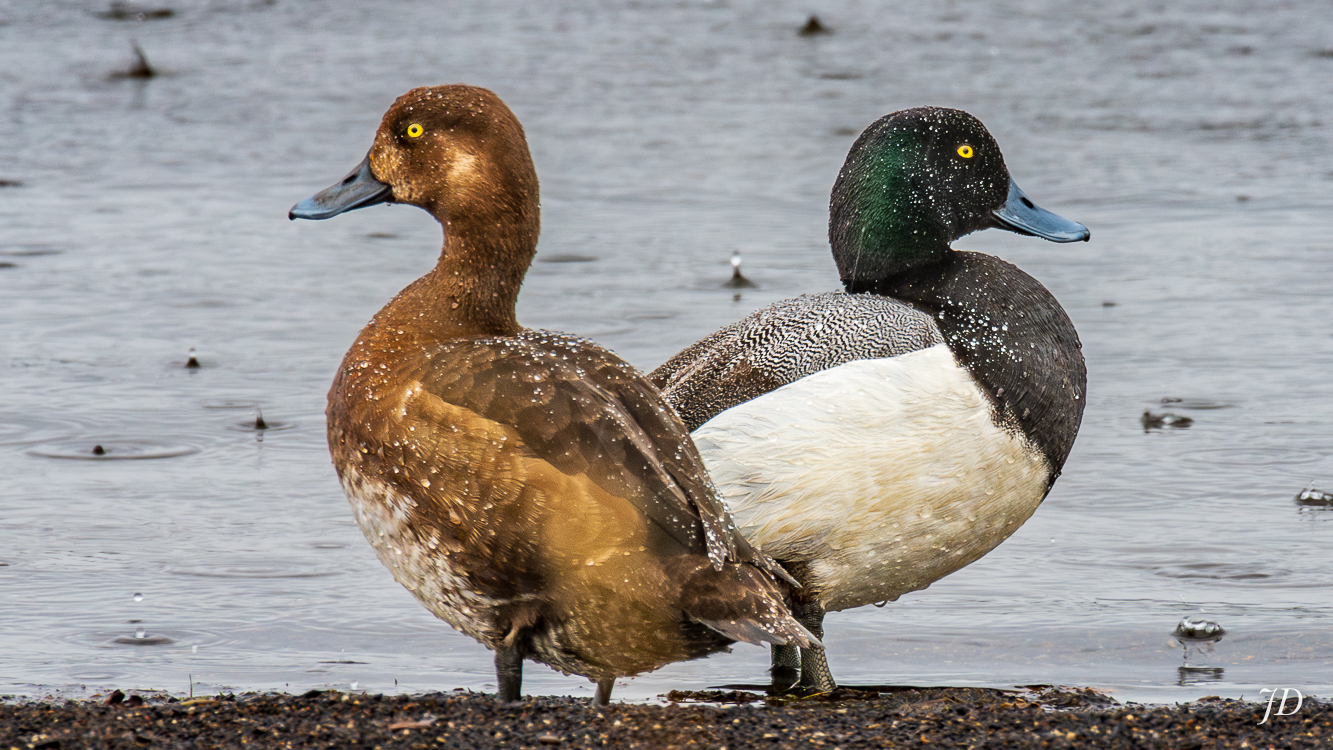
Female (left) and male Greater Scaup, Chignik Lake, Alaska Peninsula, June 2, 2020
It hasn’t been until fairly recently, perhaps coinciding with a general interest in birding rather than mainly hunters looking closely at waterfowl, that the term Scaup has begun to supplant Bluebill when referring to the ducks in the above photo. These are Greater Scaup, a mated pair that paused at the lake along with several others of their kind for a little while in early June before heading off to find their own kettle pond nesting sight. There are also Lesser Scaup, very similar in appearance though slightly smaller and with a less rounded head. Though Greater Scaup were often abundant on the lake and in the river’s largest pools in winter and spring, I never encounter a Lesser there.
The term Scaup may be derived from the Scottish scalp which refers to bivalves such as clams and mussels, preferred food items for these diving ducks, though they also eat various types of aquatic vegetation. Interestingly, they are the only circumpolar diving duck – hence the European origin of their vernacular name. Their “quack” is a bit more hoarse or nasal than that of the familiar Mallard, and is often comparatively quiet. But at The Lake, it was a music we associated with spring, and we find now that we miss it.
JD
 CutterLight