Down the Hatch!
Reply
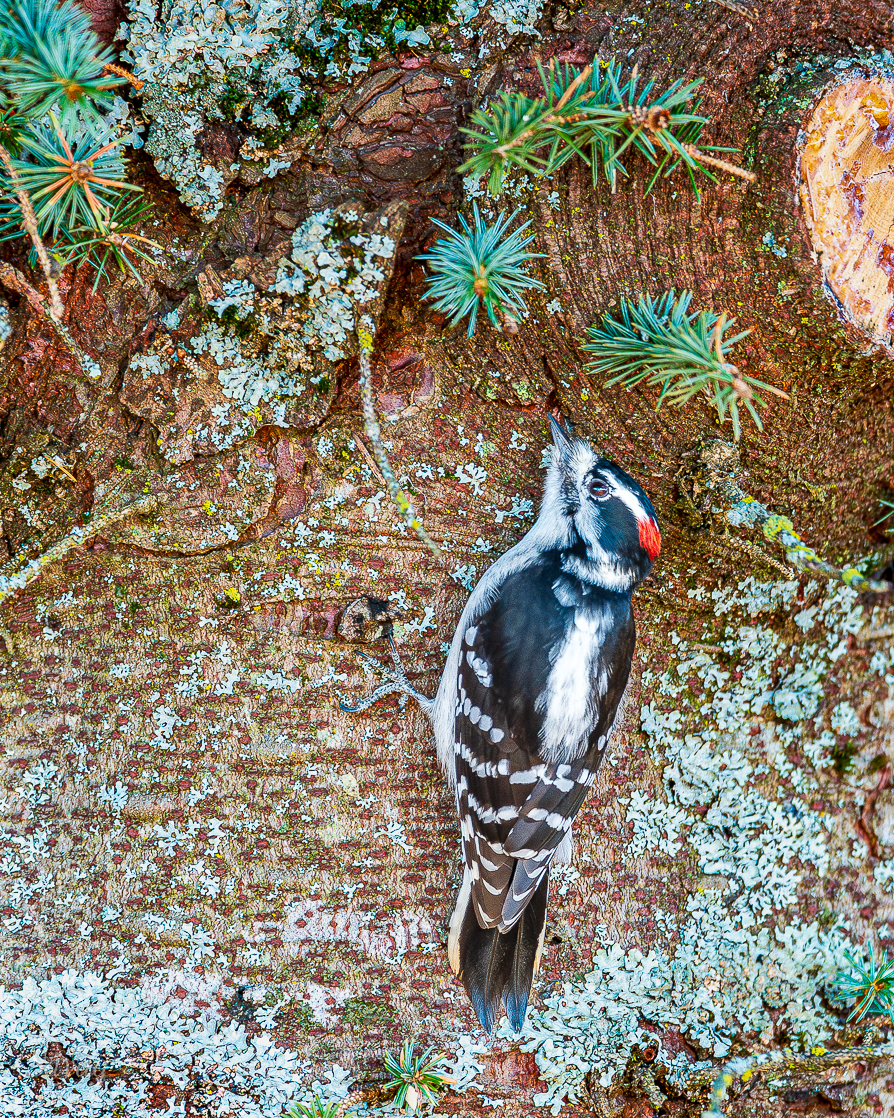
It is suggested in T. Gilbert Pearson’s Birds of America (1917) that the moniker Tommy Woodpecker would better suit North America’s smallest member of the woodpecker tribe “…for his boyish, buoyant disposition makes friends for him wherever he goes.” Perhaps for a moment we can set aside the sexism and celebrate an era and it ornithologists who took such a personal and personified approach to avian studies. I’d like to see any number of birds renamed, starting with discarding all those appellations that are essentially slave names applied by the person who “discovered” a given species – Wilson’s Warbler; Audubon’s Oriole; Steller’s Jay; etcetera. But Downy seems apt for this six-inch bird with its soft breast feathers.
No woodpeckers appear in David Narver’s study of the Chignik River Drainage conducted in the early 1960’s. Range maps have historically placed the Three-toed Woodpecker on the Alaska Peninsula – with no mention of Downies -, but this is surely in error as historically there was essentially no suitable habitat for spruce-and-pine-loving Three-toeds in that part of the world. My guess is that someone conducting an early biological survey got a glimpse of a woodpecker, made a guess, and that became the text for the peninsula. Very recently, I’ve noticed that the Cornell Lab of Ornithology and other authorities have begun to make corrections.
Though they are often common – the woodpecker one is most likely to encounter throughout much of North America – even in the most suitable habitat Downies are seldom abundant. And although the above photograph was recorded in the Sitka Spruce Grove at The Lake, Downies are equally likely to be found in the peninsula’s alder thickets and occasional cottonwoods. Though they are generally listed as uncommon or rare on the Alaska Peninsula, they are in fact regularly seen along the length of the Chignik River. It is probably a lack of nesting cavities rather than a shortage of food that limits Downy numbers on the peninsula, so as the land becomes more forested and trees mature and die and cavities are created their numbers will increase. Listen for their distinctive Peek! Peek! call and then for tell-tale light tapping.
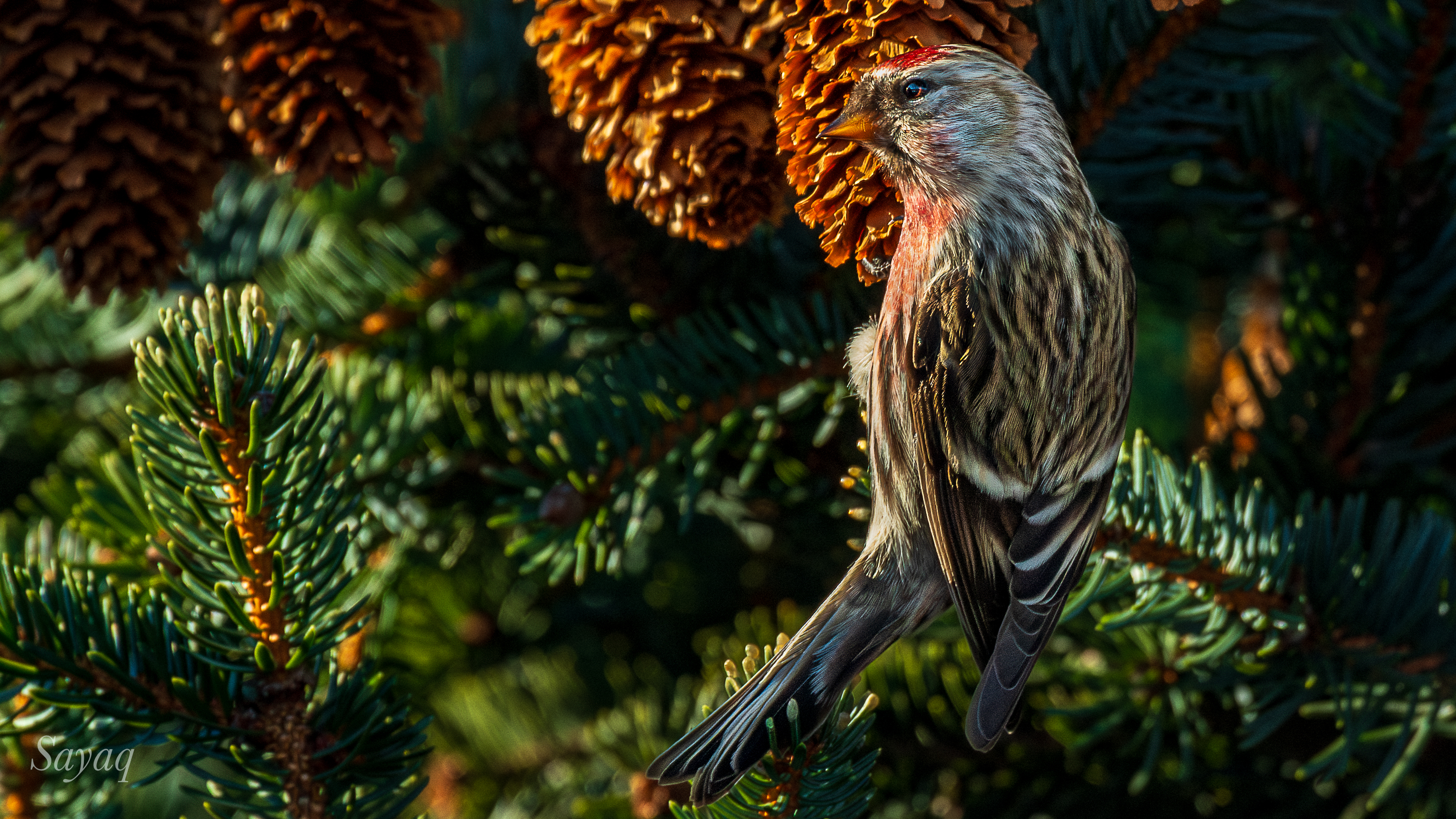
Up and down Southwest Alaska’s Alaska Peninsula, Redpolls, Siskins, Crossbills and Grosbeaks – all members of the finch tribe – have typically been marked as uncommon, rare or absent, breeding in small numbers here and there but generally not species one expects to encounter on the windswept peninsula. However, as trees – particularly alders -, have become increasingly abundant in that part of the world, so too have the finches. Seeds of the tiny alder cones are relished by Redpolls; the tender leaf buds by Pine Grosbeaks. But nowhere has the recent emergence of trees more dramatically impacted avian life than in the village of Chignik Lake where 70-some years ago Sitka Spruce trees were transplanted from seedlings gathered on Kodiak Island.
Some of the spruce trees at The Lake now tower over the landscape, producing both shelter and food for a wide variety of birds. The seeds of mature cones draw Pine Siskins, Hoary and Common Redpolls, White-winged and Red Crossbills, Black-capped Chickadees, Black-billed Magpies and several species of sparrow. While they’re still soft and reddish-purple, immature cones are feasted on by Pine Grosbeaks. Meanwhile, the variety of invertebrates that have moved into the little groves of spruce trees provide sustenance for Downy Woodpeckers, Pacific Wrens, Golden-crowned Kinglets and Yellow Warblers. Great Horned Owls roost and nest in the dark shadows of spruce bows and Northern Shrikes, Merlins and an occasional Sharp-shinned Hawk hunt the songbirds attracted to the trees. My guess is that it’s only a matter of time – and not too distant time – before the first Steller’s Jays are reported at The Lake. In fact, based on a description a now deceased resident reported to me, I’m not sure they haven’t already been there.
But here’s a question: Are these trees actually an invasive species… like the Orange Hawkweed that only very recently has begun showing up at The Lake? Or, for that matter, the dandelions which have taken over the school yard (and also, in some years, provide food for the finches as they go to seed)? And what about the above-mentioned alders that are steadily crowding out what remains of the peninsula’s tundra?
For decades, the transplanted Sitka Spruce trees did not propagate themselves in the Chignik Drainage. But about five years ago that began to change when seedlings suddenly began volunteering themselves throughout the village. One might argue that even without human intervention it was only a matter of time before Picea sitchensis made its way down the peninsula. But couldn’t the same be said of the Orange Hawkweed, dandelions and even the Kamchatka Rhododendron that has naturally, over time, found its way to The Lake from its native grounds in far eastern Russia?
Dumping a bucket of carp or pike into a lake where they never before existed is one thing…
On the other extreme are dandelions and hawkweed, which seem to to have devised strategies to show up wherever environmental conditions suit them.
Somewhere in between are a vast array of flora and fauna that – with or without humankind’s assistance – are finding their way into new niches.
So, what do you think? Where is the line between happily-received newcomer and dreaded invader?


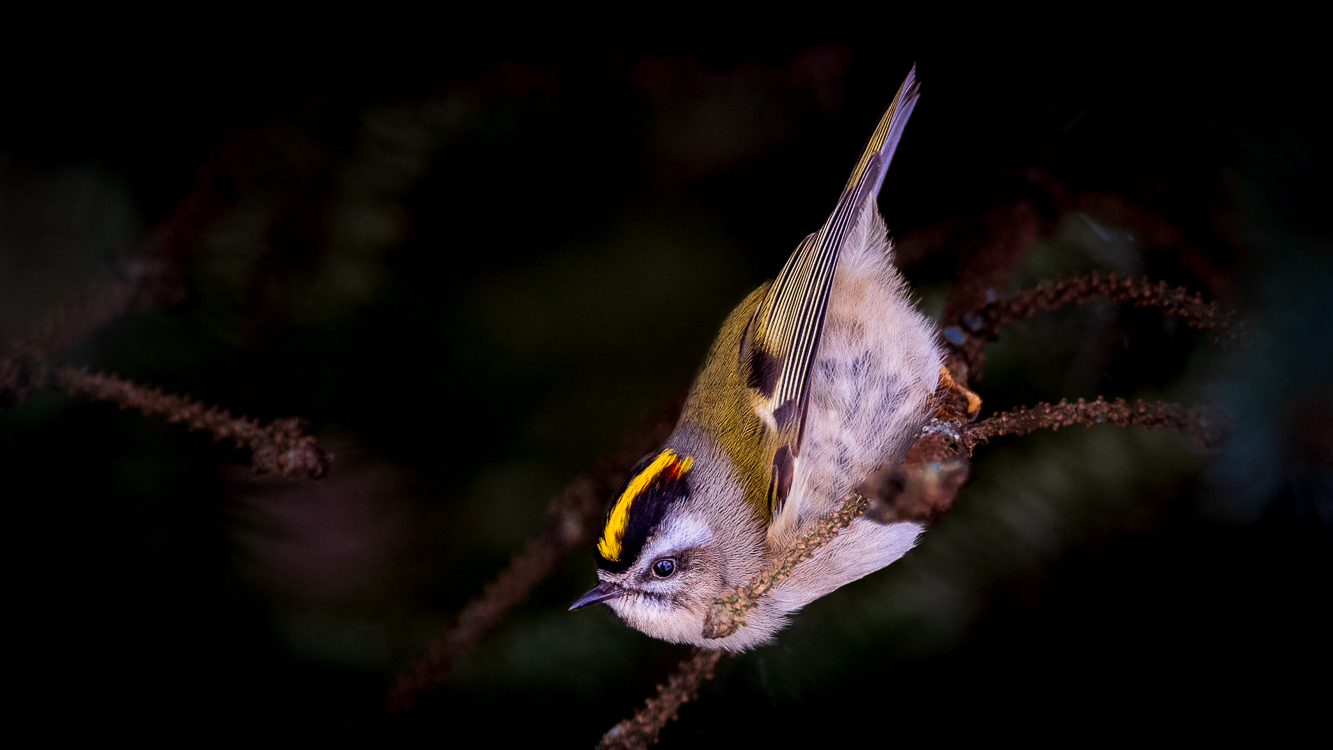
Every autumn coinciding with the peak of the Coho run on the Chignik River, we’d begin to hear a new voice as we pushed through thick stands of alders or walked by the village’s scattered spruce trees. By this time, there weren’t many other passerines around, and so there was no mistaking the high, almost cricket-like call of returning Golden-crowned Kinglets. They were a new species for for us, always in motion, difficult to locate in the dense alders and dark spruce boughs they prefer, and they are not indicated on the Alaska Peninsula on any of the range maps we checked – Cornell, Audubon, Sibley – so we were very happy when we finally got binoculars on them and could make positive identification. Kinglets tended to remain at The Lake throughout winter. At some point, they presumably had cleaned all the invertebrate eggs and dormant insects they could find and moved on to other grounds, but they were there every year in those fall and winter months and should be added to peninsular checklists and range maps.


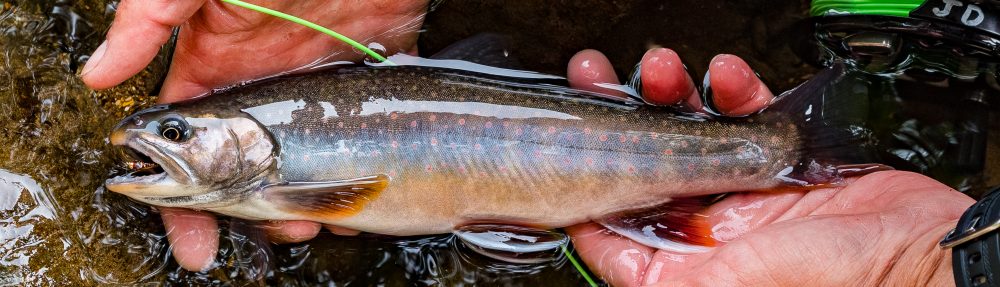
All summer and well into fall, we could often see salmon and char from our dining table window as they migrated along the lakeshore beach. The char could be there in any season, following the salmon to gorge on eggs and then making their own spawning run. At other times the char would cruise the lake shoreline chasing down the fry, parr and smolts of Sockeye and Coho Salmon. At that time they would readily come to streamers, and even in winter you could sometimes get a couple of fresh fish for the evening meal.
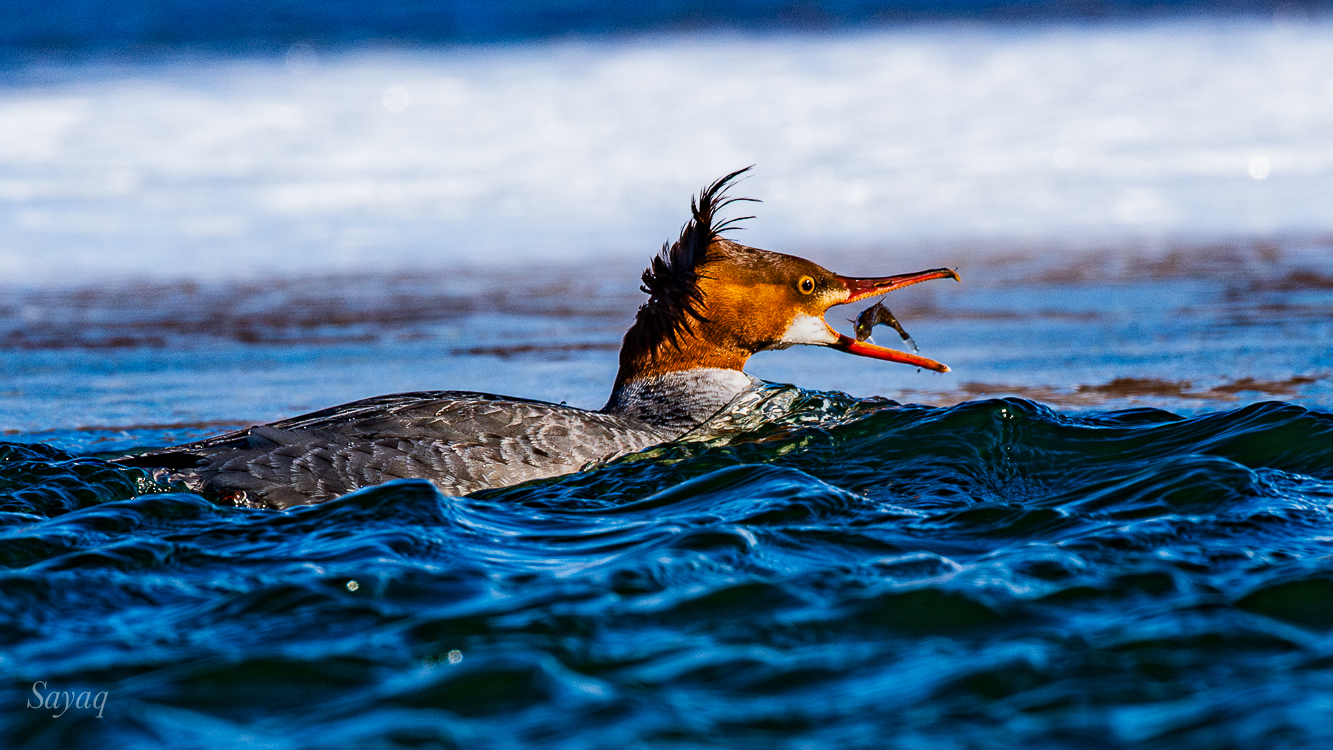
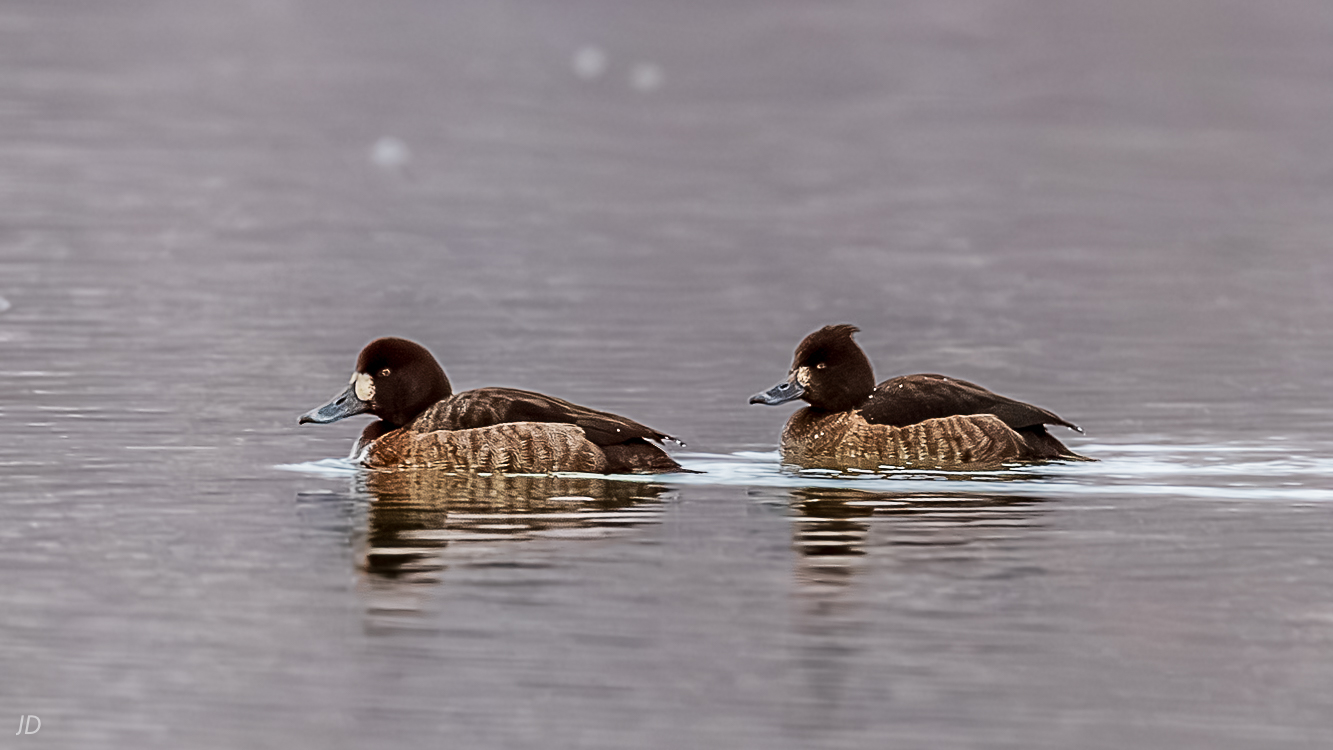
More interesting than fishing for the char was watching the mergansers and otters go after them. The diving ducks often worked cooperatively, cruising along the shoreline with purpose reminiscent of soldiers on patrol. When they found a school of Dollies they’d herd them against the shoreline or sometimes against ice sheets. The otters behaved in a similar manner, and when there were a lot of char around the otters and the mergansers would set aside some of their natural caution and you could find yourself pretty close to the action if you sat still and waited.
Although it was late in the morning when I took the above photograph, the sun was just barely beginning to emerge over the mountains south-east of the lake. At first it was too dark to shoot, so I positioned myself behind a natural blind of tall, winter-brown grass and waited. There were about half-a-dozen merganser hens, or a hen and her first-year offspring, patrolling the shoreline, catching fish. Then this one came up with the catch of the day just as a flock of Greater Scaup were passing behind her.
So, what do you think? Black and white, or color?
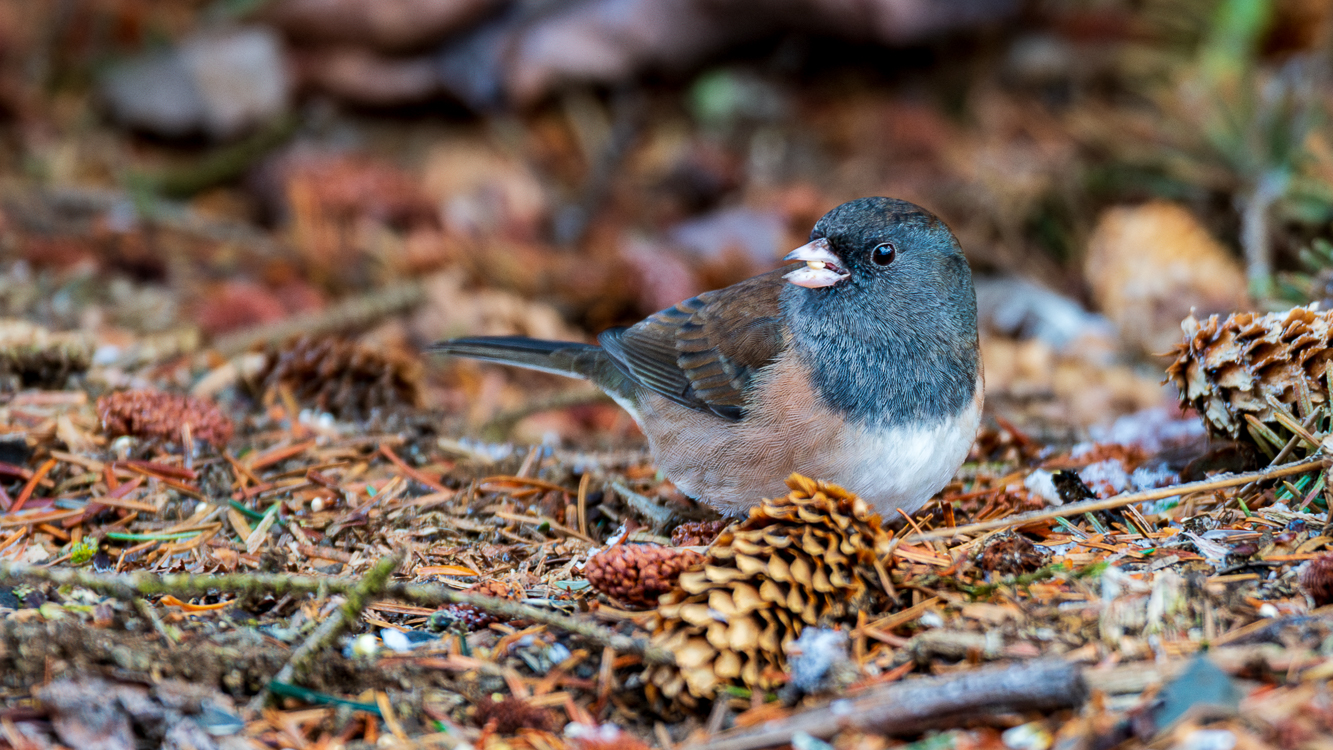
“I’ve been hoping to see you!” Sam came out to intercept me as I was walking along the dirt road past his house on my way to Sitka Spruce Grove. It was an overcast, cold November morning, the tinny smell of snow in the air. “I’ve been seeing a bird I’ve never seen out here. Batman birds. They have a dark head, like Batman’s hood. Nick’s been seeing them too. We’ve been calling them Batman birds.”
“Yeah. I’ve been seeing them too. Just in the last few days, right?”
“Yeah. I’ve never seen them before. What are they?”
“Oregon Juncos. They’re not supposed to be here. I’ve checked my books and range maps on the internet. This might be the first time they’ve ever been out here.”
Sam, in his early 70’s and not more than five-six looked up at me as he rolled the burning cigarette he was holding between his thumb and his first two fingers. For a moment nothing was said. He lifted his arm to take a drag and looked out over the landscape as he let the smoke out. Winter-brown salmonberry breaks and willows, scrub alders an even more drab shade of brown covered the country all the way to the treeline on nearby snow-capped mountains, country that in Sam’s youth had mostly been tundra.
“Things sure are changing here,” he said.
There are still people in denial, people who not so very long ago dismissed Climate Warming as some sort of hoax, who refused to believe any scientists except those who work for the fossil fuel industry. Most of those hardcore deniers have given up the tack of total denial. But they haven’t gone away, and they certainly haven’t conceded their error. Instead, the refrain now is initial agreement, “Yes, it appears the earth is getting warmer,” followed by a deflating return to denialism with, “but the world has always been changing.”
Not with this rapidity it hasn’t – the occasional meteor strike notwithstanding.
The result is that almost anywhere one lives, change can be observed in real time. This might be manifested in new species of flowers and other plants, new birds, other vertebrates, insects… or the rather sudden absence of formerly familiar species. Anyone with a camera has a chance to contribute to real-time, meaningful documentation of the change that is occurring right now all around us.
It’s not just the natural world that is undergoing rapid change. As expanding urbanization follows an overpopulated species across the globe, historic buildings are being torn down, forests leveled, rivers rerouted, lakes and aquifers emptied. Things that had remained much the same for decades, for generations even, are suddenly in a state of upheaval.
Photography is used for many things: to capture holiday moments; family portraits; events of all kinds; and increasingly, to make fine art. But some of the most compelling photographic images have always been and continue to be well-composed, straightforward documentation.
Anyone with a camera can make a meaningful contribution. Get out and shoot.
 CutterLight