
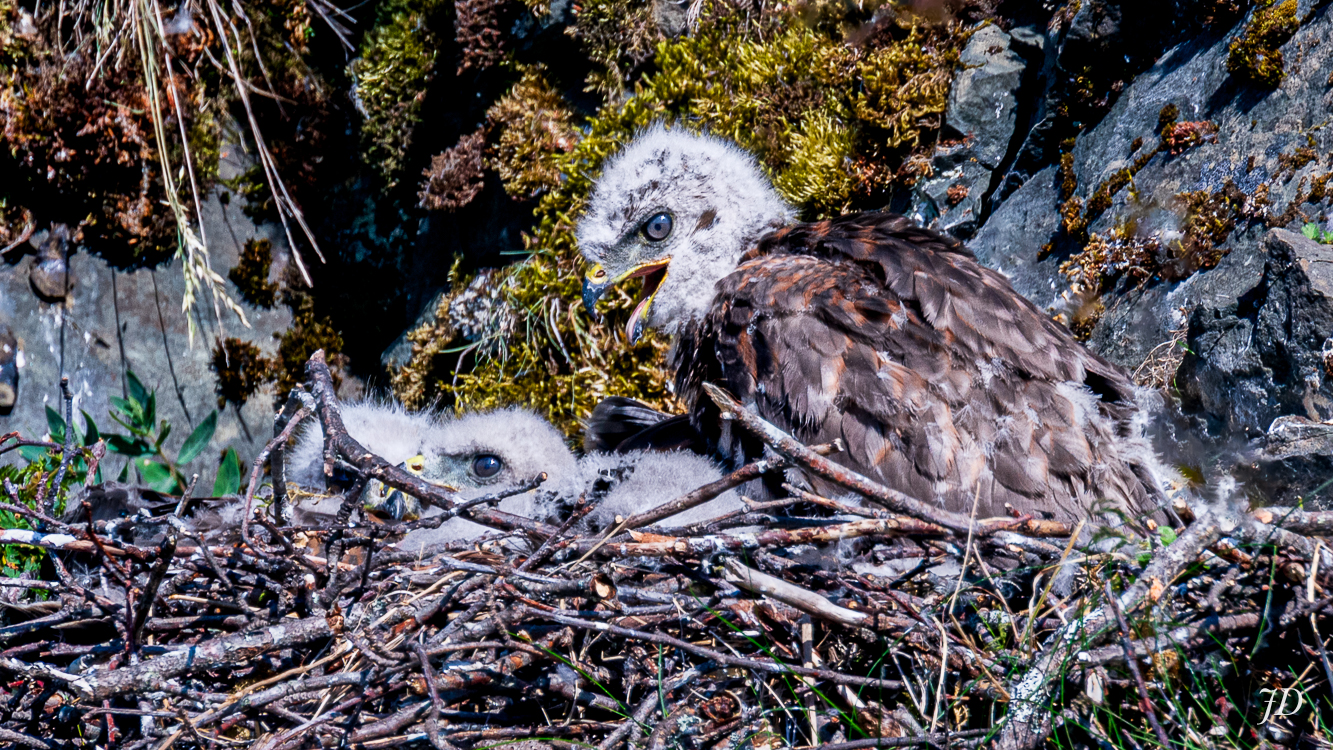
Chignik River, Alaska Peninsula, July 14, 2020
When I had the opportunity to make images of the Rough-legged Hawk nest at the cliffs along the lower Chignik River, I was still thinking of myself as primarily a documentarian. Additionally, human proximity to the nest was clearly upsetting to the chicks as well as to the parents. And so, a couple of times I waded into the river, made quick photographs, and left. Documentation accomplished.
In hindsight, it might have been worthwhile to construct a blind at a respectful distance and to thereby more thoroughly record the nesting events that occurred every summer until recently at this little ledge about 60 feet up from the surface of the river. A regret is that I never made a video of the birds. Unfortunately, in July 2021, a magnitude 8.2 earthquake rocked the Chignik area and in so doing deposited a volleyball-sized boulder squarely in the center of the nest. The little ledge had always been a precarious site – exposed at times to high winds, vulnerable to potential predation by our resident Great Horned Owls, and subject to regular skiff traffic (and associated engine noise) – and in fact the summer of the big quake after laying just one egg, for unknown reasons the hawks abandoned the nest, before the earthquake struck.
After the big earthquake, with a large rock left in the middle of the nest, the site was no longer usable. We think we discovered a new nest further up the drainage, so hopefully Rough-legged Hawks will continue to be a part of Chignik fauna.
 CutterLight
I second your wish: let’s hope they found another suitable nest site and have been breeding successfully since.
After doing a bit of reading, I learned that Rough-leggeds are birds of the Arctic due in part for their preference for hunting for rodents over tundra. I have a memory of seeing one or two in the fall as an undergrad in Colorado (and, more recently, we saw them during a fall excursion through Mongolia’s Gobi Desert), but during summer – the breeding season – Rough-leggeds are almost strictly confined to the far north. The Alaska Peninsula is at the southern limits of their range, so, with the landscape there changing (tundra being overtaken by trees), their days in the Chignik Drainage may be coming to an end. It’s possible that although Rough-legged Hawks have been documented on the Peninsula, that the photos Barbra and I got are the only photos of this species in that part of the world. So perhaps the photographic documentation we got will prove to be especially valuable at some future point. Our world is rapidly changing. I hope your day is going well. JD
The article on Hawk Chicks is both informative and heartwarming! Learning about their growth and development offers a glimpse into the fascinating world of wildlife. The challenges they face and the care from their parents highlight the beauty of nature. It’s a reminder of the importance of conservation efforts to protect these incredible birds!
https://beruki.by/
Thanks! Glad you enjoyed the article.