

Resplendent! This male Pine Grosbeak came down from a tree crown to forage beneath one of the feeders at White Spruce Grove.
When we stepped out the door yesterday morning, the first thing we noticed was a new song in the air. A spring song. Returning Fox Sparrows have been the first to begin this each year we’ve been in Chignik Lake, but the warbling melody didn’t sound like a Fox Sparrow’s riff. We could see the bird, a plump silhouette atop a spruce tree near the church and since we were on the way to the White Spruce Grove to top off bird feeders anyway, the obvious choice of walking path was the one that would bring us nearer to the singer.
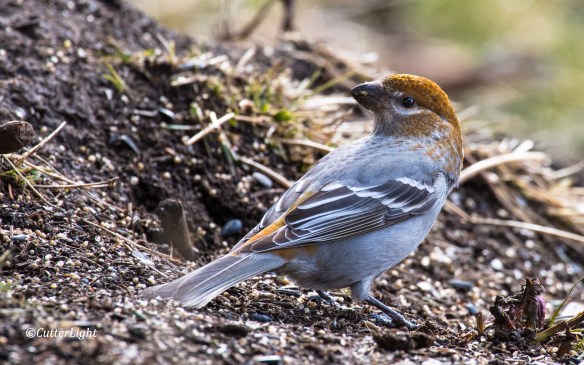
The female grosbeak briefly joined her mate.
Pine Grosbeak, brilliant red and singing for all he was worth. Quite a change from the brief but distinctive Peek Peek! we hear from this species throughout fall and winter. It wasn’t a new bird, but it was new behavior. We continued on the half-mile to the spruce grove with anticipation.
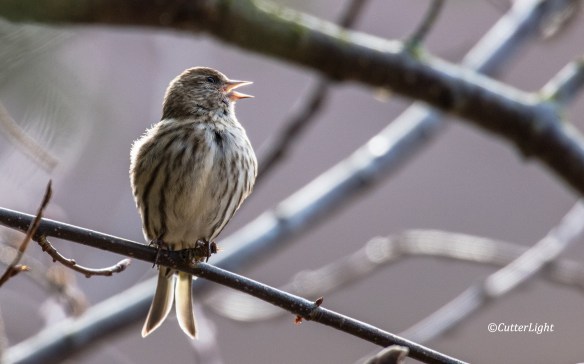
Our Pine Siskins were their usual raucous selves, singing, squabbling, gorging on seeds, darting from tree to tree.
Along the way scattered flocks of Pine Siskins buzzed and called from the sky and from a neighbors’ house where they sometimes take refuge in a few spruce trees while visiting the feeder there. Magpies, common here at The Lake, made their presence known, as did a woodpecker, almost certainly a Downy though we couldn’t find it. Further along a pair of Black-capped Chickadees gave a couple of their various calls from willows, the branches of the scrubby trees suddenly having turned bright yellow-green and beginning to bud.
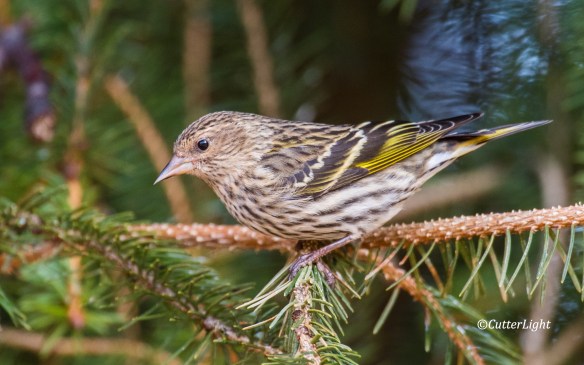
My guess is that when the time comes, the siskins will head up the peninsula to the denser spruce forests around Lake Iliamna and similar places to nest, but they’ve been welcome winter visitors the past two years.
At the White Spruce Grove the usual Siskins, which showed up last fall and have spent the winter, were busy at the feeders as well as prying the last seeds from cones. But there were a few larger, rounder shapes foraging on the ground as well. We didn’t get our binoculars up in time to have a look, but as we were filling the feeders we heard the unmistakable plaintive song of Golden-crowned Sparrows.

There’s just a touch more gold in this Golden-crowned Sparrow’s crown than there may have been a month ago. He’s still a ways off from full breeding plumage though.
Sure enough, once we scattered a little seed along the brushy edge where they like to feed, they began to show up, and they brought a Dark-eyed Junco with them. Seldom observed out on the Alaska Peninsula – and absent altogether or marked with a question on most of the region’s birding lists – Juncos have shown up in small numbers each of the three winters we’ve spent here. In fact, we think we have the only documentation on the peninsula of Oregon race juncos.
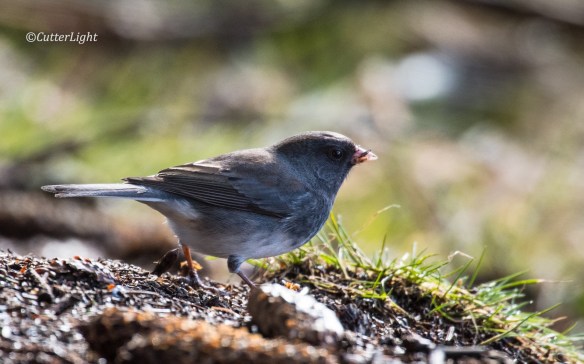
While there have been fewer Juncos at the Lake than there were last year, every so often we see one or two or three.
The Golden-crowned Sparrows appear to have just begun growing in their breeding plumage. Some of the male Siskins though are already there, showing off brilliant canary yellow in their primaries. At one point a Belted Kingfisher rattled by, most likely a male getting things ready for the females that will soon return. Ravens called in throaty croaks from a far hill. No ducks on the water and no eagles on their usual perches, which is a little unusual. Perhaps the ducks are already up at Black Lake where most of the nesting occurs. Gulls will begin returning any day.
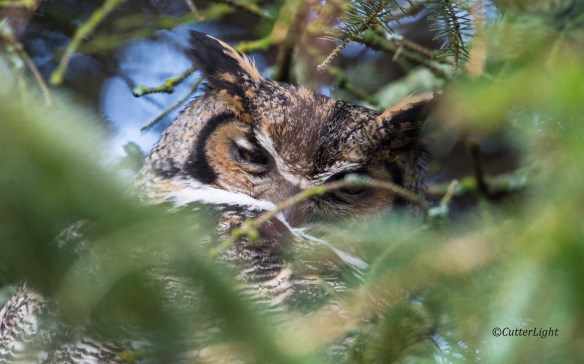
Sleepy but looking well fed, she lost both of her fully-fledged chicks last year, one to an electrical box on a utility pole and the other to some other cause. We’re hoping she nests again this year with much better luck.
We aren’t always lucky enough to see one and we rarely see both of them, but this was a red letter day as both of our Great Horned Owls – the female and the slightly smaller, more lightly colored male – were perched where we were able to find them. As is usually the case, they were buried in shadows behind thick evergreen boughs, aware of our presence but seemingly unconcerned. The ground beneath their favorite roosts is littered with bits of hair, feather, bone and beaks and oblong balls the size of two thumbs placed together packed tight with the remains of the various voles, Magpies, ermine, lemmings or whatever else constitutes one of their meals. Last year the female spent several days perched atop a winter-white Snowshoe Hare – several meals.

Discernibly smaller and with brighter plumage, we feel fairly certain that this is the male. The Ainu – Japan’s indigenous people – believed that owls protected their villages. They are certainly regal animals.
Frost on the ground this morning, but if you look closely at the photos, you can see other signs that spring is coming to Chignik Lake. Hopefully I’ll be posting a video of a Fox Sparrow singing in the near future.

With their uplifting songs and stunning plumage, if birds didn’t actually exist I don’t think we’d believe that they even could exist. They certainly brighten our world.
 CutterLight